

26
2 The Generation of Nitrile Imine Derivatives
R 2
N
N
N
N
O
N
N N
N
MeO
O
O
O
O
O
EtO
5
N
N
O
N
N N
N
MeO
O
O
O
O
CO 2 Et
+
N
N
O
N
N
MeO
O
O
O
O
CO 2 Et
N
O
O
N
O
O
410-420 nm
320 nm
R 1
R 1
R 1
R 2
5
5
H
H
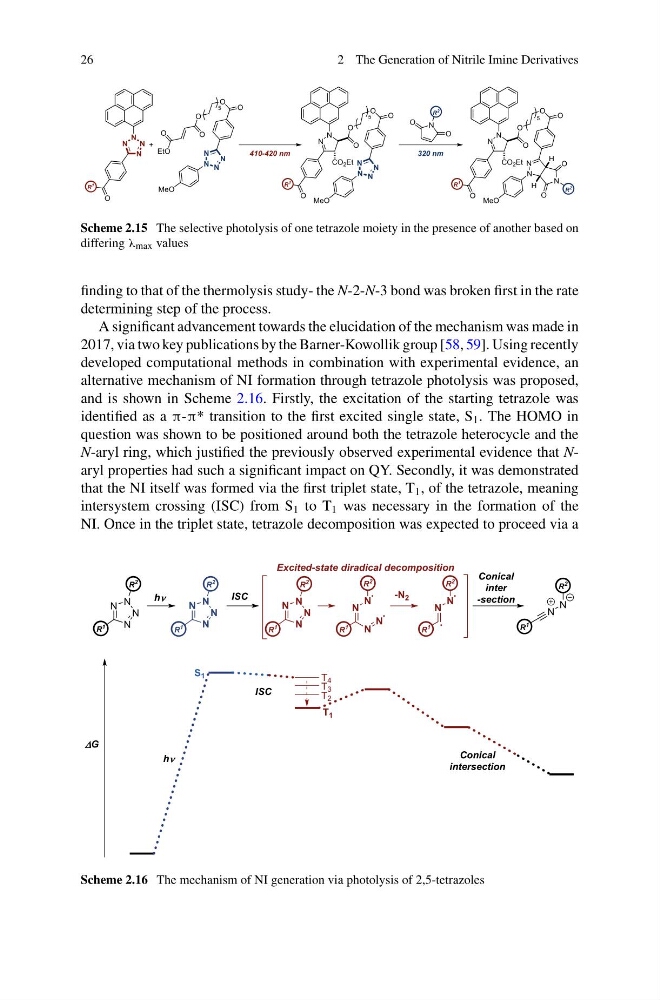
Scheme 2.15 The selective photolysis of one tetrazole moiety in the presence of another based on
differing λ max values
finding to that of the thermolysis study- the N-2-N-3 bond was broken first in the rate
determining step of the process.
A significant advancement towards the elucidation of the mechanism was made in
2017, via two key publications by the Barner-Kowollik group [58, 59]. Using recently
developed computational methods in combination with experimental evidence, an
alternative mechanism of NI formation through tetrazole photolysis was proposed,
and is shown in Scheme 2.16. Firstly, the excitation of the starting tetrazole was
identified as a π-π* transition to the first excited single state, S 1 . The HOMO in
question was shown to be positioned around both the tetrazole heterocycle and the
N-aryl ring, which justified the previously observed experimental evidence that Naryl properties had such a significant impact on QY. Secondly, it was demonstrated
that the NI itself was formed via the first triplet state, T 1 , of the tetrazole, meaning
intersystem crossing (ISC) from S 1 to T 1 was necessary in the formation of the
NI. Once in the triplet state, tetrazole decomposition was expected to proceed via a
N
N
N
N
h
N
N
N
N
ISC
N
N
N
N
N
N
N
N
N
N
-N 2
N
N
Conical
inter
-section
Excited-state diradical decomposition
S 1
T 1
T 2
T 3
T 4
ISC
h
Conical
intersection
G
R 2
R 1
R 1
R 1
R 1
R 1
R 2
R 2
R 2
R 2
R 2
R 1
Scheme 2.16 The mechanism of NI generation via photolysis of 2,5-tetrazoles
2 The Generation of Nitrile Imine Derivatives
R 2
N
N
N
N
O
N
N N
N
MeO
O
O
O
O
O
EtO
5
N
N
O
N
N N
N
MeO
O
O
O
O
CO 2 Et
+
N
N
O
N
N
MeO
O
O
O
O
CO 2 Et
N
O
O
N
O
O
410-420 nm
320 nm
R 1
R 1
R 1
R 2
5
5
H
H
Scheme 2.15 The selective photolysis of one tetrazole moiety in the presence of another based on
differing λ max values
finding to that of the thermolysis study- the N-2-N-3 bond was broken first in the rate
determining step of the process.
A significant advancement towards the elucidation of the mechanism was made in
2017, via two key publications by the Barner-Kowollik group [58, 59]. Using recently
developed computational methods in combination with experimental evidence, an
alternative mechanism of NI formation through tetrazole photolysis was proposed,
and is shown in Scheme 2.16. Firstly, the excitation of the starting tetrazole was
identified as a π-π* transition to the first excited single state, S 1 . The HOMO in
question was shown to be positioned around both the tetrazole heterocycle and the
N-aryl ring, which justified the previously observed experimental evidence that Naryl properties had such a significant impact on QY. Secondly, it was demonstrated
that the NI itself was formed via the first triplet state, T 1 , of the tetrazole, meaning
intersystem crossing (ISC) from S 1 to T 1 was necessary in the formation of the
NI. Once in the triplet state, tetrazole decomposition was expected to proceed via a
N
N
N
N
h
N
N
N
N
ISC
N
N
N
N
N
N
N
N
N
N
-N 2
N
N
Conical
inter
-section
Excited-state diradical decomposition
S 1
T 1
T 2
T 3
T 4
ISC
h
Conical
intersection
G
R 2
R 1
R 1
R 1
R 1
R 1
R 2
R 2
R 2
R 2
R 2
R 1
Scheme 2.16 The mechanism of NI generation via photolysis of 2,5-tetrazoles