

1.3 Spectroscopy and Isolation
7
C
N
N
H
Li
C
N
N
Li
C
N
N Li
C
N
N Li
C
N
N
H
+
diazomethane
stable
isodiazomethane
not formed
nitrile imine
stable
H
C
N
N
H
N
N
N
Li
1,2,3-triazole
isolable
R
1
R
1
R
1
R
1
R
1
R
1
R
1
R
1
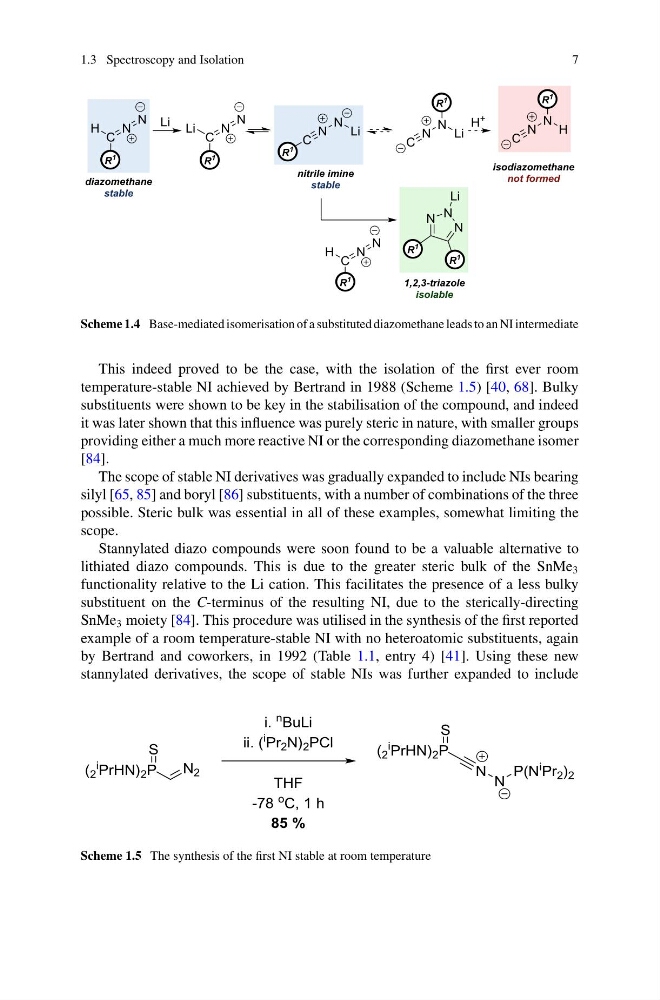
Scheme 1.4 Base-mediated isomerisation of a substituted diazomethane leads to an NI intermediate
This indeed proved to be the case, with the isolation of the first ever room
temperature-stable NI achieved by Bertrand in 1988 (Scheme 1.5) [40, 68]. Bulky
substituents were shown to be key in the stabilisation of the compound, and indeed
it was later shown that this influence was purely steric in nature, with smaller groups
providing either a much more reactive NI or the corresponding diazomethane isomer
[84].
The scope of stable NI derivatives was gradually expanded to include NIs bearing
silyl [65, 85] and boryl [86] substituents, with a number of combinations of the three
possible. Steric bulk was essential in all of these examples, somewhat limiting the
scope.
Stannylated diazo compounds were soon found to be a valuable alternative to
lithiated diazo compounds. This is due to the greater steric bulk of the SnMe 3
functionality relative to the Li cation. This facilitates the presence of a less bulky
substituent on the C-terminus of the resulting NI, due to the sterically-directing
SnMe 3 moiety [84]. This procedure was utilised in the synthesis of the first reported
example of a room temperature-stable NI with no heteroatomic substituents, again
by Bertrand and coworkers, in 1992 (Table 1.1, entry 4) [41]. Using these new
stannylated derivatives, the scope of stable NIs was further expanded to include
( 2
i
PrHN) 2 P
S
N 2
i.
n
BuLi
ii. (
i
Pr 2 N) 2 PCl
THF
-78
o
C, 1 h
85 %
( 2
i
PrHN) 2 P
S
N N
P(N
i
Pr 2 ) 2
Scheme 1.5 The synthesis of the first NI stable at room temperature
7
C
N
N
H
Li
C
N
N
Li
C
N
N Li
C
N
N Li
C
N
N
H
+
diazomethane
stable
isodiazomethane
not formed
nitrile imine
stable
H
C
N
N
H
N
N
N
Li
1,2,3-triazole
isolable
R
1
R
1
R
1
R
1
R
1
R
1
R
1
R
1
Scheme 1.4 Base-mediated isomerisation of a substituted diazomethane leads to an NI intermediate
This indeed proved to be the case, with the isolation of the first ever room
temperature-stable NI achieved by Bertrand in 1988 (Scheme 1.5) [40, 68]. Bulky
substituents were shown to be key in the stabilisation of the compound, and indeed
it was later shown that this influence was purely steric in nature, with smaller groups
providing either a much more reactive NI or the corresponding diazomethane isomer
[84].
The scope of stable NI derivatives was gradually expanded to include NIs bearing
silyl [65, 85] and boryl [86] substituents, with a number of combinations of the three
possible. Steric bulk was essential in all of these examples, somewhat limiting the
scope.
Stannylated diazo compounds were soon found to be a valuable alternative to
lithiated diazo compounds. This is due to the greater steric bulk of the SnMe 3
functionality relative to the Li cation. This facilitates the presence of a less bulky
substituent on the C-terminus of the resulting NI, due to the sterically-directing
SnMe 3 moiety [84]. This procedure was utilised in the synthesis of the first reported
example of a room temperature-stable NI with no heteroatomic substituents, again
by Bertrand and coworkers, in 1992 (Table 1.1, entry 4) [41]. Using these new
stannylated derivatives, the scope of stable NIs was further expanded to include
( 2
i
PrHN) 2 P
S
N 2
i.
n
BuLi
ii. (
i
Pr 2 N) 2 PCl
THF
-78
o
C, 1 h
85 %
( 2
i
PrHN) 2 P
S
N N
P(N
i
Pr 2 ) 2
Scheme 1.5 The synthesis of the first NI stable at room temperature