

4.3 Materials Chemistry
131
N N
OMe
NO 2
N N
OMe
NO 2
N N
OMe
NO 2
*
h
fluorescence
N N
OMe
NO 2
*
e
- transfer
+
-
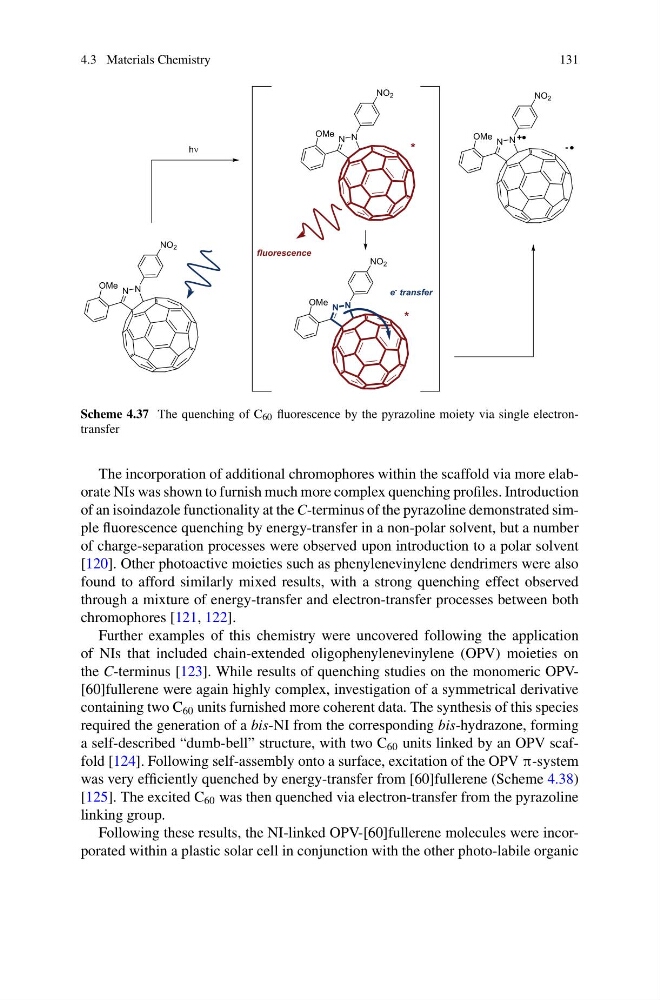
Scheme 4.37 The quenching of C 60 fluorescence by the pyrazoline moiety via single electrontransfer
The incorporation of additional chromophores within the scaffold via more elaborate NIs was shown to furnish much more complex quenching profiles. Introduction
of an isoindazole functionality at the C-terminus of the pyrazoline demonstrated simple fluorescence quenching by energy-transfer in a non-polar solvent, but a number
of charge-separation processes were observed upon introduction to a polar solvent
[120]. Other photoactive moieties such as phenylenevinylene dendrimers were also
found to afford similarly mixed results, with a strong quenching effect observed
through a mixture of energy-transfer and electron-transfer processes between both
chromophores [121, 122].
Further examples of this chemistry were uncovered following the application
of NIs that included chain-extended oligophenylenevinylene (OPV) moieties on
the C-terminus [123]. While results of quenching studies on the monomeric OPV[60]fullerene were again highly complex, investigation of a symmetrical derivative
containing two C 60 units furnished more coherent data. The synthesis of this species
required the generation of a bis-NI from the corresponding bis-hydrazone, forming
a self-described “dumb-bell” structure, with two C 60 units linked by an OPV scaffold [124]. Following self-assembly onto a surface, excitation of the OPV π-system
was very efficiently quenched by energy-transfer from [60]fullerene (Scheme 4.38)
[125]. The excited C 60 was then quenched via electron-transfer from the pyrazoline
linking group.
Following these results, the NI-linked OPV-[60]fullerene molecules were incorporated within a plastic solar cell in conjunction with the other photo-labile organic
131
N N
OMe
NO 2
N N
OMe
NO 2
N N
OMe
NO 2
*
h
fluorescence
N N
OMe
NO 2
*
e
- transfer
+
-
Scheme 4.37 The quenching of C 60 fluorescence by the pyrazoline moiety via single electrontransfer
The incorporation of additional chromophores within the scaffold via more elaborate NIs was shown to furnish much more complex quenching profiles. Introduction
of an isoindazole functionality at the C-terminus of the pyrazoline demonstrated simple fluorescence quenching by energy-transfer in a non-polar solvent, but a number
of charge-separation processes were observed upon introduction to a polar solvent
[120]. Other photoactive moieties such as phenylenevinylene dendrimers were also
found to afford similarly mixed results, with a strong quenching effect observed
through a mixture of energy-transfer and electron-transfer processes between both
chromophores [121, 122].
Further examples of this chemistry were uncovered following the application
of NIs that included chain-extended oligophenylenevinylene (OPV) moieties on
the C-terminus [123]. While results of quenching studies on the monomeric OPV[60]fullerene were again highly complex, investigation of a symmetrical derivative
containing two C 60 units furnished more coherent data. The synthesis of this species
required the generation of a bis-NI from the corresponding bis-hydrazone, forming
a self-described “dumb-bell” structure, with two C 60 units linked by an OPV scaffold [124]. Following self-assembly onto a surface, excitation of the OPV π-system
was very efficiently quenched by energy-transfer from [60]fullerene (Scheme 4.38)
[125]. The excited C 60 was then quenched via electron-transfer from the pyrazoline
linking group.
Following these results, the NI-linked OPV-[60]fullerene molecules were incorporated within a plastic solar cell in conjunction with the other photo-labile organic