

4.3 Materials Chemistry
129
Cl
N
NH
Ph
Et 3 N, PhH
rt, 240 h
78 %
Ph
N N
Ph
Ph
C 60
N
N
Ph
Ph
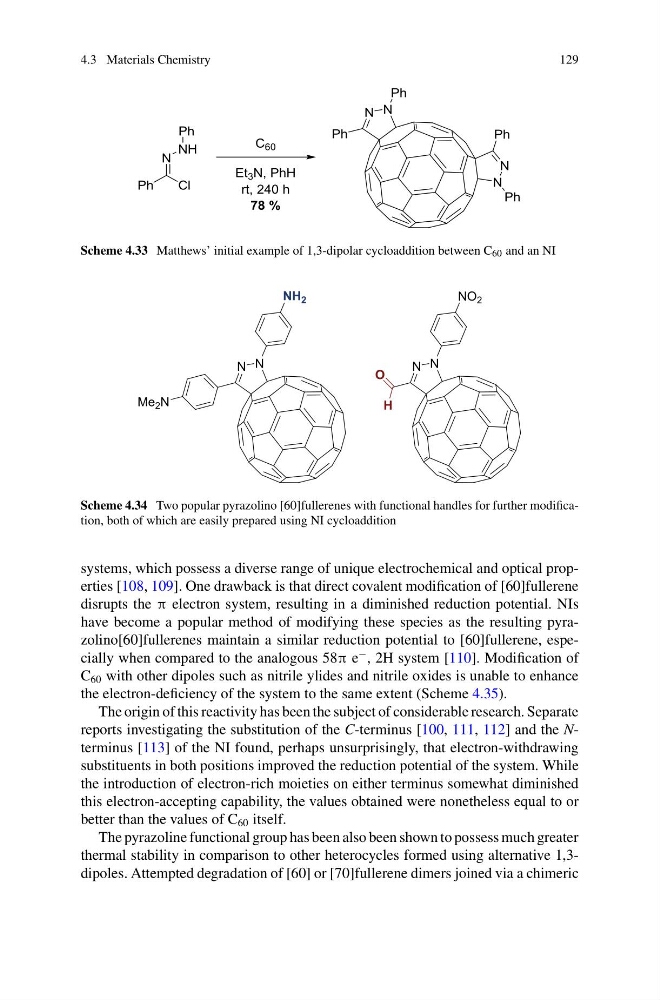
Scheme 4.33 Matthews’ initial example of 1,3-dipolar cycloaddition between C 60 and an NI
N N
O
H
NO 2
N N
NH 2
Me 2 N
Scheme 4.34 Two popular pyrazolino [60]fullerenes with functional handles for further modification, both of which are easily prepared using NI cycloaddition
systems, which possess a diverse range of unique electrochemical and optical properties [108, 109]. One drawback is that direct covalent modification of [60]fullerene
disrupts the π electron system, resulting in a diminished reduction potential. NIs
have become a popular method of modifying these species as the resulting pyrazolino[60]fullerenes maintain a similar reduction potential to [60]fullerene, especially when compared to the analogous 58π e
− , 2H system [110]. Modification of
C 60 with other dipoles such as nitrile ylides and nitrile oxides is unable to enhance
the electron-deficiency of the system to the same extent (Scheme 4.35).
The origin of this reactivity has been the subject of considerable research. Separate
reports investigating the substitution of the C-terminus [100, 111, 112] and the Nterminus [113] of the NI found, perhaps unsurprisingly, that electron-withdrawing
substituents in both positions improved the reduction potential of the system. While
the introduction of electron-rich moieties on either terminus somewhat diminished
this electron-accepting capability, the values obtained were nonetheless equal to or
better than the values of C 60 itself.
The pyrazoline functional group has been also been shown to possess much greater
thermal stability in comparison to other heterocycles formed using alternative 1,3dipoles. Attempted degradation of [60] or [70]fullerene dimers joined via a chimeric
129
Cl
N
NH
Ph
Et 3 N, PhH
rt, 240 h
78 %
Ph
N N
Ph
Ph
C 60
N
N
Ph
Ph
Scheme 4.33 Matthews’ initial example of 1,3-dipolar cycloaddition between C 60 and an NI
N N
O
H
NO 2
N N
NH 2
Me 2 N
Scheme 4.34 Two popular pyrazolino [60]fullerenes with functional handles for further modification, both of which are easily prepared using NI cycloaddition
systems, which possess a diverse range of unique electrochemical and optical properties [108, 109]. One drawback is that direct covalent modification of [60]fullerene
disrupts the π electron system, resulting in a diminished reduction potential. NIs
have become a popular method of modifying these species as the resulting pyrazolino[60]fullerenes maintain a similar reduction potential to [60]fullerene, especially when compared to the analogous 58π e
− , 2H system [110]. Modification of
C 60 with other dipoles such as nitrile ylides and nitrile oxides is unable to enhance
the electron-deficiency of the system to the same extent (Scheme 4.35).
The origin of this reactivity has been the subject of considerable research. Separate
reports investigating the substitution of the C-terminus [100, 111, 112] and the Nterminus [113] of the NI found, perhaps unsurprisingly, that electron-withdrawing
substituents in both positions improved the reduction potential of the system. While
the introduction of electron-rich moieties on either terminus somewhat diminished
this electron-accepting capability, the values obtained were nonetheless equal to or
better than the values of C 60 itself.
The pyrazoline functional group has been also been shown to possess much greater
thermal stability in comparison to other heterocycles formed using alternative 1,3dipoles. Attempted degradation of [60] or [70]fullerene dimers joined via a chimeric