

1.2 Resonance Forms
3
[29–34]. However, as computational power progressed and higher levels of theory
were applied, it was later determined that formyl NI existed as the allenic structure
almost exclusively, with the propargylic form existing only as a transition state
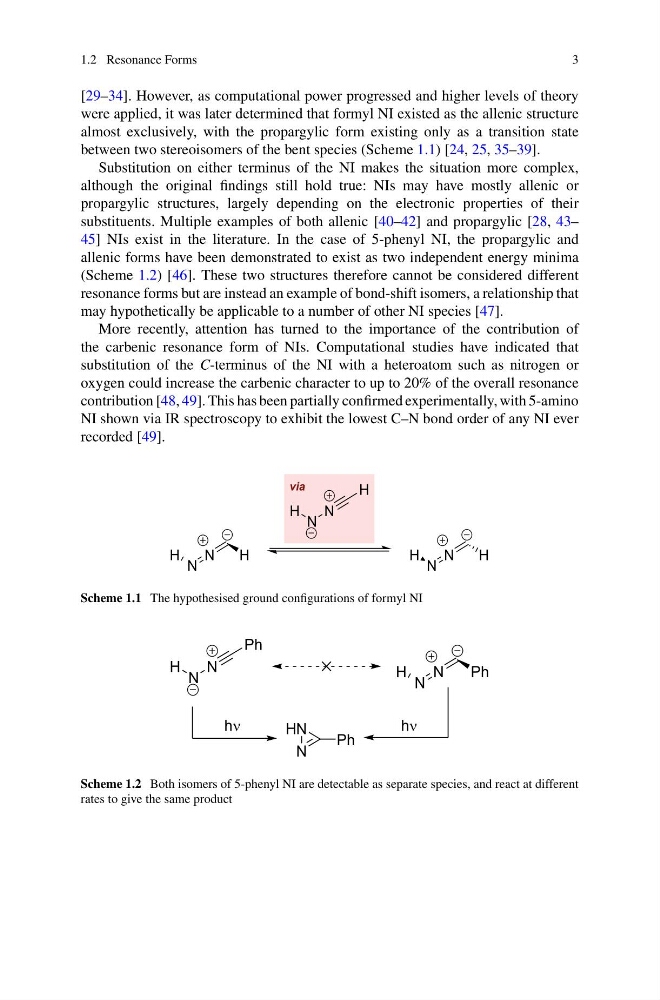
between two stereoisomers of the bent species (Scheme 1.1) [24, 25, 35–39].
Substitution on either terminus of the NI makes the situation more complex,
although the original findings still hold true: NIs may have mostly allenic or
propargylic structures, largely depending on the electronic properties of their
substituents. Multiple examples of both allenic [40–42] and propargylic [28, 43–
45] NIs exist in the literature. In the case of 5-phenyl NI, the propargylic and
allenic forms have been demonstrated to exist as two independent energy minima
(Scheme 1.2) [46]. These two structures therefore cannot be considered different
resonance forms but are instead an example of bond-shift isomers, a relationship that
may hypothetically be applicable to a number of other NI species [47].
More recently, attention has turned to the importance of the contribution of
the carbenic resonance form of NIs. Computational studies have indicated that
substitution of the C-terminus of the NI with a heteroatom such as nitrogen or
oxygen could increase the carbenic character to up to 20% of the overall resonance
contribution [48, 49]. This has been partially confirmed experimentally, with 5-amino
NI shown via IR spectroscopy to exhibit the lowest C–N bond order of any NI ever
recorded [49].
N
H
N
H
N
N
H
H
N
H
N
H
via
Scheme 1.1 The hypothesised ground configurations of formyl NI
N
Ph
N
H
N
N
Ph
H
HN
N
Ph
h
h
Scheme 1.2 Both isomers of 5-phenyl NI are detectable as separate species, and react at different
rates to give the same product
3
[29–34]. However, as computational power progressed and higher levels of theory
were applied, it was later determined that formyl NI existed as the allenic structure
almost exclusively, with the propargylic form existing only as a transition state
between two stereoisomers of the bent species (Scheme 1.1) [24, 25, 35–39].
Substitution on either terminus of the NI makes the situation more complex,
although the original findings still hold true: NIs may have mostly allenic or
propargylic structures, largely depending on the electronic properties of their
substituents. Multiple examples of both allenic [40–42] and propargylic [28, 43–
45] NIs exist in the literature. In the case of 5-phenyl NI, the propargylic and
allenic forms have been demonstrated to exist as two independent energy minima
(Scheme 1.2) [46]. These two structures therefore cannot be considered different
resonance forms but are instead an example of bond-shift isomers, a relationship that
may hypothetically be applicable to a number of other NI species [47].
More recently, attention has turned to the importance of the contribution of
the carbenic resonance form of NIs. Computational studies have indicated that
substitution of the C-terminus of the NI with a heteroatom such as nitrogen or
oxygen could increase the carbenic character to up to 20% of the overall resonance
contribution [48, 49]. This has been partially confirmed experimentally, with 5-amino
NI shown via IR spectroscopy to exhibit the lowest C–N bond order of any NI ever
recorded [49].
N
H
N
H
N
N
H
H
N
H
N
H
via
Scheme 1.1 The hypothesised ground configurations of formyl NI
N
Ph
N
H
N
N
Ph
H
HN
N
Ph
h
h
Scheme 1.2 Both isomers of 5-phenyl NI are detectable as separate species, and react at different
rates to give the same product