

2
1 Nitrile Imines and Their Properties
1.2 Resonance Forms
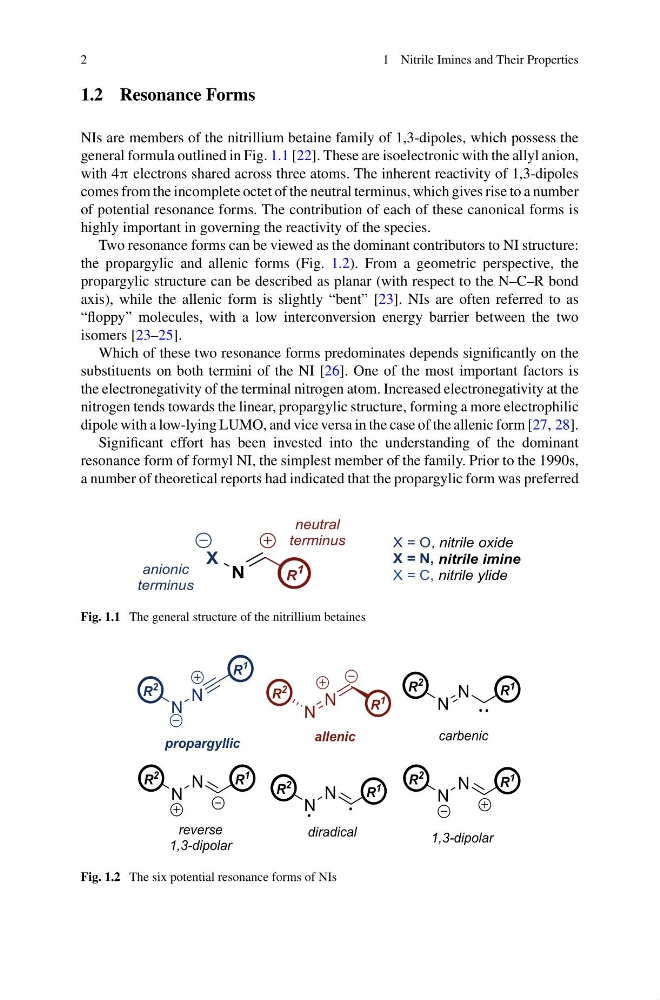
NIs are members of the nitrillium betaine family of 1,3-dipoles, which possess the
general formula outlined in Fig. 1.1 [22]. These are isoelectronic with the allyl anion,
with 4π electrons shared across three atoms. The inherent reactivity of 1,3-dipoles
comes from the incomplete octet of the neutral terminus, which gives rise to a number
of potential resonance forms. The contribution of each of these canonical forms is
highly important in governing the reactivity of the species.
Two resonance forms can be viewed as the dominant contributors to NI structure:
the propargylic and allenic forms (Fig. 1.2). From a geometric perspective, the
propargylic structure can be described as planar (with respect to the N–C–R bond
axis), while the allenic form is slightly “bent” [23]. NIs are often referred to as
“floppy” molecules, with a low interconversion energy barrier between the two
isomers [23–25].
Which of these two resonance forms predominates depends significantly on the
substituents on both termini of the NI [26]. One of the most important factors is
the electronegativity of the terminal nitrogen atom. Increased electronegativity at the
nitrogen tends towards the linear, propargylic structure, forming a more electrophilic
dipole with a low-lying LUMO, and vice versa in the case of the allenic form [27, 28].
Significant effort has been invested into the understanding of the dominant
resonance form of formyl NI, the simplest member of the family. Prior to the 1990s,
a number of theoretical reports had indicated that the propargylic form was preferred
N
X
anionic
terminus
neutral
terminus
X = O, nitrile oxide
X = N, nitrile imine
X = C, nitrile ylide
R
1
Fig. 1.1 The general structure of the nitrillium betaines
N
N
N
N
1,3-dipolar
carbenic
N
N
reverse
1,3-dipolar
N
N
diradical
N
allenic
N
N
N
propargyllic
R
1
R
1
R
1
R
1
R
1
R
1
R
2
R
2
R
2
R
2
R
2
R
2
Fig. 1.2 The six potential resonance forms of NIs
1 Nitrile Imines and Their Properties
1.2 Resonance Forms
NIs are members of the nitrillium betaine family of 1,3-dipoles, which possess the
general formula outlined in Fig. 1.1 [22]. These are isoelectronic with the allyl anion,
with 4π electrons shared across three atoms. The inherent reactivity of 1,3-dipoles
comes from the incomplete octet of the neutral terminus, which gives rise to a number
of potential resonance forms. The contribution of each of these canonical forms is
highly important in governing the reactivity of the species.
Two resonance forms can be viewed as the dominant contributors to NI structure:
the propargylic and allenic forms (Fig. 1.2). From a geometric perspective, the
propargylic structure can be described as planar (with respect to the N–C–R bond
axis), while the allenic form is slightly “bent” [23]. NIs are often referred to as
“floppy” molecules, with a low interconversion energy barrier between the two
isomers [23–25].
Which of these two resonance forms predominates depends significantly on the
substituents on both termini of the NI [26]. One of the most important factors is
the electronegativity of the terminal nitrogen atom. Increased electronegativity at the
nitrogen tends towards the linear, propargylic structure, forming a more electrophilic
dipole with a low-lying LUMO, and vice versa in the case of the allenic form [27, 28].
Significant effort has been invested into the understanding of the dominant
resonance form of formyl NI, the simplest member of the family. Prior to the 1990s,
a number of theoretical reports had indicated that the propargylic form was preferred
N
X
anionic
terminus
neutral
terminus
X = O, nitrile oxide
X = N, nitrile imine
X = C, nitrile ylide
R
1
Fig. 1.1 The general structure of the nitrillium betaines
N
N
N
N
1,3-dipolar
carbenic
N
N
reverse
1,3-dipolar
N
N
diradical
N
allenic
N
N
N
propargyllic
R
1
R
1
R
1
R
1
R
1
R
1
R
2
R
2
R
2
R
2
R
2
R
2
Fig. 1.2 The six potential resonance forms of NIs