

4.2 Bioorthogonal Chemistry
111
complex and require multiple transformations, but remain relatively straightforward
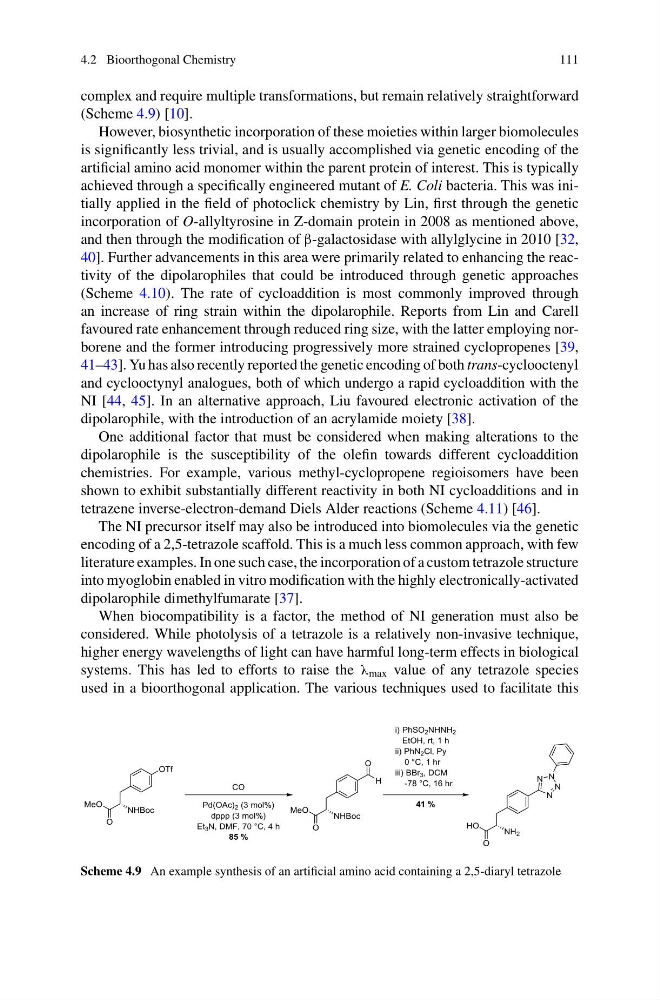
(Scheme 4.9) [10].
However, biosynthetic incorporation of these moieties within larger biomolecules
is significantly less trivial, and is usually accomplished via genetic encoding of the
artificial amino acid monomer within the parent protein of interest. This is typically
achieved through a specifically engineered mutant of E. Coli bacteria. This was initially applied in the field of photoclick chemistry by Lin, first through the genetic
incorporation of O-allyltyrosine in Z-domain protein in 2008 as mentioned above,
and then through the modification of β-galactosidase with allylglycine in 2010 [32,
40]. Further advancements in this area were primarily related to enhancing the reactivity of the dipolarophiles that could be introduced through genetic approaches
(Scheme 4.10). The rate of cycloaddition is most commonly improved through
an increase of ring strain within the dipolarophile. Reports from Lin and Carell
favoured rate enhancement through reduced ring size, with the latter employing norborene and the former introducing progressively more strained cyclopropenes [39,
41–43]. Yu has also recently reported the genetic encoding of both trans-cyclooctenyl
and cyclooctynyl analogues, both of which undergo a rapid cycloaddition with the
NI [44, 45]. In an alternative approach, Liu favoured electronic activation of the
dipolarophile, with the introduction of an acrylamide moiety [38].
One additional factor that must be considered when making alterations to the
dipolarophile is the susceptibility of the olefin towards different cycloaddition
chemistries. For example, various methyl-cyclopropene regioisomers have been
shown to exhibit substantially different reactivity in both NI cycloadditions and in
tetrazene inverse-electron-demand Diels Alder reactions (Scheme 4.11) [46].
The NI precursor itself may also be introduced into biomolecules via the genetic
encoding of a 2,5-tetrazole scaffold. This is a much less common approach, with few
literature examples. In one such case, the incorporation of a custom tetrazole structure
into myoglobin enabled in vitro modification with the highly electronically-activated
dipolarophile dimethylfumarate [37].
When biocompatibility is a factor, the method of NI generation must also be
considered. While photolysis of a tetrazole is a relatively non-invasive technique,
higher energy wavelengths of light can have harmful long-term effects in biological
systems. This has led to efforts to raise the λ max value of any tetrazole species
used in a bioorthogonal application. The various techniques used to facilitate this
NHBoc
O
MeO
O
H
NH 2
O
HO
i) PhSO 2 NHNH 2
EtOH, rt, 1 h
ii) PhN 2 Cl, Py
0 °C, 1 hr
iii) BBr 3 , DCM
-78 °C, 16 hr
41 %
N
N
N
N
NHBoc
O
MeO
OTf
CO
Pd(OAc) 2 (3 mol%)
dppp (3 mol%)
Et 3 N, DMF, 70 °C, 4 h
85 %
Scheme 4.9 An example synthesis of an artificial amino acid containing a 2,5-diaryl tetrazole
111
complex and require multiple transformations, but remain relatively straightforward
(Scheme 4.9) [10].
However, biosynthetic incorporation of these moieties within larger biomolecules
is significantly less trivial, and is usually accomplished via genetic encoding of the
artificial amino acid monomer within the parent protein of interest. This is typically
achieved through a specifically engineered mutant of E. Coli bacteria. This was initially applied in the field of photoclick chemistry by Lin, first through the genetic
incorporation of O-allyltyrosine in Z-domain protein in 2008 as mentioned above,
and then through the modification of β-galactosidase with allylglycine in 2010 [32,
40]. Further advancements in this area were primarily related to enhancing the reactivity of the dipolarophiles that could be introduced through genetic approaches
(Scheme 4.10). The rate of cycloaddition is most commonly improved through
an increase of ring strain within the dipolarophile. Reports from Lin and Carell
favoured rate enhancement through reduced ring size, with the latter employing norborene and the former introducing progressively more strained cyclopropenes [39,
41–43]. Yu has also recently reported the genetic encoding of both trans-cyclooctenyl
and cyclooctynyl analogues, both of which undergo a rapid cycloaddition with the
NI [44, 45]. In an alternative approach, Liu favoured electronic activation of the
dipolarophile, with the introduction of an acrylamide moiety [38].
One additional factor that must be considered when making alterations to the
dipolarophile is the susceptibility of the olefin towards different cycloaddition
chemistries. For example, various methyl-cyclopropene regioisomers have been
shown to exhibit substantially different reactivity in both NI cycloadditions and in
tetrazene inverse-electron-demand Diels Alder reactions (Scheme 4.11) [46].
The NI precursor itself may also be introduced into biomolecules via the genetic
encoding of a 2,5-tetrazole scaffold. This is a much less common approach, with few
literature examples. In one such case, the incorporation of a custom tetrazole structure
into myoglobin enabled in vitro modification with the highly electronically-activated
dipolarophile dimethylfumarate [37].
When biocompatibility is a factor, the method of NI generation must also be
considered. While photolysis of a tetrazole is a relatively non-invasive technique,
higher energy wavelengths of light can have harmful long-term effects in biological
systems. This has led to efforts to raise the λ max value of any tetrazole species
used in a bioorthogonal application. The various techniques used to facilitate this
NHBoc
O
MeO
O
H
NH 2
O
HO
i) PhSO 2 NHNH 2
EtOH, rt, 1 h
ii) PhN 2 Cl, Py
0 °C, 1 hr
iii) BBr 3 , DCM
-78 °C, 16 hr
41 %
N
N
N
N
NHBoc
O
MeO
OTf
CO
Pd(OAc) 2 (3 mol%)
dppp (3 mol%)
Et 3 N, DMF, 70 °C, 4 h
85 %
Scheme 4.9 An example synthesis of an artificial amino acid containing a 2,5-diaryl tetrazole