

110
4 Applications of Nitrile Imine Derivatives
chemistry was that the pyrazoline products were fluorescent, and as a consequence
this represented self-reporting ligation methodology.
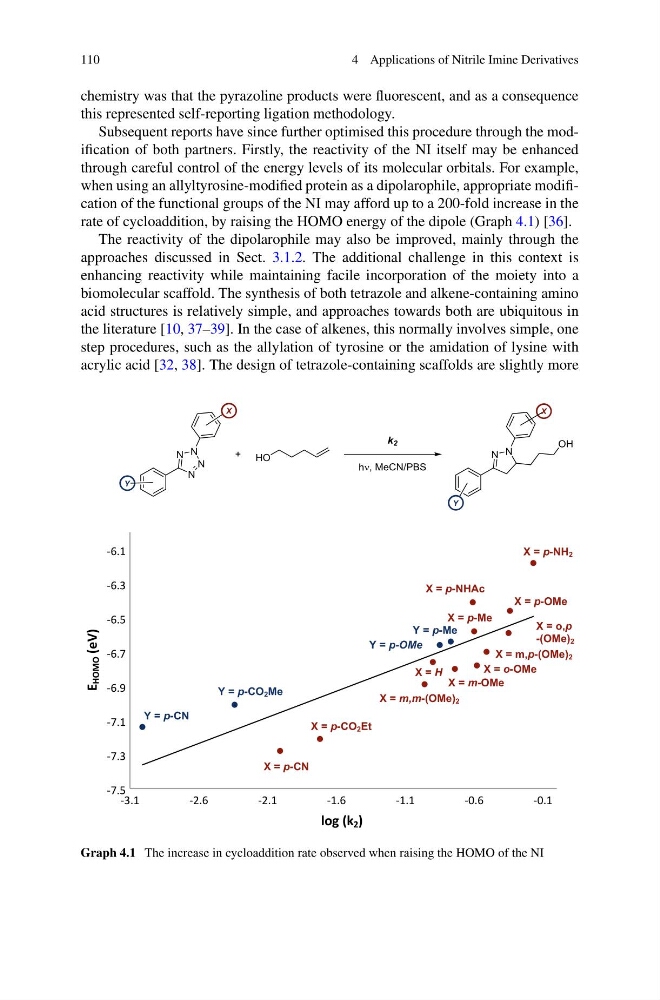
Subsequent reports have since further optimised this procedure through the modification of both partners. Firstly, the reactivity of the NI itself may be enhanced
through careful control of the energy levels of its molecular orbitals. For example,
when using an allyltyrosine-modified protein as a dipolarophile, appropriate modification of the functional groups of the NI may afford up to a 200-fold increase in the
rate of cycloaddition, by raising the HOMO energy of the dipole (Graph 4.1) [36].
The reactivity of the dipolarophile may also be improved, mainly through the
approaches discussed in Sect. 3.1.2. The additional challenge in this context is
enhancing reactivity while maintaining facile incorporation of the moiety into a
biomolecular scaffold. The synthesis of both tetrazole and alkene-containing amino
acid structures is relatively simple, and approaches towards both are ubiquitous in
the literature [10, 37–39]. In the case of alkenes, this normally involves simple, one
step procedures, such as the allylation of tyrosine or the amidation of lysine with
acrylic acid [32, 38]. The design of tetrazole-containing scaffolds are slightly more
N
N
N
N
k 2
, MeCN/PBS
X
Y
HO
N
N
OH
+
Y
X
-7.5
-7.3
-7.1
-6.9
-6.7
-6.5
-6.3
-6.1
-3.1
-2.6
-2.1
-1.6
-1.1
-0.6
-0.1
log (k 2 )
E
HOMO (eV)
Y = p-CN
Y = p-CO 2 Me
Y = p-OMe
Y = p-Me
X = p-CN
X = p-CO 2 Et
X = m,m-(OMe) 2
X = H
X = m-OMe
X = o-OMe
X = m,p-(OMe) 2
X = o,p
-(OMe) 2
X = p-Me
X = p-NHAc
X = p-OMe
X = p-NH 2
h
Graph 4.1 The increase in cycloaddition rate observed when raising the HOMO of the NI
4 Applications of Nitrile Imine Derivatives
chemistry was that the pyrazoline products were fluorescent, and as a consequence
this represented self-reporting ligation methodology.
Subsequent reports have since further optimised this procedure through the modification of both partners. Firstly, the reactivity of the NI itself may be enhanced
through careful control of the energy levels of its molecular orbitals. For example,
when using an allyltyrosine-modified protein as a dipolarophile, appropriate modification of the functional groups of the NI may afford up to a 200-fold increase in the
rate of cycloaddition, by raising the HOMO energy of the dipole (Graph 4.1) [36].
The reactivity of the dipolarophile may also be improved, mainly through the
approaches discussed in Sect. 3.1.2. The additional challenge in this context is
enhancing reactivity while maintaining facile incorporation of the moiety into a
biomolecular scaffold. The synthesis of both tetrazole and alkene-containing amino
acid structures is relatively simple, and approaches towards both are ubiquitous in
the literature [10, 37–39]. In the case of alkenes, this normally involves simple, one
step procedures, such as the allylation of tyrosine or the amidation of lysine with
acrylic acid [32, 38]. The design of tetrazole-containing scaffolds are slightly more
N
N
N
N
k 2
, MeCN/PBS
X
Y
HO
N
N
OH
+
Y
X
-7.5
-7.3
-7.1
-6.9
-6.7
-6.5
-6.3
-6.1
-3.1
-2.6
-2.1
-1.6
-1.1
-0.6
-0.1
log (k 2 )
E
HOMO (eV)
Y = p-CN
Y = p-CO 2 Me
Y = p-OMe
Y = p-Me
X = p-CN
X = p-CO 2 Et
X = m,m-(OMe) 2
X = H
X = m-OMe
X = o-OMe
X = m,p-(OMe) 2
X = o,p
-(OMe) 2
X = p-Me
X = p-NHAc
X = p-OMe
X = p-NH 2
h
Graph 4.1 The increase in cycloaddition rate observed when raising the HOMO of the NI