

102
4 Applications of Nitrile Imine Derivatives
N N
MeS
Ph H
H 2 O, THF
100
o
C, 24 h
80 %
H
N N
O
Ph H
HCl
THF
-20
o C, 2 h
84 %
newbouldine
N N
Ph H
Cp 2 ZnHCl
-wave, CHCl 3
120
o C, 10 min
90 %
N N
MeS
DDQ
EtOH
rt, 2 h
95 %
withasomnine
N N
Ph
Raney Ni
N N
MeS
Ph H
Ph
MeCN
rt, 16 h
73 %
N
N N
N
MeS
Ph
h
N N
MeS
Ph H
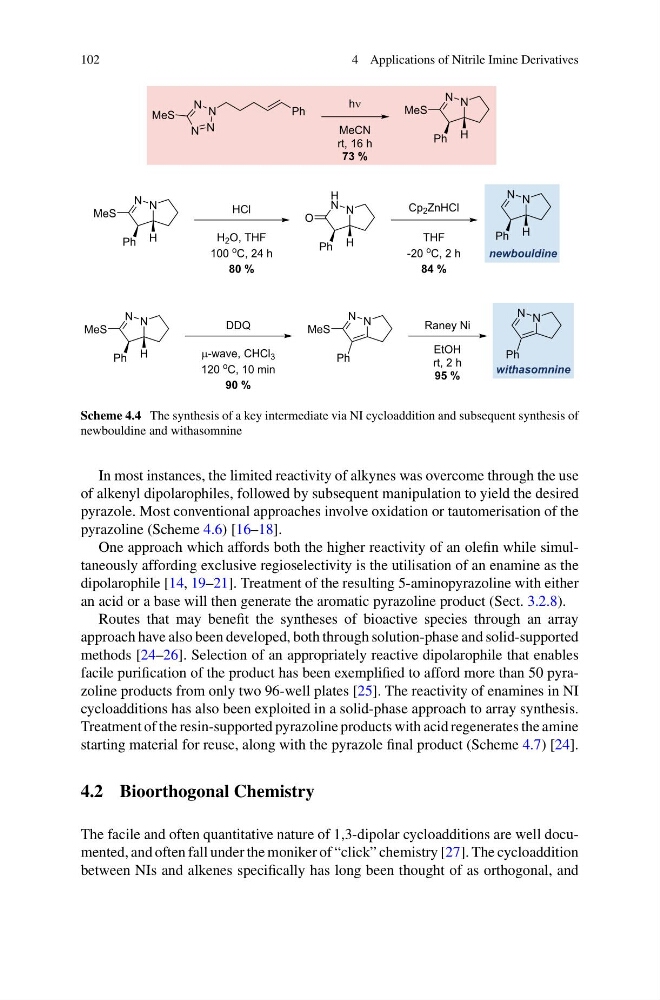
Scheme 4.4 The synthesis of a key intermediate via NI cycloaddition and subsequent synthesis of
newbouldine and withasomnine
In most instances, the limited reactivity of alkynes was overcome through the use
of alkenyl dipolarophiles, followed by subsequent manipulation to yield the desired
pyrazole. Most conventional approaches involve oxidation or tautomerisation of the
pyrazoline (Scheme 4.6) [16–18].
One approach which affords both the higher reactivity of an olefin while simultaneously affording exclusive regioselectivity is the utilisation of an enamine as the
dipolarophile [14, 19–21]. Treatment of the resulting 5-aminopyrazoline with either
an acid or a base will then generate the aromatic pyrazoline product (Sect. 3.2.8).
Routes that may benefit the syntheses of bioactive species through an array
approach have also been developed, both through solution-phase and solid-supported
methods [24–26]. Selection of an appropriately reactive dipolarophile that enables
facile purification of the product has been exemplified to afford more than 50 pyrazoline products from only two 96-well plates [25]. The reactivity of enamines in NI
cycloadditions has also been exploited in a solid-phase approach to array synthesis.
Treatment of the resin-supported pyrazoline products with acid regenerates the amine
starting material for reuse, along with the pyrazole final product (Scheme 4.7) [24].
4.2 Bioorthogonal Chemistry
The facile and often quantitative nature of 1,3-dipolar cycloadditions are well documented, and often fall under the moniker of “click” chemistry [27]. The cycloaddition
between NIs and alkenes specifically has long been thought of as orthogonal, and
4 Applications of Nitrile Imine Derivatives
N N
MeS
Ph H
H 2 O, THF
100
o
C, 24 h
80 %
H
N N
O
Ph H
HCl
THF
-20
o C, 2 h
84 %
newbouldine
N N
Ph H
Cp 2 ZnHCl
-wave, CHCl 3
120
o C, 10 min
90 %
N N
MeS
DDQ
EtOH
rt, 2 h
95 %
withasomnine
N N
Ph
Raney Ni
N N
MeS
Ph H
Ph
MeCN
rt, 16 h
73 %
N
N N
N
MeS
Ph
h
N N
MeS
Ph H
Scheme 4.4 The synthesis of a key intermediate via NI cycloaddition and subsequent synthesis of
newbouldine and withasomnine
In most instances, the limited reactivity of alkynes was overcome through the use
of alkenyl dipolarophiles, followed by subsequent manipulation to yield the desired
pyrazole. Most conventional approaches involve oxidation or tautomerisation of the
pyrazoline (Scheme 4.6) [16–18].
One approach which affords both the higher reactivity of an olefin while simultaneously affording exclusive regioselectivity is the utilisation of an enamine as the
dipolarophile [14, 19–21]. Treatment of the resulting 5-aminopyrazoline with either
an acid or a base will then generate the aromatic pyrazoline product (Sect. 3.2.8).
Routes that may benefit the syntheses of bioactive species through an array
approach have also been developed, both through solution-phase and solid-supported
methods [24–26]. Selection of an appropriately reactive dipolarophile that enables
facile purification of the product has been exemplified to afford more than 50 pyrazoline products from only two 96-well plates [25]. The reactivity of enamines in NI
cycloadditions has also been exploited in a solid-phase approach to array synthesis.
Treatment of the resin-supported pyrazoline products with acid regenerates the amine
starting material for reuse, along with the pyrazole final product (Scheme 4.7) [24].
4.2 Bioorthogonal Chemistry
The facile and often quantitative nature of 1,3-dipolar cycloadditions are well documented, and often fall under the moniker of “click” chemistry [27]. The cycloaddition
between NIs and alkenes specifically has long been thought of as orthogonal, and