

4.3 Mechanism of Vermicomposting
Earthworm is an invertebrate living in soil, belonging to Oligochaeta of Annelida.
As early as Darwin period, earthworm was found to have an important role in
degrading forest dead leaves and improving soil (Graff 1983). After a hundred of
years, it has been growingly known that earthworms contributed to the material
circulation and energy transfer in the drilosphere through intestinal digestion, casting, mucus secretion, and burrowing (Brown 1995; Edwards and Bohlen 1996;
Domínguez et al. 2010; Huang and Xia 2018). Vermicomposting is a kind of
resource utilization technology for the degradation of biological organic waste,
which refers to the ecological function of earthworms and microorganisms inhabited
in the surround of earthworms (Huang et al. 2018). In this process, earthworms can
convert soluble microbial products and aromatic compounds of organic matter into
humus such as humic acid and fulvic acid. Meanwhile, the final product is rich in
active nitrogen, phosphorus, potassium, and several beneficial microbial groups
(Huang et al. 2017). Therefore, vermicompost is regarded as the gold of organic
fertilizer.
Accordingly, earthworms are the leaders of microorganisms in the whole process
of vermicomposting, which can significantly change the number, activity, and
population of microorganisms directly or indirectly and thus regulate the path and
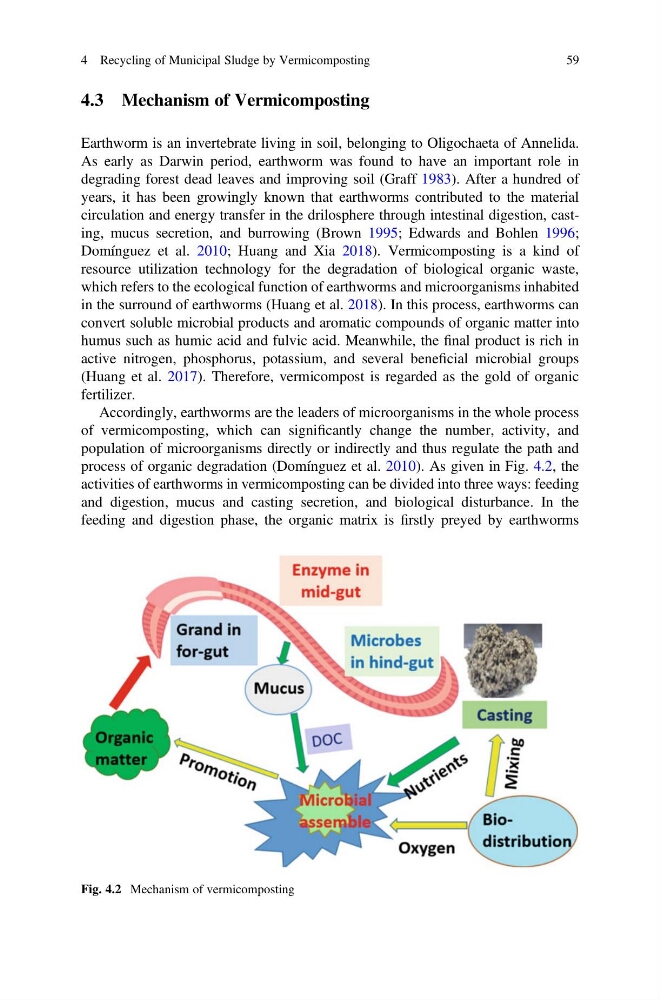
process of organic degradation (Domínguez et al. 2010). As given in Fig. 4.2, the
activities of earthworms in vermicomposting can be divided into three ways: feeding
and digestion, mucus and casting secretion, and biological disturbance. In the
feeding and digestion phase, the organic matrix is firstly preyed by earthworms
Fig. 4.2 Mechanism of vermicomposting
4 Recycling of Municipal Sludge by Vermicomposting
59
Earthworm is an invertebrate living in soil, belonging to Oligochaeta of Annelida.
As early as Darwin period, earthworm was found to have an important role in
degrading forest dead leaves and improving soil (Graff 1983). After a hundred of
years, it has been growingly known that earthworms contributed to the material
circulation and energy transfer in the drilosphere through intestinal digestion, casting, mucus secretion, and burrowing (Brown 1995; Edwards and Bohlen 1996;
Domínguez et al. 2010; Huang and Xia 2018). Vermicomposting is a kind of
resource utilization technology for the degradation of biological organic waste,
which refers to the ecological function of earthworms and microorganisms inhabited
in the surround of earthworms (Huang et al. 2018). In this process, earthworms can
convert soluble microbial products and aromatic compounds of organic matter into
humus such as humic acid and fulvic acid. Meanwhile, the final product is rich in
active nitrogen, phosphorus, potassium, and several beneficial microbial groups
(Huang et al. 2017). Therefore, vermicompost is regarded as the gold of organic
fertilizer.
Accordingly, earthworms are the leaders of microorganisms in the whole process
of vermicomposting, which can significantly change the number, activity, and
population of microorganisms directly or indirectly and thus regulate the path and
process of organic degradation (Domínguez et al. 2010). As given in Fig. 4.2, the
activities of earthworms in vermicomposting can be divided into three ways: feeding
and digestion, mucus and casting secretion, and biological disturbance. In the
feeding and digestion phase, the organic matrix is firstly preyed by earthworms
Fig. 4.2 Mechanism of vermicomposting
4 Recycling of Municipal Sludge by Vermicomposting
59