

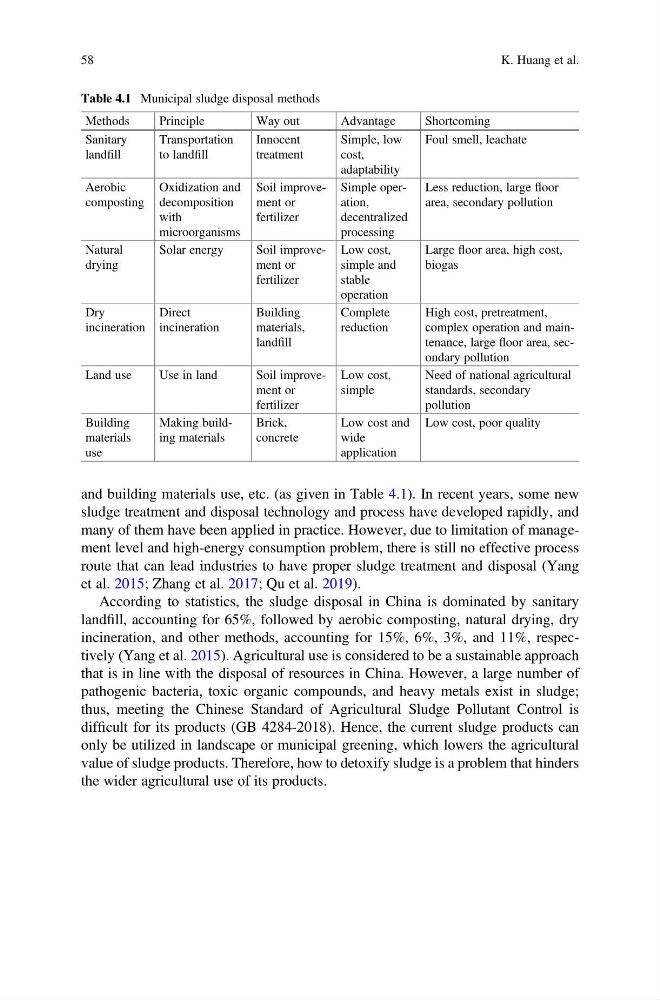
and building materials use, etc. (as given in Table 4.1). In recent years, some new
sludge treatment and disposal technology and process have developed rapidly, and
many of them have been applied in practice. However, due to limitation of management level and high-energy consumption problem, there is still no effective process
route that can lead industries to have proper sludge treatment and disposal (Yang
et al. 2015; Zhang et al. 2017; Qu et al. 2019).
According to statistics, the sludge disposal in China is dominated by sanitary
landfill, accounting for 65%, followed by aerobic composting, natural drying, dry
incineration, and other methods, accounting for 15%, 6%, 3%, and 11%, respectively (Yang et al. 2015). Agricultural use is considered to be a sustainable approach
that is in line with the disposal of resources in China. However, a large number of
pathogenic bacteria, toxic organic compounds, and heavy metals exist in sludge;
thus, meeting the Chinese Standard of Agricultural Sludge Pollutant Control is
difficult for its products (GB 4284-2018). Hence, the current sludge products can
only be utilized in landscape or municipal greening, which lowers the agricultural
value of sludge products. Therefore, how to detoxify sludge is a problem that hinders
the wider agricultural use of its products.
Table 4.1 Municipal sludge disposal methods
Methods
Principle
Way out
Advantage
Shortcoming
Sanitary
landfill
Transportation
to landfill
Innocent
treatment
Simple, low
cost,
adaptability
Foul smell, leachate
Aerobic
composting
Oxidization and
decomposition
with
microorganisms
Soil improvement or
fertilizer
Simple operation,
decentralized
processing
Less reduction, large floor
area, secondary pollution
Natural
drying
Solar energy
Soil improvement or
fertilizer
Low cost,
simple and
stable
operation
Large floor area, high cost,
biogas
Dry
incineration
Direct
incineration
Building
materials,
landfill
Complete
reduction
High cost, pretreatment,
complex operation and maintenance, large floor area, secondary pollution
Land use
Use in land
Soil improvement or
fertilizer
Low cost,
simple
Need of national agricultural
standards, secondary
pollution
Building
materials
use
Making building materials
Brick,
concrete
Low cost and
wide
application
Low cost, poor quality
58
K. Huang et al.
sludge treatment and disposal technology and process have developed rapidly, and
many of them have been applied in practice. However, due to limitation of management level and high-energy consumption problem, there is still no effective process
route that can lead industries to have proper sludge treatment and disposal (Yang
et al. 2015; Zhang et al. 2017; Qu et al. 2019).
According to statistics, the sludge disposal in China is dominated by sanitary
landfill, accounting for 65%, followed by aerobic composting, natural drying, dry
incineration, and other methods, accounting for 15%, 6%, 3%, and 11%, respectively (Yang et al. 2015). Agricultural use is considered to be a sustainable approach
that is in line with the disposal of resources in China. However, a large number of
pathogenic bacteria, toxic organic compounds, and heavy metals exist in sludge;
thus, meeting the Chinese Standard of Agricultural Sludge Pollutant Control is
difficult for its products (GB 4284-2018). Hence, the current sludge products can
only be utilized in landscape or municipal greening, which lowers the agricultural
value of sludge products. Therefore, how to detoxify sludge is a problem that hinders
the wider agricultural use of its products.
Table 4.1 Municipal sludge disposal methods
Methods
Principle
Way out
Advantage
Shortcoming
Sanitary
landfill
Transportation
to landfill
Innocent
treatment
Simple, low
cost,
adaptability
Foul smell, leachate
Aerobic
composting
Oxidization and
decomposition
with
microorganisms
Soil improvement or
fertilizer
Simple operation,
decentralized
processing
Less reduction, large floor
area, secondary pollution
Natural
drying
Solar energy
Soil improvement or
fertilizer
Low cost,
simple and
stable
operation
Large floor area, high cost,
biogas
Dry
incineration
Direct
incineration
Building
materials,
landfill
Complete
reduction
High cost, pretreatment,
complex operation and maintenance, large floor area, secondary pollution
Land use
Use in land
Soil improvement or
fertilizer
Low cost,
simple
Need of national agricultural
standards, secondary
pollution
Building
materials
use
Making building materials
Brick,
concrete
Low cost and
wide
application
Low cost, poor quality
58
K. Huang et al.