

19.3 Roles of Earthworms Communities in Soil Ecosystem
Earthworms stimulate microbial activity, mix and aggregate the soil, water infiltration rate, soil water content and water-holding capacity, etc. They also increase litter
decomposition, soil organic matter dynamics, nutrient cycles, promote plant growth
and reduce some soil-borne diseases (Chandran et al. 2012; Elmer 2012). Earthworms are functionally very important and diverse, and are therefore potentially
useful for the management of biodiversity and ecosystem services (Blouin et al.
2013).
19.3.1 Stimulate Microbial Activity in the Soil
Earthworms derive their nutrition with the help of microorganisms. Many more
microorganisms are present in their casts than in organic matter that they consume.
The earthworm’s ability to decompose organic matter has been attributed to the
microbial species which inhabit in their digestive tract or the structures they create,
which in effect contribute to making up the drilosphere, a microbial activity hotspot
(Medina-Sauza et al. 2019). According to Kale and Karmegam (2010), there is a
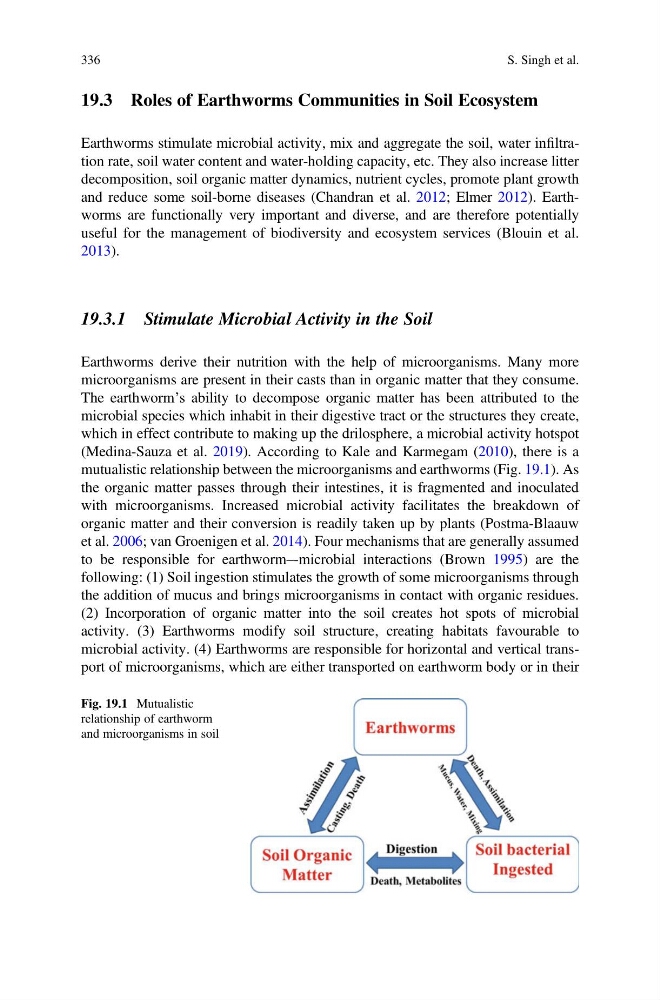
mutualistic relationship between the microorganisms and earthworms (Fig. 19.1). As
the organic matter passes through their intestines, it is fragmented and inoculated
with microorganisms. Increased microbial activity facilitates the breakdown of
organic matter and their conversion is readily taken up by plants (Postma-Blaauw
et al. 2006; van Groenigen et al. 2014). Four mechanisms that are generally assumed
to be responsible for earthworm–-microbial interactions (Brown 1995) are the
following: (1) Soil ingestion stimulates the growth of some microorganisms through
the addition of mucus and brings microorganisms in contact with organic residues.
(2) Incorporation of organic matter into the soil creates hot spots of microbial
activity. (3) Earthworms modify soil structure, creating habitats favourable to
microbial activity. (4) Earthworms are responsible for horizontal and vertical transport of microorganisms, which are either transported on earthworm body or in their
Fig. 19.1 Mutualistic
relationship of earthworm
and microorganisms in soil
336
S. Singh et al.
Earthworms stimulate microbial activity, mix and aggregate the soil, water infiltration rate, soil water content and water-holding capacity, etc. They also increase litter
decomposition, soil organic matter dynamics, nutrient cycles, promote plant growth
and reduce some soil-borne diseases (Chandran et al. 2012; Elmer 2012). Earthworms are functionally very important and diverse, and are therefore potentially
useful for the management of biodiversity and ecosystem services (Blouin et al.
2013).
19.3.1 Stimulate Microbial Activity in the Soil
Earthworms derive their nutrition with the help of microorganisms. Many more
microorganisms are present in their casts than in organic matter that they consume.
The earthworm’s ability to decompose organic matter has been attributed to the
microbial species which inhabit in their digestive tract or the structures they create,
which in effect contribute to making up the drilosphere, a microbial activity hotspot
(Medina-Sauza et al. 2019). According to Kale and Karmegam (2010), there is a
mutualistic relationship between the microorganisms and earthworms (Fig. 19.1). As
the organic matter passes through their intestines, it is fragmented and inoculated
with microorganisms. Increased microbial activity facilitates the breakdown of
organic matter and their conversion is readily taken up by plants (Postma-Blaauw
et al. 2006; van Groenigen et al. 2014). Four mechanisms that are generally assumed
to be responsible for earthworm–-microbial interactions (Brown 1995) are the
following: (1) Soil ingestion stimulates the growth of some microorganisms through
the addition of mucus and brings microorganisms in contact with organic residues.
(2) Incorporation of organic matter into the soil creates hot spots of microbial
activity. (3) Earthworms modify soil structure, creating habitats favourable to
microbial activity. (4) Earthworms are responsible for horizontal and vertical transport of microorganisms, which are either transported on earthworm body or in their
Fig. 19.1 Mutualistic
relationship of earthworm
and microorganisms in soil
336
S. Singh et al.