

role in mixing the nutrients present in deep layers to the surface of the soil by
casting. They feed on the surface residue along with the soil after pulling the same
into their burrows (Anon 2001), but they egest their vermicast at the surface of the
soil. Examples: Lampito mauritii, Aporrectodea longa, Lumbricus terrestris.
2. Epigeic: Earthworms having epigeic ecological category are usually small in size
with uniform body colour. They live on the upper surface of litter and are also
able to tolerate a variable range of temperature. These types of earthworms do not
prefer the food having low organic matter content (Anon 2001; Duiker and
Stehouwer 2008). They also play an important role in humus formation. They
have a high reproductive rate, hatching rate and feeding rate. Thus, epigeic
earthworm species are good for vermicomposting. Examples: Eisenia fetida,
Dendrobaena rubida, Perionyx excavatus and Eudrilus eugeniae.
3. Endogeic: Endogeic earthworms are large- or small-sized worms with weak
pigmentation on their bodies. These are geophagus and are mostly found in the
soil layer with the organic and mineralized matter. They move within the soil after
creating the three-dimensional horizontal burrows by consuming the soil (Duiker
and Stehouwer 2008). They also egest their vermicast within the soil. Examples:
Metaphire posthuma, Octochaetona thurstoni, Allolobophora caliginosa,
Aporrectodea rosea and Octolasion cyaneum.
Lee (1985) classified the earthworm’s species on the basis of their feeding habits
into two groups:
1. Detritivorous earthworms: Earthworms mainly feed on plant litter or dead roots or
mammalian dung at or near the soil surface. Example: Eisenia fetida, Lampito
mauritii, Perionyx excavatus and Eudrilus eugeniae.
2. Geophagus earthworms: They mainly feed on organically rich soil beneath the
soil surface. Example: Metaphire posthuma, Octochaetona thurstoni.
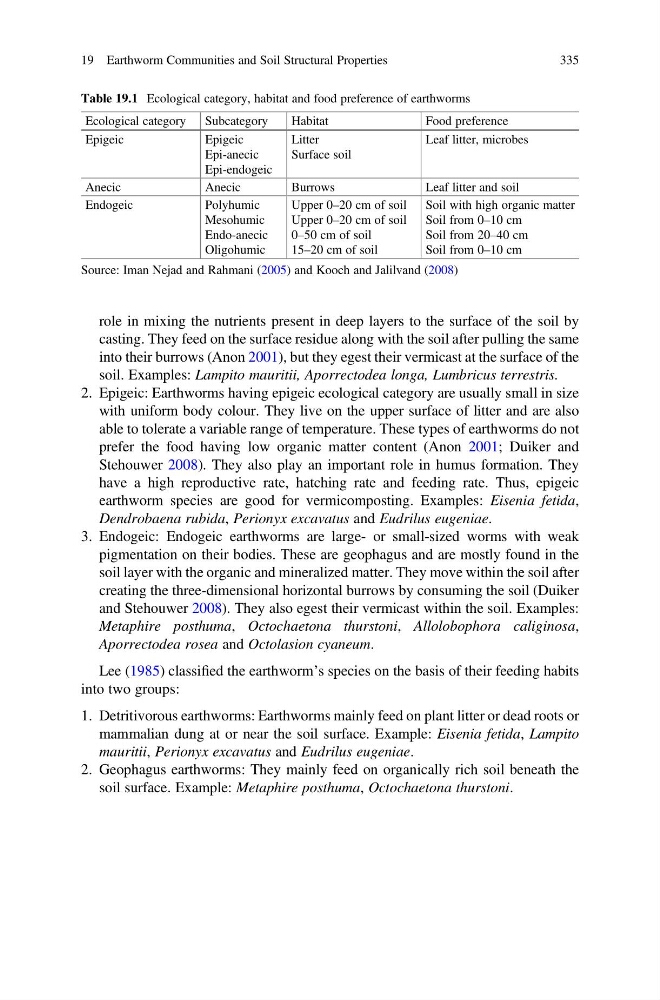
Table 19.1 Ecological category, habitat and food preference of earthworms
Ecological category
Subcategory
Habitat
Food preference
Epigeic
Epigeic
Epi-anecic
Epi-endogeic
Litter
Surface soil
Leaf litter, microbes
Anecic
Anecic
Burrows
Leaf litter and soil
Endogeic
Polyhumic
Mesohumic
Endo-anecic
Oligohumic
Upper 0–20 cm of soil
Upper 0–20 cm of soil
0–50 cm of soil
15–20 cm of soil
Soil with high organic matter
Soil from 0–10 cm
Soil from 20–40 cm
Soil from 0–10 cm
Source: Iman Nejad and Rahmani (2005) and Kooch and Jalilvand (2008)
19 Earthworm Communities and Soil Structural Properties
335
casting. They feed on the surface residue along with the soil after pulling the same
into their burrows (Anon 2001), but they egest their vermicast at the surface of the
soil. Examples: Lampito mauritii, Aporrectodea longa, Lumbricus terrestris.
2. Epigeic: Earthworms having epigeic ecological category are usually small in size
with uniform body colour. They live on the upper surface of litter and are also
able to tolerate a variable range of temperature. These types of earthworms do not
prefer the food having low organic matter content (Anon 2001; Duiker and
Stehouwer 2008). They also play an important role in humus formation. They
have a high reproductive rate, hatching rate and feeding rate. Thus, epigeic
earthworm species are good for vermicomposting. Examples: Eisenia fetida,
Dendrobaena rubida, Perionyx excavatus and Eudrilus eugeniae.
3. Endogeic: Endogeic earthworms are large- or small-sized worms with weak
pigmentation on their bodies. These are geophagus and are mostly found in the
soil layer with the organic and mineralized matter. They move within the soil after
creating the three-dimensional horizontal burrows by consuming the soil (Duiker
and Stehouwer 2008). They also egest their vermicast within the soil. Examples:
Metaphire posthuma, Octochaetona thurstoni, Allolobophora caliginosa,
Aporrectodea rosea and Octolasion cyaneum.
Lee (1985) classified the earthworm’s species on the basis of their feeding habits
into two groups:
1. Detritivorous earthworms: Earthworms mainly feed on plant litter or dead roots or
mammalian dung at or near the soil surface. Example: Eisenia fetida, Lampito
mauritii, Perionyx excavatus and Eudrilus eugeniae.
2. Geophagus earthworms: They mainly feed on organically rich soil beneath the
soil surface. Example: Metaphire posthuma, Octochaetona thurstoni.
Table 19.1 Ecological category, habitat and food preference of earthworms
Ecological category
Subcategory
Habitat
Food preference
Epigeic
Epigeic
Epi-anecic
Epi-endogeic
Litter
Surface soil
Leaf litter, microbes
Anecic
Anecic
Burrows
Leaf litter and soil
Endogeic
Polyhumic
Mesohumic
Endo-anecic
Oligohumic
Upper 0–20 cm of soil
Upper 0–20 cm of soil
0–50 cm of soil
15–20 cm of soil
Soil with high organic matter
Soil from 0–10 cm
Soil from 20–40 cm
Soil from 0–10 cm
Source: Iman Nejad and Rahmani (2005) and Kooch and Jalilvand (2008)
19 Earthworm Communities and Soil Structural Properties
335