

18.9 Conclusions
The concept of organic agriculture is not new, though recent realizations of its
benefits relative to inorganically fertilized agriculture are driving the renewed
interest in this concept. Organic agriculture feeds the soil so that it can feed the
crop rather than inorganically fertilized agriculture, which focuses solely on feeding
the crop. This chapter presented information on how organic agriculture driven by
vermicomposts can be a crucial driver leading to the increased adoption of organic
agriculture at a commercial scale. However, much of the evidence presented has
been based on small-scale experiments, and there is still need for large-scale field
evaluation of the vermicomposting technologies presented. Furthermore, there is still
also a need for the creation of proper standards of production and utilization of
organic fertilizers similar to those existing in inorganically fertilized agriculture.
Overly, vermicomposting presents a biotechnology-driven process that can be
adopted in organic agriculture as an effective nutrient source.
References
Aboutalebi A, Jahromi MG, Farahi MH (2013) Evaluation of growth and yield of organicallygrown basil (Ocimum basilicum L.) in soilless culture. J Food Agric Environ 11(1):299–301
Adhami E, Hosseini S, Owliaie H (2014) Forms of phosphorus of vermicompost produced from leaf
compost and sheep dung enriched with rock phosphate. Int J Recycl Org Waste Agric 3:5
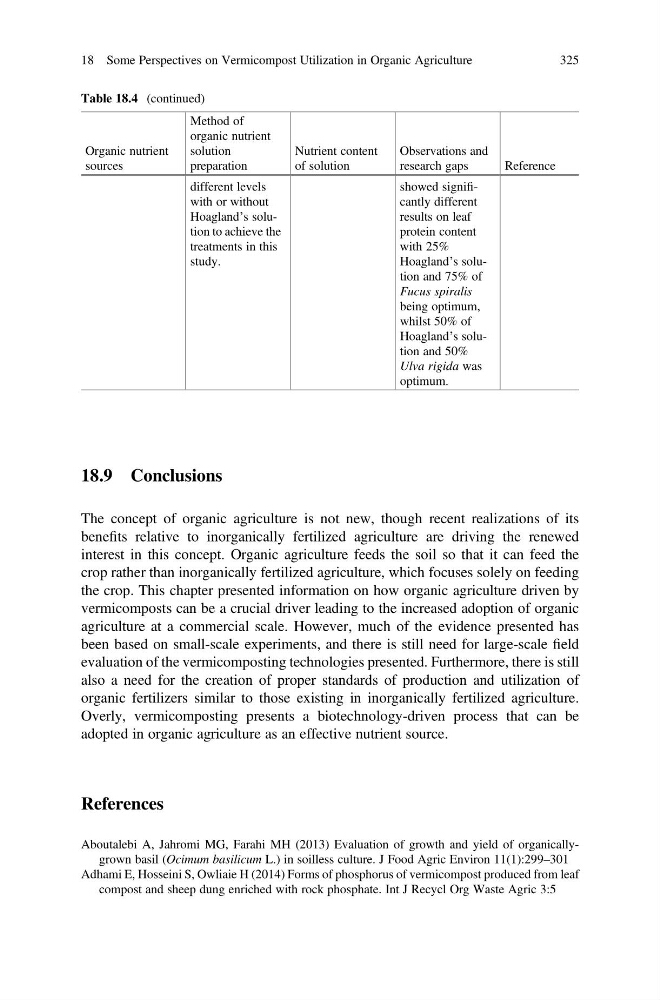
Table 18.4 (continued)
Organic nutrient
sources
Method of
organic nutrient
solution
preparation
Nutrient content
of solution
Observations and
research gaps
Reference
different levels
with or without
Hoagland’s solution to achieve the
treatments in this
study.
showed significantly different
results on leaf
protein content
with 25%
Hoagland’s solution and 75% of
Fucus spiralis
being optimum,
whilst 50% of
Hoagland’s solution and 50%
Ulva rigida was
optimum.
18 Some Perspectives on Vermicompost Utilization in Organic Agriculture
325
The concept of organic agriculture is not new, though recent realizations of its
benefits relative to inorganically fertilized agriculture are driving the renewed
interest in this concept. Organic agriculture feeds the soil so that it can feed the
crop rather than inorganically fertilized agriculture, which focuses solely on feeding
the crop. This chapter presented information on how organic agriculture driven by
vermicomposts can be a crucial driver leading to the increased adoption of organic
agriculture at a commercial scale. However, much of the evidence presented has
been based on small-scale experiments, and there is still need for large-scale field
evaluation of the vermicomposting technologies presented. Furthermore, there is still
also a need for the creation of proper standards of production and utilization of
organic fertilizers similar to those existing in inorganically fertilized agriculture.
Overly, vermicomposting presents a biotechnology-driven process that can be
adopted in organic agriculture as an effective nutrient source.
References
Aboutalebi A, Jahromi MG, Farahi MH (2013) Evaluation of growth and yield of organicallygrown basil (Ocimum basilicum L.) in soilless culture. J Food Agric Environ 11(1):299–301
Adhami E, Hosseini S, Owliaie H (2014) Forms of phosphorus of vermicompost produced from leaf
compost and sheep dung enriched with rock phosphate. Int J Recycl Org Waste Agric 3:5
Table 18.4 (continued)
Organic nutrient
sources
Method of
organic nutrient
solution
preparation
Nutrient content
of solution
Observations and
research gaps
Reference
different levels
with or without
Hoagland’s solution to achieve the
treatments in this
study.
showed significantly different
results on leaf
protein content
with 25%
Hoagland’s solution and 75% of
Fucus spiralis
being optimum,
whilst 50% of
Hoagland’s solution and 50%
Ulva rigida was
optimum.
18 Some Perspectives on Vermicompost Utilization in Organic Agriculture
325