

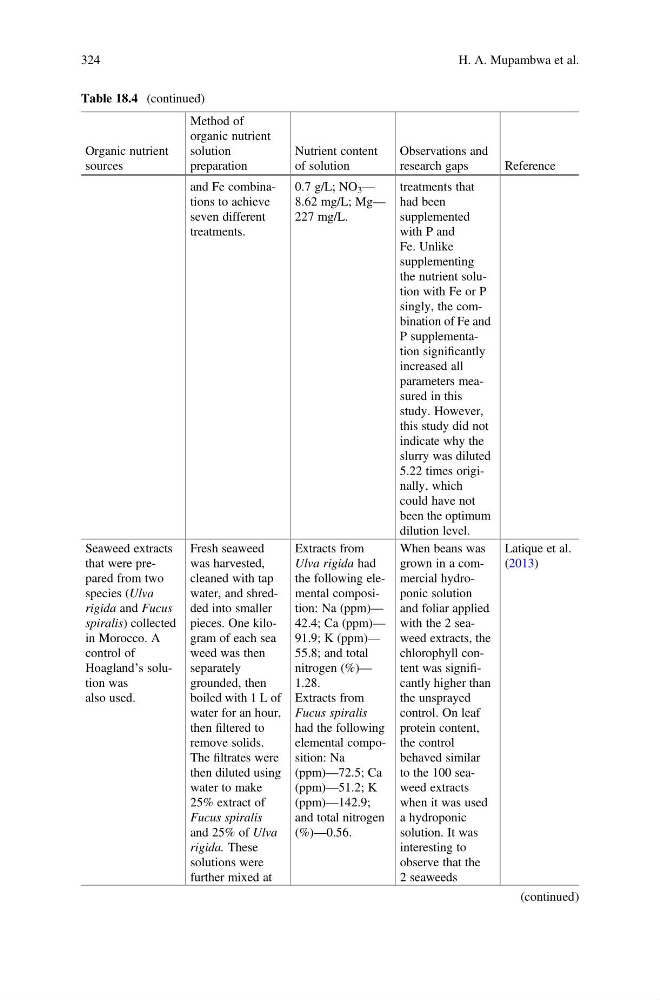
Table 18.4 (continued)
Organic nutrient
sources
Method of
organic nutrient
solution
preparation
Nutrient content
of solution
Observations and
research gaps
Reference
and Fe combinations to achieve
seven different
treatments.
0.7 g/L; NO 3 —
8.62 mg/L; Mg—
227 mg/L.
treatments that
had been
supplemented
with P and
Fe. Unlike
supplementing
the nutrient solution with Fe or P
singly, the combination of Fe and
P supplementation significantly
increased all
parameters measured in this
study. However,
this study did not
indicate why the
slurry was diluted
5.22 times originally, which
could have not
been the optimum
dilution level.
Seaweed extracts
that were prepared from two
species (Ulva
rigida and Fucus
spiralis) collected
in Morocco. A
control of
Hoagland’s solution was
also used.
Fresh seaweed
was harvested,
cleaned with tap
water, and shredded into smaller
pieces. One kilogram of each sea
weed was then
separately
grounded, then
boiled with 1 L of
water for an hour,
then filtered to
remove solids.
The filtrates were
then diluted using
water to make
25% extract of
Fucus spiralis
and 25% of Ulva
rigida. These
solutions were
further mixed at
Extracts from
Ulva rigida had
the following elemental composition: Na (ppm)—
42.4; Ca (ppm)—
91.9; K (ppm)—
55.8; and total
nitrogen (%)—
1.28.
Extracts from
Fucus spiralis
had the following
elemental composition: Na
(ppm)—72.5; Ca
(ppm)—51.2; K
(ppm)—142.9;
and total nitrogen
(%)—0.56.
When beans was
grown in a commercial hydroponic solution
and foliar applied
with the 2 seaweed extracts, the
chlorophyll content was significantly higher than
the unsprayed
control. On leaf
protein content,
the control
behaved similar
to the 100 seaweed extracts
when it was used
a hydroponic
solution. It was
interesting to
observe that the
2 seaweeds
Latique et al.
(2013)
(continued)
324
H. A. Mupambwa et al.
Organic nutrient
sources
Method of
organic nutrient
solution
preparation
Nutrient content
of solution
Observations and
research gaps
Reference
and Fe combinations to achieve
seven different
treatments.
0.7 g/L; NO 3 —
8.62 mg/L; Mg—
227 mg/L.
treatments that
had been
supplemented
with P and
Fe. Unlike
supplementing
the nutrient solution with Fe or P
singly, the combination of Fe and
P supplementation significantly
increased all
parameters measured in this
study. However,
this study did not
indicate why the
slurry was diluted
5.22 times originally, which
could have not
been the optimum
dilution level.
Seaweed extracts
that were prepared from two
species (Ulva
rigida and Fucus
spiralis) collected
in Morocco. A
control of
Hoagland’s solution was
also used.
Fresh seaweed
was harvested,
cleaned with tap
water, and shredded into smaller
pieces. One kilogram of each sea
weed was then
separately
grounded, then
boiled with 1 L of
water for an hour,
then filtered to
remove solids.
The filtrates were
then diluted using
water to make
25% extract of
Fucus spiralis
and 25% of Ulva
rigida. These
solutions were
further mixed at
Extracts from
Ulva rigida had
the following elemental composition: Na (ppm)—
42.4; Ca (ppm)—
91.9; K (ppm)—
55.8; and total
nitrogen (%)—
1.28.
Extracts from
Fucus spiralis
had the following
elemental composition: Na
(ppm)—72.5; Ca
(ppm)—51.2; K
(ppm)—142.9;
and total nitrogen
(%)—0.56.
When beans was
grown in a commercial hydroponic solution
and foliar applied
with the 2 seaweed extracts, the
chlorophyll content was significantly higher than
the unsprayed
control. On leaf
protein content,
the control
behaved similar
to the 100 seaweed extracts
when it was used
a hydroponic
solution. It was
interesting to
observe that the
2 seaweeds
Latique et al.
(2013)
(continued)
324
H. A. Mupambwa et al.