

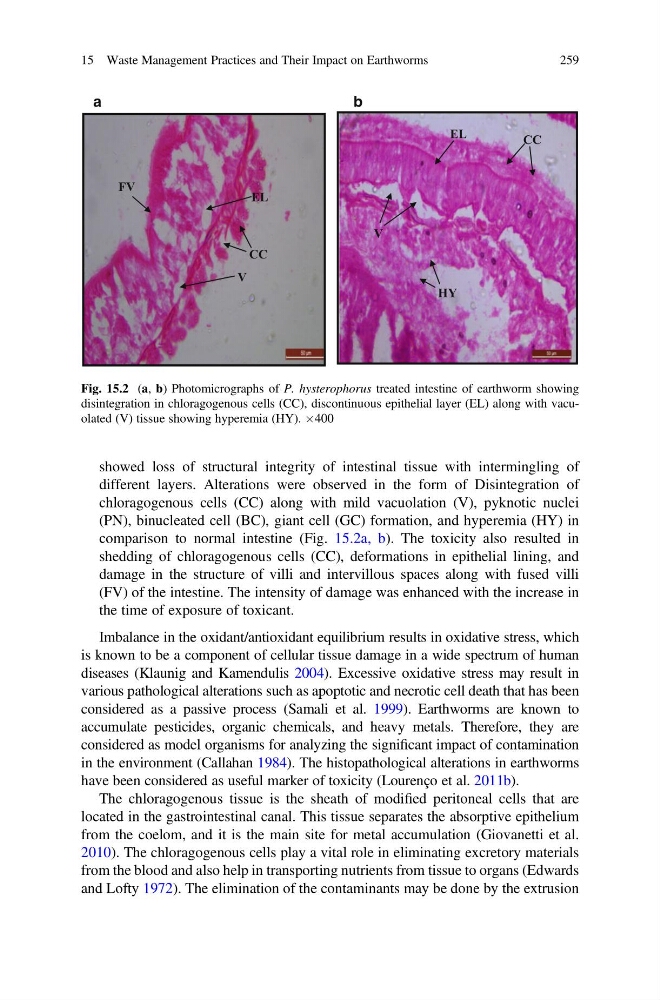
showed loss of structural integrity of intestinal tissue with intermingling of
different layers. Alterations were observed in the form of Disintegration of
chloragogenous cells (CC) along with mild vacuolation (V), pyknotic nuclei
(PN), binucleated cell (BC), giant cell (GC) formation, and hyperemia (HY) in
comparison to normal intestine (Fig. 15.2a, b). The toxicity also resulted in
shedding of chloragogenous cells (CC), deformations in epithelial lining, and
damage in the structure of villi and intervillous spaces along with fused villi
(FV) of the intestine. The intensity of damage was enhanced with the increase in
the time of exposure of toxicant.
Imbalance in the oxidant/antioxidant equilibrium results in oxidative stress, which
is known to be a component of cellular tissue damage in a wide spectrum of human
diseases (Klaunig and Kamendulis 2004). Excessive oxidative stress may result in
various pathological alterations such as apoptotic and necrotic cell death that has been
considered as a passive process (Samali et al. 1999). Earthworms are known to
accumulate pesticides, organic chemicals, and heavy metals. Therefore, they are
considered as model organisms for analyzing the significant impact of contamination
in the environment (Callahan 1984). The histopathological alterations in earthworms
have been considered as useful marker of toxicity (Lourenço et al. 2011b).
The chloragogenous tissue is the sheath of modified peritoneal cells that are
located in the gastrointestinal canal. This tissue separates the absorptive epithelium
from the coelom, and it is the main site for metal accumulation (Giovanetti et al.
2010). The chloragogenous cells play a vital role in eliminating excretory materials
from the blood and also help in transporting nutrients from tissue to organs (Edwards
and Lofty 1972). The elimination of the contaminants may be done by the extrusion
EL
CC
FV
V
a
b
EL
CC
HY
V
Fig. 15.2 (a, b) Photomicrographs of P. hysterophorus treated intestine of earthworm showing
disintegration in chloragogenous cells (CC), discontinuous epithelial layer (EL) along with vacuolated (V) tissue showing hyperemia (HY). Â400
15 Waste Management Practices and Their Impact on Earthworms
259
different layers. Alterations were observed in the form of Disintegration of
chloragogenous cells (CC) along with mild vacuolation (V), pyknotic nuclei
(PN), binucleated cell (BC), giant cell (GC) formation, and hyperemia (HY) in
comparison to normal intestine (Fig. 15.2a, b). The toxicity also resulted in
shedding of chloragogenous cells (CC), deformations in epithelial lining, and
damage in the structure of villi and intervillous spaces along with fused villi
(FV) of the intestine. The intensity of damage was enhanced with the increase in
the time of exposure of toxicant.
Imbalance in the oxidant/antioxidant equilibrium results in oxidative stress, which
is known to be a component of cellular tissue damage in a wide spectrum of human
diseases (Klaunig and Kamendulis 2004). Excessive oxidative stress may result in
various pathological alterations such as apoptotic and necrotic cell death that has been
considered as a passive process (Samali et al. 1999). Earthworms are known to
accumulate pesticides, organic chemicals, and heavy metals. Therefore, they are
considered as model organisms for analyzing the significant impact of contamination
in the environment (Callahan 1984). The histopathological alterations in earthworms
have been considered as useful marker of toxicity (Lourenço et al. 2011b).
The chloragogenous tissue is the sheath of modified peritoneal cells that are
located in the gastrointestinal canal. This tissue separates the absorptive epithelium
from the coelom, and it is the main site for metal accumulation (Giovanetti et al.
2010). The chloragogenous cells play a vital role in eliminating excretory materials
from the blood and also help in transporting nutrients from tissue to organs (Edwards
and Lofty 1972). The elimination of the contaminants may be done by the extrusion
EL
CC
FV
V
a
b
EL
CC
HY
V
Fig. 15.2 (a, b) Photomicrographs of P. hysterophorus treated intestine of earthworm showing
disintegration in chloragogenous cells (CC), discontinuous epithelial layer (EL) along with vacuolated (V) tissue showing hyperemia (HY). Â400
15 Waste Management Practices and Their Impact on Earthworms
259