

combat oxidative stress. The increased exposure time to toxicants may result in the
decline of enzyme activities in worms which may be due to exceedance of earthworm’s normal antioxidative capability, leading to a need for higher antioxidative
enzyme production (Yang et al. 2012). Ukpabi et al. (2013) determined that the
heavy metal toxicity also promoted the formation of reactive oxygen species, which
may cause severe damage and injury to the biological system.
During oxidative stress, an organism needs sufficient amount of energy which is
dispensed from reserve materials, such as glycogen, proteins, and lipids. In mild
stress conditions, glycogen is used as an energy source, while in high stress, the
energy stored in proteins and lipids may also be used by the organism (Mark 1961).
Histological changes: Histopathology signifies the damaging effects in organisms
resulting from the exposure to toxic substances. Histology is a significant tool for
analyzing the effect of organic wastes, agricultural pesticides, and industrial
pollutants on the organism at the tissue level by providing information regarding
the disorganization and damage of tissues (Kavitha and Anandhan 2018). These
changes were reported in the intestine of earthworm, when exposed to any
pollutant, organic and inorganic waste, as well as any other stress conditions.
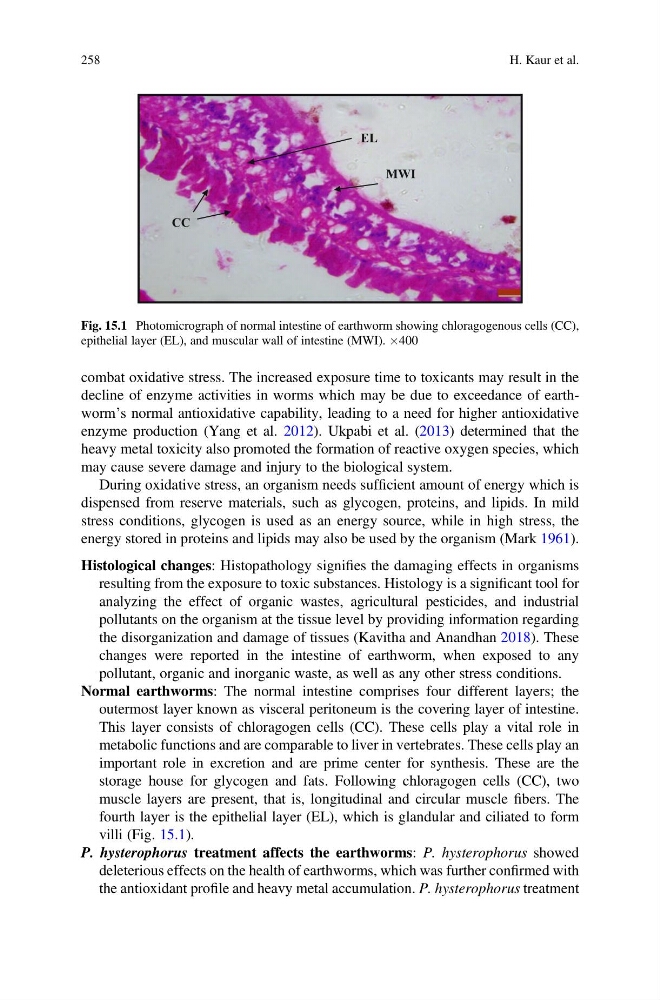
Normal earthworms: The normal intestine comprises four different layers; the
outermost layer known as visceral peritoneum is the covering layer of intestine.
This layer consists of chloragogen cells (CC). These cells play a vital role in
metabolic functions and are comparable to liver in vertebrates. These cells play an
important role in excretion and are prime center for synthesis. These are the
storage house for glycogen and fats. Following chloragogen cells (CC), two
muscle layers are present, that is, longitudinal and circular muscle fibers. The
fourth layer is the epithelial layer (EL), which is glandular and ciliated to form
villi (Fig. 15.1).
P. hysterophorus treatment affects the earthworms: P. hysterophorus showed
deleterious effects on the health of earthworms, which was further confirmed with
the antioxidant profile and heavy metal accumulation. P. hysterophorus treatment
CC
MWI
EL
Fig. 15.1 Photomicrograph of normal intestine of earthworm showing chloragogenous cells (CC),
epithelial layer (EL), and muscular wall of intestine (MWI). Â400
258
H. Kaur et al.
decline of enzyme activities in worms which may be due to exceedance of earthworm’s normal antioxidative capability, leading to a need for higher antioxidative
enzyme production (Yang et al. 2012). Ukpabi et al. (2013) determined that the
heavy metal toxicity also promoted the formation of reactive oxygen species, which
may cause severe damage and injury to the biological system.
During oxidative stress, an organism needs sufficient amount of energy which is
dispensed from reserve materials, such as glycogen, proteins, and lipids. In mild
stress conditions, glycogen is used as an energy source, while in high stress, the
energy stored in proteins and lipids may also be used by the organism (Mark 1961).
Histological changes: Histopathology signifies the damaging effects in organisms
resulting from the exposure to toxic substances. Histology is a significant tool for
analyzing the effect of organic wastes, agricultural pesticides, and industrial
pollutants on the organism at the tissue level by providing information regarding
the disorganization and damage of tissues (Kavitha and Anandhan 2018). These
changes were reported in the intestine of earthworm, when exposed to any
pollutant, organic and inorganic waste, as well as any other stress conditions.
Normal earthworms: The normal intestine comprises four different layers; the
outermost layer known as visceral peritoneum is the covering layer of intestine.
This layer consists of chloragogen cells (CC). These cells play a vital role in
metabolic functions and are comparable to liver in vertebrates. These cells play an
important role in excretion and are prime center for synthesis. These are the
storage house for glycogen and fats. Following chloragogen cells (CC), two
muscle layers are present, that is, longitudinal and circular muscle fibers. The
fourth layer is the epithelial layer (EL), which is glandular and ciliated to form
villi (Fig. 15.1).
P. hysterophorus treatment affects the earthworms: P. hysterophorus showed
deleterious effects on the health of earthworms, which was further confirmed with
the antioxidant profile and heavy metal accumulation. P. hysterophorus treatment
CC
MWI
EL
Fig. 15.1 Photomicrograph of normal intestine of earthworm showing chloragogenous cells (CC),
epithelial layer (EL), and muscular wall of intestine (MWI). Â400
258
H. Kaur et al.