

increased total KSB population in the midgut and lower intestine of E. eugeniae by
45.53% and 87.48%, respectively.
This study indicated that KSB present in the gut of earthworms possibly played a
major role in solubilizing bound K compounds and that in turn increased waterextractable K and exchangeable K in organic substrates during vermicomposting.
The presence of KSB was detected in organic substrates during vermicomposting.
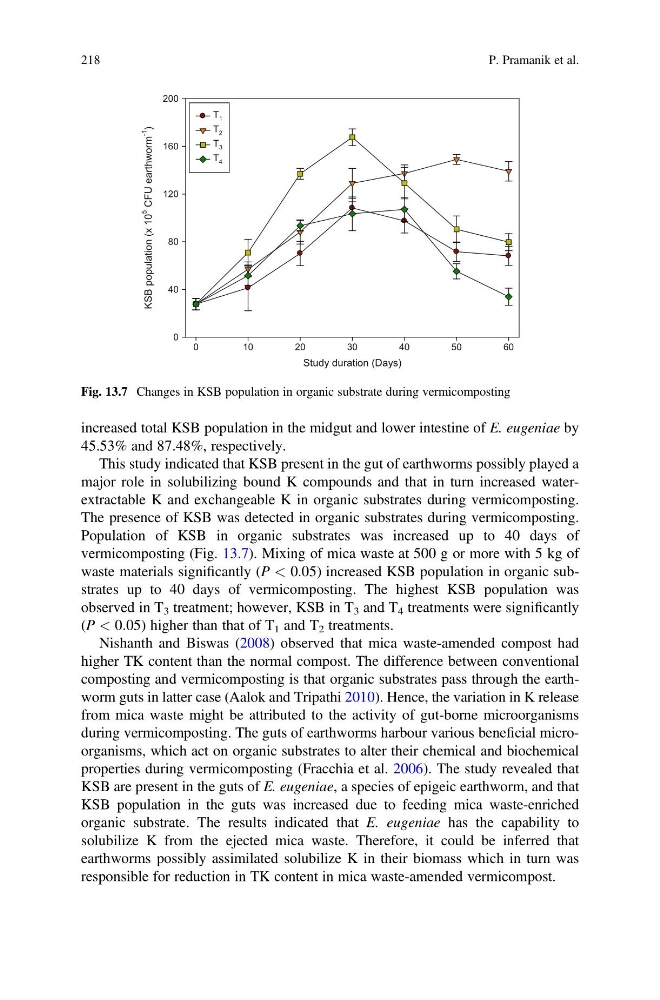
Population of KSB in organic substrates was increased up to 40 days of
vermicomposting (Fig. 13.7). Mixing of mica waste at 500 g or more with 5 kg of
waste materials significantly (P < 0.05) increased KSB population in organic substrates up to 40 days of vermicomposting. The highest KSB population was
observed in T 3 treatment; however, KSB in T 3 and T 4 treatments were significantly
(P < 0.05) higher than that of T 1 and T 2 treatments.
Nishanth and Biswas (2008) observed that mica waste-amended compost had
higher TK content than the normal compost. The difference between conventional
composting and vermicomposting is that organic substrates pass through the earthworm guts in latter case (Aalok and Tripathi 2010). Hence, the variation in K release
from mica waste might be attributed to the activity of gut-borne microorganisms
during vermicomposting. The guts of earthworms harbour various beneficial microorganisms, which act on organic substrates to alter their chemical and biochemical
properties during vermicomposting (Fracchia et al. 2006). The study revealed that
KSB are present in the guts of E. eugeniae, a species of epigeic earthworm, and that
KSB population in the guts was increased due to feeding mica waste-enriched
organic substrate. The results indicated that E. eugeniae has the capability to
solubilize K from the ejected mica waste. Therefore, it could be inferred that
earthworms possibly assimilated solubilize K in their biomass which in turn was
responsible for reduction in TK content in mica waste-amended vermicompost.
Study duration (Days)
0
1 0
2 0
3 0
4 0
5 0
6 0
KSB population (x 10
5
CFU earthworm
-1
)
0
40
80
120
160
200
T 1
T 2
T 3
T 4
Fig. 13.7 Changes in KSB population in organic substrate during vermicomposting
218
P. Pramanik et al.
45.53% and 87.48%, respectively.
This study indicated that KSB present in the gut of earthworms possibly played a
major role in solubilizing bound K compounds and that in turn increased waterextractable K and exchangeable K in organic substrates during vermicomposting.
The presence of KSB was detected in organic substrates during vermicomposting.
Population of KSB in organic substrates was increased up to 40 days of
vermicomposting (Fig. 13.7). Mixing of mica waste at 500 g or more with 5 kg of
waste materials significantly (P < 0.05) increased KSB population in organic substrates up to 40 days of vermicomposting. The highest KSB population was
observed in T 3 treatment; however, KSB in T 3 and T 4 treatments were significantly
(P < 0.05) higher than that of T 1 and T 2 treatments.
Nishanth and Biswas (2008) observed that mica waste-amended compost had
higher TK content than the normal compost. The difference between conventional
composting and vermicomposting is that organic substrates pass through the earthworm guts in latter case (Aalok and Tripathi 2010). Hence, the variation in K release
from mica waste might be attributed to the activity of gut-borne microorganisms
during vermicomposting. The guts of earthworms harbour various beneficial microorganisms, which act on organic substrates to alter their chemical and biochemical
properties during vermicomposting (Fracchia et al. 2006). The study revealed that
KSB are present in the guts of E. eugeniae, a species of epigeic earthworm, and that
KSB population in the guts was increased due to feeding mica waste-enriched
organic substrate. The results indicated that E. eugeniae has the capability to
solubilize K from the ejected mica waste. Therefore, it could be inferred that
earthworms possibly assimilated solubilize K in their biomass which in turn was
responsible for reduction in TK content in mica waste-amended vermicompost.
Study duration (Days)
0
1 0
2 0
3 0
4 0
5 0
6 0
KSB population (x 10
5
CFU earthworm
-1
)
0
40
80
120
160
200
T 1
T 2
T 3
T 4
Fig. 13.7 Changes in KSB population in organic substrate during vermicomposting
218
P. Pramanik et al.