

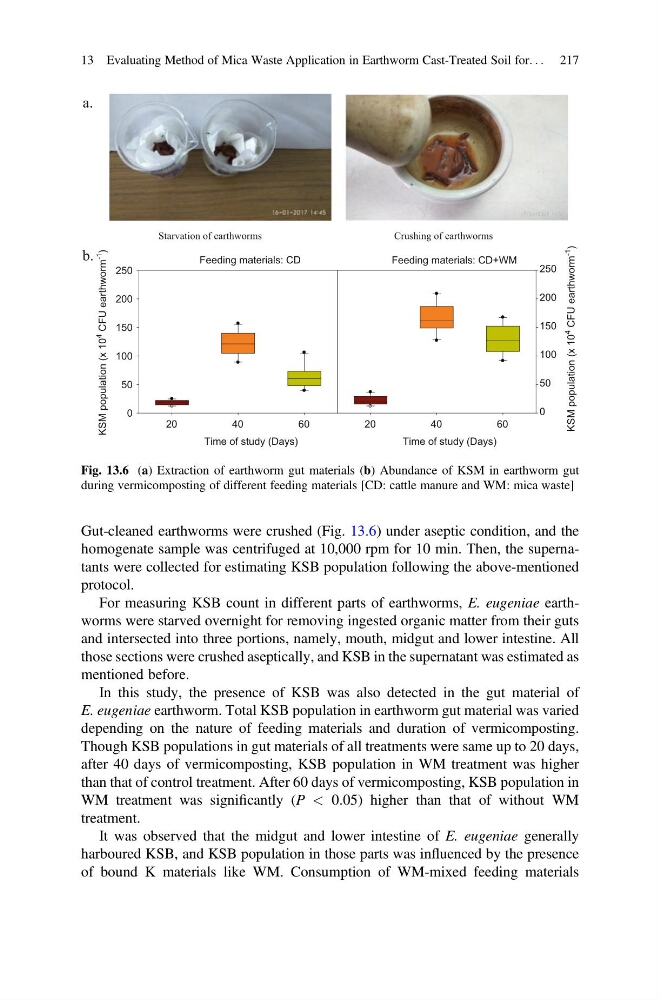
Gut-cleaned earthworms were crushed (Fig. 13.6) under aseptic condition, and the
homogenate sample was centrifuged at 10,000 rpm for 10 min. Then, the supernatants were collected for estimating KSB population following the above-mentioned
protocol.
For measuring KSB count in different parts of earthworms, E. eugeniae earthworms were starved overnight for removing ingested organic matter from their guts
and intersected into three portions, namely, mouth, midgut and lower intestine. All
those sections were crushed aseptically, and KSB in the supernatant was estimated as
mentioned before.
In this study, the presence of KSB was also detected in the gut material of
E. eugeniae earthworm. Total KSB population in earthworm gut material was varied
depending on the nature of feeding materials and duration of vermicomposting.
Though KSB populations in gut materials of all treatments were same up to 20 days,
after 40 days of vermicomposting, KSB population in WM treatment was higher
than that of control treatment. After 60 days of vermicomposting, KSB population in
WM treatment was significantly (P < 0.05) higher than that of without WM
treatment.
It was observed that the midgut and lower intestine of E. eugeniae generally
harboured KSB, and KSB population in those parts was influenced by the presence
of bound K materials like WM. Consumption of WM-mixed feeding materials
a.
Starvation of earthworms
Crushing of earthworms
b.
Feeding materials: CD
Time of study (Days)
20
40
60
KSM population (x 10
4
CFU earthworm
-1
)
0
50
100
150
200
250
Time of study (Days)
20
40
60
KSM population (x 10
4
CFU earthworm
-1
)
0
50
100
150
200
250
Feeding materials: CD+WM
Fig. 13.6 (a) Extraction of earthworm gut materials (b) Abundance of KSM in earthworm gut
during vermicomposting of different feeding materials [CD: cattle manure and WM: mica waste]
13 Evaluating Method of Mica Waste Application in Earthworm Cast-Treated Soil for. . . 217
homogenate sample was centrifuged at 10,000 rpm for 10 min. Then, the supernatants were collected for estimating KSB population following the above-mentioned
protocol.
For measuring KSB count in different parts of earthworms, E. eugeniae earthworms were starved overnight for removing ingested organic matter from their guts
and intersected into three portions, namely, mouth, midgut and lower intestine. All
those sections were crushed aseptically, and KSB in the supernatant was estimated as
mentioned before.
In this study, the presence of KSB was also detected in the gut material of
E. eugeniae earthworm. Total KSB population in earthworm gut material was varied
depending on the nature of feeding materials and duration of vermicomposting.
Though KSB populations in gut materials of all treatments were same up to 20 days,
after 40 days of vermicomposting, KSB population in WM treatment was higher
than that of control treatment. After 60 days of vermicomposting, KSB population in
WM treatment was significantly (P < 0.05) higher than that of without WM
treatment.
It was observed that the midgut and lower intestine of E. eugeniae generally
harboured KSB, and KSB population in those parts was influenced by the presence
of bound K materials like WM. Consumption of WM-mixed feeding materials
a.
Starvation of earthworms
Crushing of earthworms
b.
Feeding materials: CD
Time of study (Days)
20
40
60
KSM population (x 10
4
CFU earthworm
-1
)
0
50
100
150
200
250
Time of study (Days)
20
40
60
KSM population (x 10
4
CFU earthworm
-1
)
0
50
100
150
200
250
Feeding materials: CD+WM
Fig. 13.6 (a) Extraction of earthworm gut materials (b) Abundance of KSM in earthworm gut
during vermicomposting of different feeding materials [CD: cattle manure and WM: mica waste]
13 Evaluating Method of Mica Waste Application in Earthworm Cast-Treated Soil for. . . 217