

well as in the enhancement of decomposition process. Waste water generated from
this process is mixed with small amount of fresh water and thus enhancement of
water conservation is promoted.
10.8 Vermicompost and its Application in Farming
With the expansion in globalization and per capita income rate, it is hard to meet the
needs of humankind using limited assets explicitly in tropical nations where the soils
are poor in organic content owing to high temperature and huge microbial invasions.
In such context, vermitechnology seems, by all accounts, to be a suitable biotechnological tool as a provider for the essential measure of macronutrients such as C, N,
P, K and so on (Zhang et al. 2000). Application of vermicompost increases not only
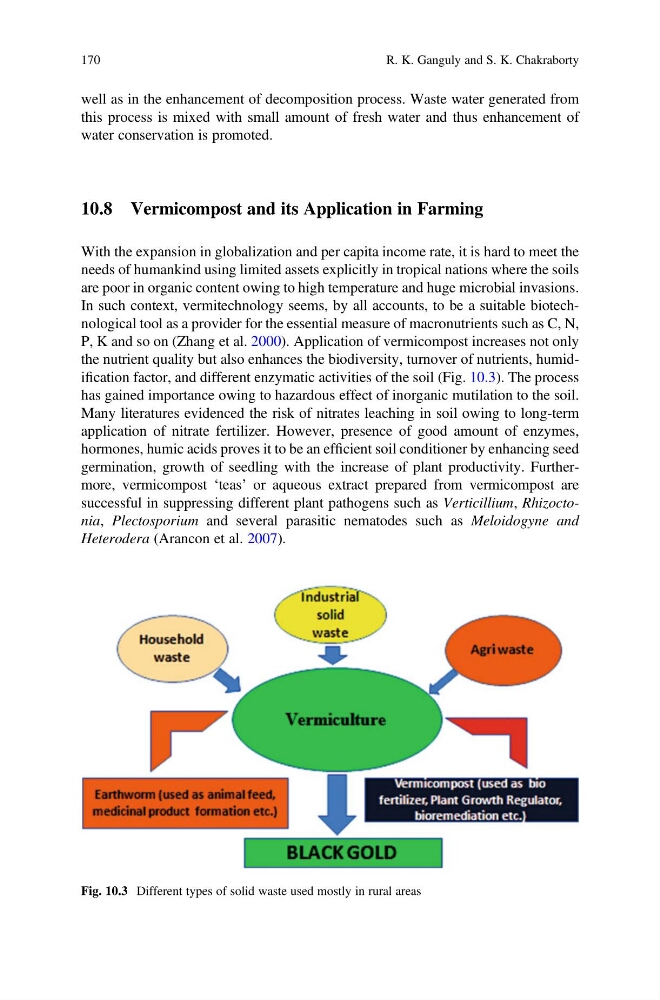
the nutrient quality but also enhances the biodiversity, turnover of nutrients, humidification factor, and different enzymatic activities of the soil (Fig. 10.3). The process
has gained importance owing to hazardous effect of inorganic mutilation to the soil.
Many literatures evidenced the risk of nitrates leaching in soil owing to long-term
application of nitrate fertilizer. However, presence of good amount of enzymes,
hormones, humic acids proves it to be an efficient soil conditioner by enhancing seed
germination, growth of seedling with the increase of plant productivity. Furthermore, vermicompost ‘teas’ or aqueous extract prepared from vermicompost are
successful in suppressing different plant pathogens such as Verticillium, Rhizoctonia, Plectosporium and several parasitic nematodes such as Meloidogyne and
Heterodera (Arancon et al. 2007).
Fig. 10.3 Different types of solid waste used mostly in rural areas
170
R. K. Ganguly and S. K. Chakraborty
this process is mixed with small amount of fresh water and thus enhancement of
water conservation is promoted.
10.8 Vermicompost and its Application in Farming
With the expansion in globalization and per capita income rate, it is hard to meet the
needs of humankind using limited assets explicitly in tropical nations where the soils
are poor in organic content owing to high temperature and huge microbial invasions.
In such context, vermitechnology seems, by all accounts, to be a suitable biotechnological tool as a provider for the essential measure of macronutrients such as C, N,
P, K and so on (Zhang et al. 2000). Application of vermicompost increases not only
the nutrient quality but also enhances the biodiversity, turnover of nutrients, humidification factor, and different enzymatic activities of the soil (Fig. 10.3). The process
has gained importance owing to hazardous effect of inorganic mutilation to the soil.
Many literatures evidenced the risk of nitrates leaching in soil owing to long-term
application of nitrate fertilizer. However, presence of good amount of enzymes,
hormones, humic acids proves it to be an efficient soil conditioner by enhancing seed
germination, growth of seedling with the increase of plant productivity. Furthermore, vermicompost ‘teas’ or aqueous extract prepared from vermicompost are
successful in suppressing different plant pathogens such as Verticillium, Rhizoctonia, Plectosporium and several parasitic nematodes such as Meloidogyne and
Heterodera (Arancon et al. 2007).
Fig. 10.3 Different types of solid waste used mostly in rural areas
170
R. K. Ganguly and S. K. Chakraborty