

75
methane using a precision high-pressure syringe pump. The pressure is maintained
at 15.1 MPa over a couple of days, and the amount of dissolved gas is monitored.
Once the saturation is complete, a single oil droplet is transferred into the countercurrent flow cell via the capillary. The subsequent execution of the experiment and
the data acquisition and evaluation are identical to that of the dead oil droplet treatment. Different decompression rates and temperatures can be adjusted. The
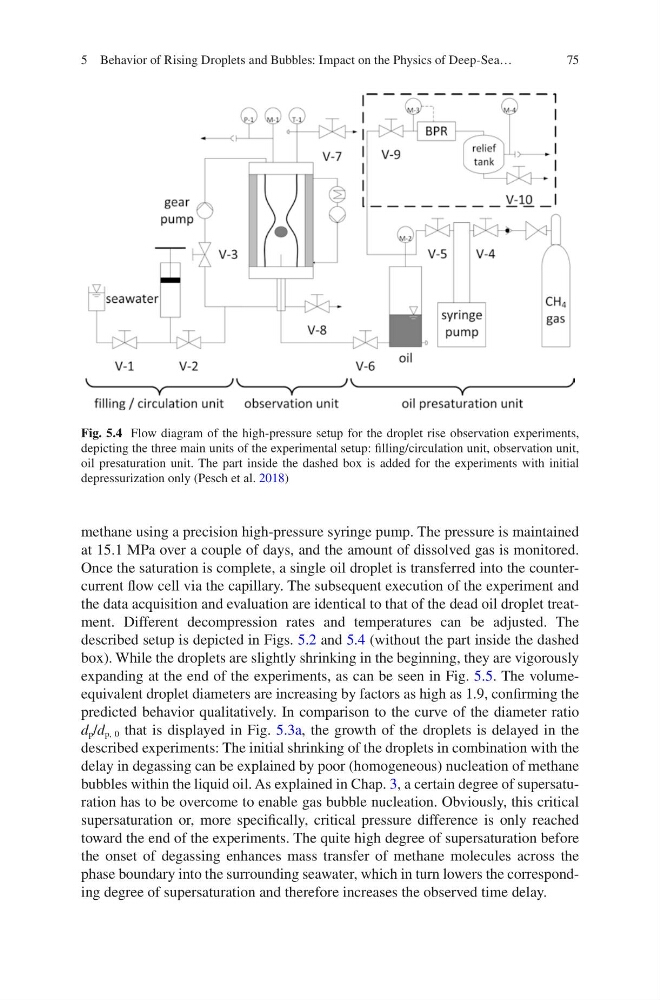
described setup is depicted in Figs. 5.2 and 5.4 (without the part inside the dashed
box). While the droplets are slightly shrinking in the beginning, they are vigorously
expanding at the end of the experiments, as can be seen in Fig. 5.5. The volumeequivalent droplet diameters are increasing by factors as high as 1.9, confirming the
predicted behavior qualitatively. In comparison to the curve of the diameter ratio
d p /d p, 0 that is displayed in Fig. 5.3a, the growth of the droplets is delayed in the
described experiments: The initial shrinking of the droplets in combination with the
delay in degassing can be explained by poor (homogeneous) nucleation of methane
bubbles within the liquid oil. As explained in Chap. 3, a certain degree of supersaturation has to be overcome to enable gas bubble nucleation. Obviously, this critical
supersaturation or, more specifically, critical pressure difference is only reached
toward the end of the experiments. The quite high degree of supersaturation before
the onset of degassing enhances mass transfer of methane molecules across the
phase boundary into the surrounding seawater, which in turn lowers the corresponding degree of supersaturation and therefore increases the observed time delay.
Fig. 5.4 Flow diagram of the high-pressure setup for the droplet rise observation experiments,
depicting the three main units of the experimental setup: filling/circulation unit, observation unit,
oil presaturation unit. The part inside the dashed box is added for the experiments with initial
depressurization only (Pesch et al. 2018)
5 Behavior of Rising Droplets and Bubbles: Impact on the Physics of Deep-Sea…
methane using a precision high-pressure syringe pump. The pressure is maintained
at 15.1 MPa over a couple of days, and the amount of dissolved gas is monitored.
Once the saturation is complete, a single oil droplet is transferred into the countercurrent flow cell via the capillary. The subsequent execution of the experiment and
the data acquisition and evaluation are identical to that of the dead oil droplet treatment. Different decompression rates and temperatures can be adjusted. The
described setup is depicted in Figs. 5.2 and 5.4 (without the part inside the dashed
box). While the droplets are slightly shrinking in the beginning, they are vigorously
expanding at the end of the experiments, as can be seen in Fig. 5.5. The volumeequivalent droplet diameters are increasing by factors as high as 1.9, confirming the
predicted behavior qualitatively. In comparison to the curve of the diameter ratio
d p /d p, 0 that is displayed in Fig. 5.3a, the growth of the droplets is delayed in the
described experiments: The initial shrinking of the droplets in combination with the
delay in degassing can be explained by poor (homogeneous) nucleation of methane
bubbles within the liquid oil. As explained in Chap. 3, a certain degree of supersaturation has to be overcome to enable gas bubble nucleation. Obviously, this critical
supersaturation or, more specifically, critical pressure difference is only reached
toward the end of the experiments. The quite high degree of supersaturation before
the onset of degassing enhances mass transfer of methane molecules across the
phase boundary into the surrounding seawater, which in turn lowers the corresponding degree of supersaturation and therefore increases the observed time delay.
Fig. 5.4 Flow diagram of the high-pressure setup for the droplet rise observation experiments,
depicting the three main units of the experimental setup: filling/circulation unit, observation unit,
oil presaturation unit. The part inside the dashed box is added for the experiments with initial
depressurization only (Pesch et al. 2018)
5 Behavior of Rising Droplets and Bubbles: Impact on the Physics of Deep-Sea…