

61
A new approach to predict the median drop diameter based on the turbulent energy
dissipation rate was presented in this chapter. To be able to generalize this approach,
further studies across multiple mixing geometries, DORs and gas/oil properties are
required.
Recent studies at artificial deep-sea conditions at Hamburg University of
Technology showed a significant influence of dissolved gases and outgassing on the
drop size distribution. In a first attempt, these influences could be modelled with
good accuracy using the turbulent energy dissipation rate. Especially the outgassing
of short-chained hydrocarbons from the oil might lead to a significant decrease in
the median drop diameter, as oil drops are broken up by expanding gas bubbles.
To be better prepared for a possible future spill in the deep-sea, it is necessary to
investigate the high-pressure, multiphase plume near the exit at a more detailed
level and at a larger scale than heretofore. Only by a thorough understanding of the
drop formation processes and turbulent conditions in this multiphase plume is it
possible to find a knowledge-based mitigation strategy, which might or might not
include subsea dispersant injection.
Acknowledgments This research was made possible by a from the Gulf of Mexico Research
Initiative/C-IMAGE. Data are publicly available through the Gulf of Mexico Research Initiative
Information and Data Cooperative (GRIIDC) at https://data.gulfresearchinitiative.org/ (DOIs:
10.7266/n7-jjqd-pa77, 10.7266/n7-eha7-tv03, 10.7266/N7V69H19, 10.7266/N77D2SM2).
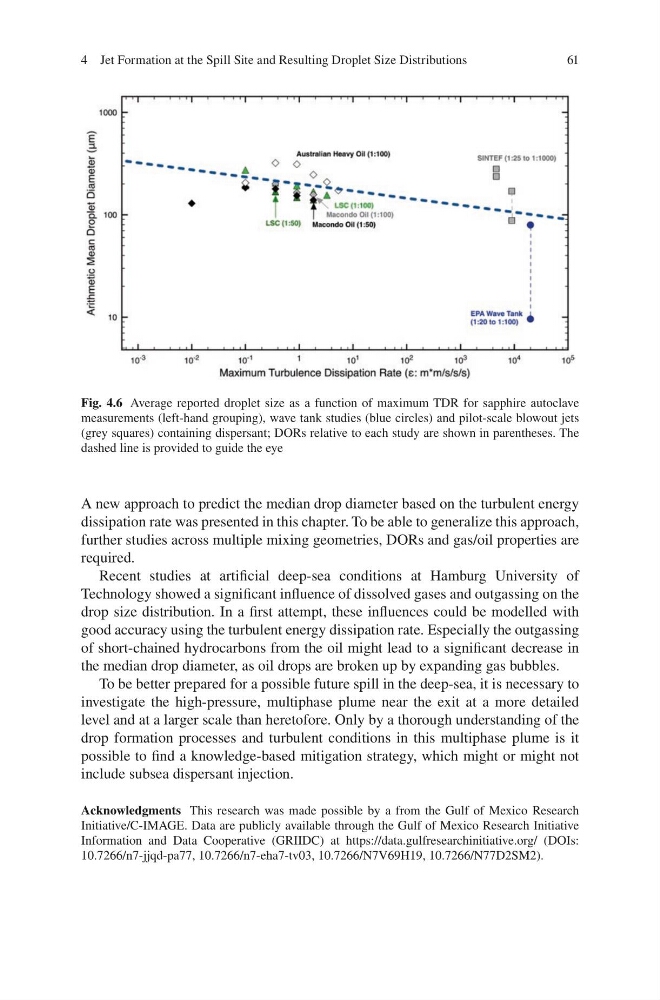
Fig. 4.6 Average reported droplet size as a function of maximum TDR for sapphire autoclave
measurements (left-hand grouping), wave tank studies (blue circles) and pilot-scale blowout jets
(grey squares) containing dispersant; DORs relative to each study are shown in parentheses. The
dashed line is provided to guide the eye
4 Jet Formation at the Spill Site and Resulting Droplet Size Distributions
A new approach to predict the median drop diameter based on the turbulent energy
dissipation rate was presented in this chapter. To be able to generalize this approach,
further studies across multiple mixing geometries, DORs and gas/oil properties are
required.
Recent studies at artificial deep-sea conditions at Hamburg University of
Technology showed a significant influence of dissolved gases and outgassing on the
drop size distribution. In a first attempt, these influences could be modelled with
good accuracy using the turbulent energy dissipation rate. Especially the outgassing
of short-chained hydrocarbons from the oil might lead to a significant decrease in
the median drop diameter, as oil drops are broken up by expanding gas bubbles.
To be better prepared for a possible future spill in the deep-sea, it is necessary to
investigate the high-pressure, multiphase plume near the exit at a more detailed
level and at a larger scale than heretofore. Only by a thorough understanding of the
drop formation processes and turbulent conditions in this multiphase plume is it
possible to find a knowledge-based mitigation strategy, which might or might not
include subsea dispersant injection.
Acknowledgments This research was made possible by a from the Gulf of Mexico Research
Initiative/C-IMAGE. Data are publicly available through the Gulf of Mexico Research Initiative
Information and Data Cooperative (GRIIDC) at https://data.gulfresearchinitiative.org/ (DOIs:
10.7266/n7-jjqd-pa77, 10.7266/n7-eha7-tv03, 10.7266/N7V69H19, 10.7266/N77D2SM2).
Fig. 4.6 Average reported droplet size as a function of maximum TDR for sapphire autoclave
measurements (left-hand grouping), wave tank studies (blue circles) and pilot-scale blowout jets
(grey squares) containing dispersant; DORs relative to each study are shown in parentheses. The
dashed line is provided to guide the eye
4 Jet Formation at the Spill Site and Resulting Droplet Size Distributions