

60
4.5 Capabilities and Limits of Subsea Dispersant Injection
The above-referenced autoclave and pilot-scale jet studies have also considered the
effect of dispersant injection, typically at dispersant-to-oil ratios of between 1:100
and 1:20. Interestingly, the results demonstrate minimal dependence between the
reported average droplet size and the maximum TDR in any system, including wave
tank studies from the EPA (Fig. 4.6). Within the context of the estimated TDR contributions for Macondo, the data show that oil droplet sizes are similar with and
without dispersant application. Further studies across multiple mixing geometries,
DORs and gas/oil properties are required to fully contextualize the critical TDR
range under which dispersant application may benefit droplet size.
4.6 Conclusions and Outlooks
The determination of the initial size distribution of oil drops and gas bubbles is still
a major challenge in modelling of deep-sea oil spills.
The state-of-the-art knowledge on drop formation is mainly based on small-scale
lab experiments of liquid-liquid jets at ambient conditions. For a better understanding of future oil spills, investigations at deep-sea conditions as well as in situ
measurements with capable equipment are critical. Despite numerous attempts, a
reliable translation of laboratory or pilot-scale experiments to the field conditions
including a turbulent, multiphase plume remains an outstanding research objective.
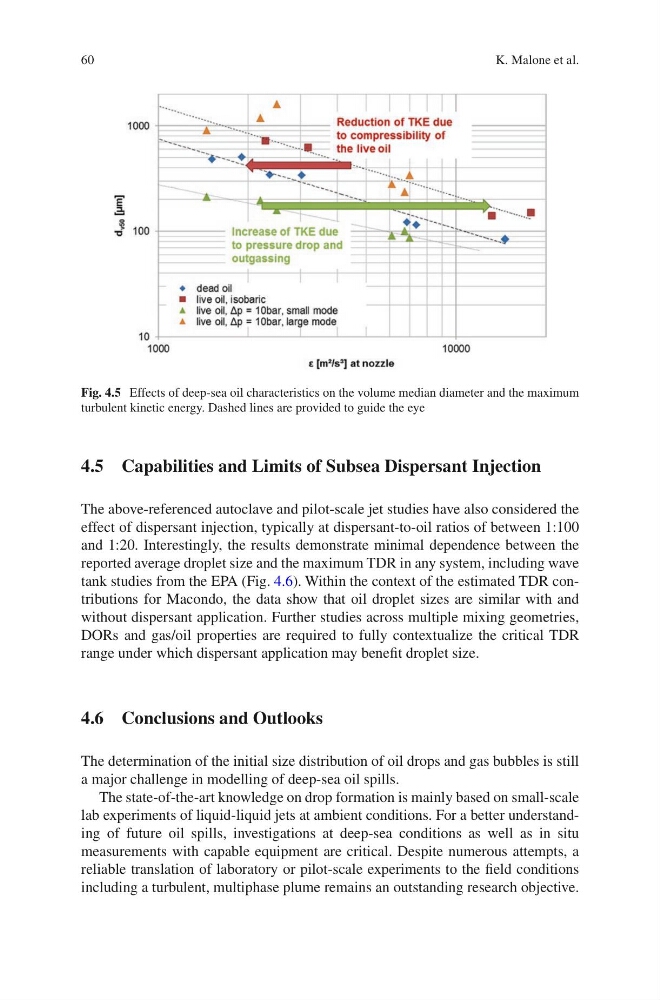
Fig. 4.5 Effects of deep-sea oil characteristics on the volume median diameter and the maximum
turbulent kinetic energy. Dashed lines are provided to guide the eye
K. Malone et al.
4.5 Capabilities and Limits of Subsea Dispersant Injection
The above-referenced autoclave and pilot-scale jet studies have also considered the
effect of dispersant injection, typically at dispersant-to-oil ratios of between 1:100
and 1:20. Interestingly, the results demonstrate minimal dependence between the
reported average droplet size and the maximum TDR in any system, including wave
tank studies from the EPA (Fig. 4.6). Within the context of the estimated TDR contributions for Macondo, the data show that oil droplet sizes are similar with and
without dispersant application. Further studies across multiple mixing geometries,
DORs and gas/oil properties are required to fully contextualize the critical TDR
range under which dispersant application may benefit droplet size.
4.6 Conclusions and Outlooks
The determination of the initial size distribution of oil drops and gas bubbles is still
a major challenge in modelling of deep-sea oil spills.
The state-of-the-art knowledge on drop formation is mainly based on small-scale
lab experiments of liquid-liquid jets at ambient conditions. For a better understanding of future oil spills, investigations at deep-sea conditions as well as in situ
measurements with capable equipment are critical. Despite numerous attempts, a
reliable translation of laboratory or pilot-scale experiments to the field conditions
including a turbulent, multiphase plume remains an outstanding research objective.
Fig. 4.5 Effects of deep-sea oil characteristics on the volume median diameter and the maximum
turbulent kinetic energy. Dashed lines are provided to guide the eye
K. Malone et al.