

563
turbulent flow of oil is consistent with the overall lesser impact on sedentary reefassociated and demersal guilds that Ixtoc 1 had compared to DWH as predicted by
Atlantis. In this case, the narrow shelf in the southwestern and western Gulf would
not have allowed any significant gradient in oil concentration to establish perpendicular to shore. Our estimates of Ixtoc 1 oil distribution based on satellite images
most likely underestimated the amount of oil that reached inshore juvenile habitat.
Although up to 6.3% of Ixtoc 1 oil ended up on beaches (Jernelöv and Lindén
1981), it did not reach Laguna de Términos (PCEESC 1980), which is an important
nursery ground in the southwestern Gulf. Thus, an alternative explanation as to why
Ixtoc 1 had less of an effect on young fish compared to DWH may therefore be that
Ixtoc 1 contaminated less the productive inshore habitats. This seems likely considering the well-documented oil intrusion on highly productive coastal wetlands of
Louisiana and Mississippi: areas critical to the production of juvenile fish (Nixon
et al. 2016).
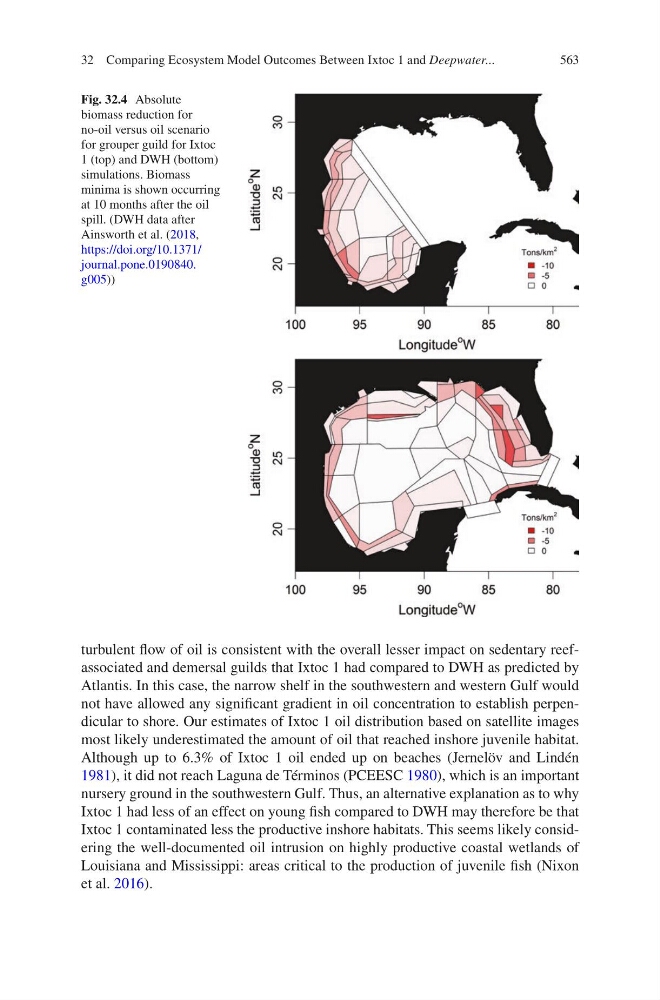
Fig. 32.4 Absolute
biomass reduction for
no-oil versus oil scenario
for grouper guild for Ixtoc
1 (top) and DWH (bottom)
simulations. Biomass
minima is shown occurring
at 10 months after the oil
spill. (DWH data after
Ainsworth et al. (2018,
https://doi.org/10.1371/
journal.pone.0190840.
g005))
32 Comparing Ecosystem Model Outcomes Between Ixtoc 1 and Deepwater...