

561
32.4.1 Difference in Impact on Juveniles and Adults
In contrast to results from the Ixtoc 1 simulations, Ainsworth et al. (2018) detected
a large shift in the age composition of most reef and demersal guilds suggesting that
young fish (juvenile and subadults) were impacted more heavily than older fish by
the DWH spill. In their study, young fish were not represented as being any more
vulnerable physiologically to oil than older fish. Therefore, any differences must be
attributable to the degree of exposure, i.e., the relative overlap between the life
stages’ spatial distributions and the oil spills’ footprint (also potentially influenced
by the degree of association with sediment) (Ainsworth et al. 2018). The results of
our simulations suggest that Ixtoc 1 oil did not linger in inshore juvenile habitats
where it could have a cumulative effect with time but rather moved quickly throughout the system, exposing nearshore and offshore habitats to a similar degree. Less
6QDSSHUV
/DUJHSHODJLFILVK
6PDOOGHPHUVDOILVK
(ODVPREUDQFKV
*URXSHUV
6PDOOSHODJLFILVK
6FLDHQLGDH
/DUJHGHPHUVDOILVK
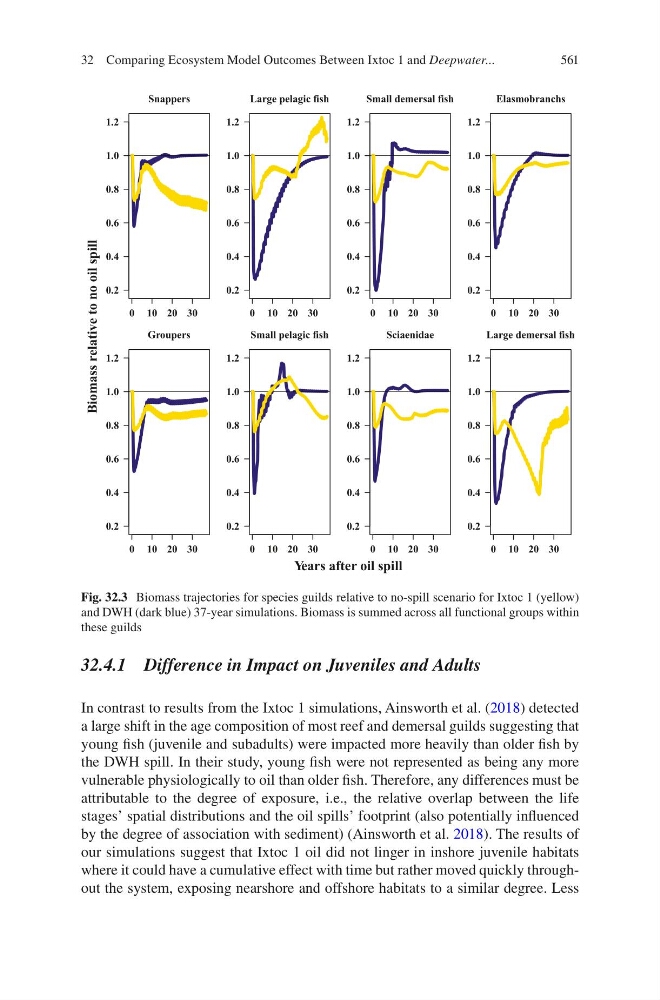
Fig. 32.3 Biomass trajectories for species guilds relative to no-spill scenario for Ixtoc 1 (yellow)
and DWH (dark blue) 37-year simulations. Biomass is summed across all functional groups within
these guilds
32 Comparing Ecosystem Model Outcomes Between Ixtoc 1 and Deepwater...