

474
27.4.3 Limitations, Uncertainties, and Assumptions
There are many challenges in utilizing toxicity data and extrapolation tools to predict the
sensitivity of deep ocean species and the aquatic communities inhabiting environments
impacted from a subsea spill (Fig. 27.4). Limitations and uncertainties include (1) the
unknown toxicity of untested species or species for which toxicity data are limited, (2)
the uncertainties associated with the tools themselves (i.e., data quality, model domain
of applicability, tool reliability), and (3) unique biotic (e.g., chemosynthesis, bioluminescence) and abiotic factors (e.g., temperature, pressure, oxygen, light) that may influence exposure and effects on deep ocean species. These challenges and limitations are
not necessarily exclusive to the understanding of toxicological effects of oil spills on
deep ocean species and are a common concern for spills in unique environments (e.g.,
polar regions, tropical habitats; Bejarano et al. 2017). To improve toxicity extrapolation
to deep ocean species, multiple implicit assumptions remain to be evaluated. These
include determining whether (1) standard test species can serve as surrogates for deep
ocean species, (2) testing deep ocean species under standard laboratory conditions is
representative of sensitivity in the deep ocean, and (3) use of extrapolation tools can
adequately predict hazards for assemblages of deep ocean species (Fig. 27.4).
27.5 Lessons Learned, Recommendations,
and Research Needs
The DWH spill highlighted the large data gaps in understanding the sensitivity of
deep ocean species and the complexity and diversity of habitats that may be affected
in subsea, offshore, and coastal environments (Carriger and Barron 2011; Barron
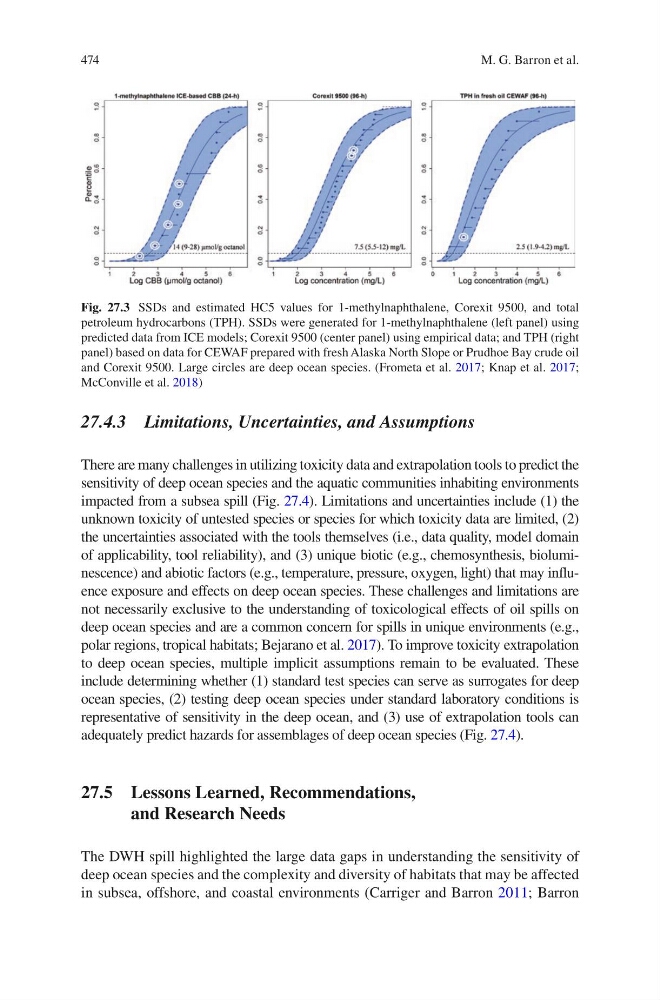
Fig. 27.3 SSDs and estimated HC5 values for 1-methylnaphthalene, Corexit 9500, and total
petroleum hydrocarbons (TPH). SSDs were generated for 1-methylnaphthalene (left panel) using
predicted data from ICE models; Corexit 9500 (center panel) using empirical data; and TPH (right
panel) based on data for CEWAF prepared with fresh Alaska North Slope or Prudhoe Bay crude oil
and Corexit 9500. Large circles are deep ocean species. (Frometa et al. 2017; Knap et al. 2017;
McConville et al. 2018)
M. G. Barron et al.
27.4.3 Limitations, Uncertainties, and Assumptions
There are many challenges in utilizing toxicity data and extrapolation tools to predict the
sensitivity of deep ocean species and the aquatic communities inhabiting environments
impacted from a subsea spill (Fig. 27.4). Limitations and uncertainties include (1) the
unknown toxicity of untested species or species for which toxicity data are limited, (2)
the uncertainties associated with the tools themselves (i.e., data quality, model domain
of applicability, tool reliability), and (3) unique biotic (e.g., chemosynthesis, bioluminescence) and abiotic factors (e.g., temperature, pressure, oxygen, light) that may influence exposure and effects on deep ocean species. These challenges and limitations are
not necessarily exclusive to the understanding of toxicological effects of oil spills on
deep ocean species and are a common concern for spills in unique environments (e.g.,
polar regions, tropical habitats; Bejarano et al. 2017). To improve toxicity extrapolation
to deep ocean species, multiple implicit assumptions remain to be evaluated. These
include determining whether (1) standard test species can serve as surrogates for deep
ocean species, (2) testing deep ocean species under standard laboratory conditions is
representative of sensitivity in the deep ocean, and (3) use of extrapolation tools can
adequately predict hazards for assemblages of deep ocean species (Fig. 27.4).
27.5 Lessons Learned, Recommendations,
and Research Needs
The DWH spill highlighted the large data gaps in understanding the sensitivity of
deep ocean species and the complexity and diversity of habitats that may be affected
in subsea, offshore, and coastal environments (Carriger and Barron 2011; Barron
Fig. 27.3 SSDs and estimated HC5 values for 1-methylnaphthalene, Corexit 9500, and total
petroleum hydrocarbons (TPH). SSDs were generated for 1-methylnaphthalene (left panel) using
predicted data from ICE models; Corexit 9500 (center panel) using empirical data; and TPH (right
panel) based on data for CEWAF prepared with fresh Alaska North Slope or Prudhoe Bay crude oil
and Corexit 9500. Large circles are deep ocean species. (Frometa et al. 2017; Knap et al. 2017;
McConville et al. 2018)
M. G. Barron et al.