

468
GoM, oxygen levels in the deep ocean typically range between 3 and 5 mg/L, temperatures are a nearly uniform 4 °C, and pressures exceed 100 atmospheres. Salinity
in the deep ocean is 36 parts per thousand except in localized areas around brine
seeps where salinity can exceed 40 parts per thousand.
In contrast to oil spilled near the sea surface, oil released into the deep ocean
results in an increased residence time of volatile hydrocarbons (gas) in the aqueous
phase in the absence of atmospheric evaporation (Reddy et al. 2011). The residence
time of hydrocarbons in the deep ocean is also affected by the decreased availability
of dissolved oxygen for biodegradation (Camilli et al. 2010). During the DWH oil
spill, a gas to oil ratio of 1600 cubic feet per petroleum barrel was measured, with
methane as the predominant volatile hydrocarbon (less than five carbon atoms)
comprising over 80 mole % of the gas hydrocarbon composition (Valentine et al.
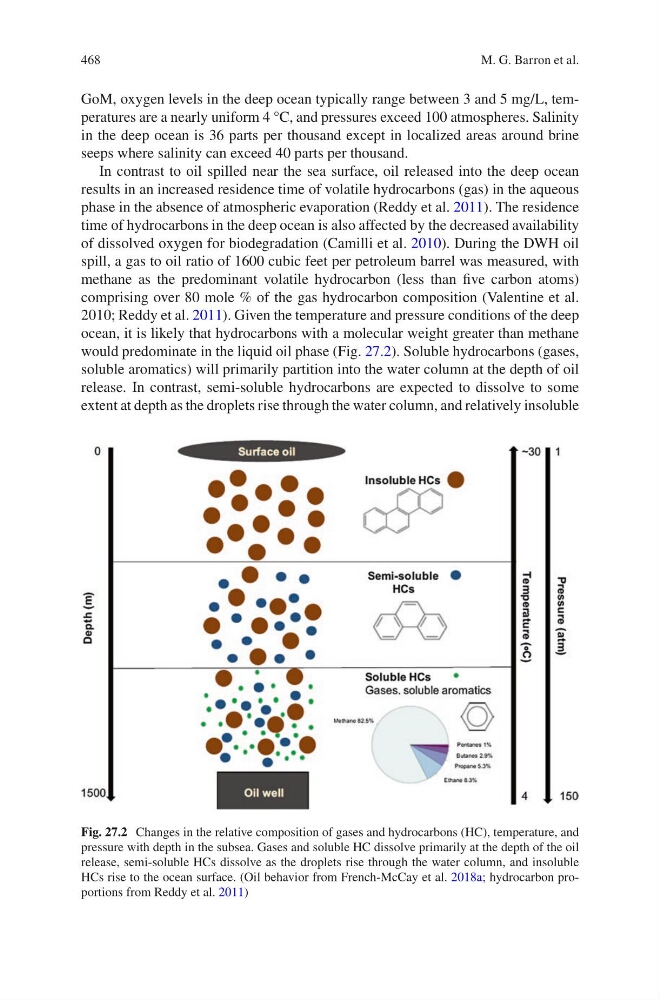
2010; Reddy et al. 2011). Given the temperature and pressure conditions of the deep
ocean, it is likely that hydrocarbons with a molecular weight greater than methane
would predominate in the liquid oil phase (Fig. 27.2). Soluble hydrocarbons (gases,
soluble aromatics) will primarily partition into the water column at the depth of oil
release. In contrast, semi-soluble hydrocarbons are expected to dissolve to some
extent at depth as the droplets rise through the water column, and relatively insoluble
Fig. 27.2 Changes in the relative composition of gases and hydrocarbons (HC), temperature, and
pressure with depth in the subsea. Gases and soluble HC dissolve primarily at the depth of the oil
release, semi-soluble HCs dissolve as the droplets rise through the water column, and insoluble
HCs rise to the ocean surface. (Oil behavior from French-McCay et al. 2018a; hydrocarbon proportions from Reddy et al. 2011)
M. G. Barron et al.
GoM, oxygen levels in the deep ocean typically range between 3 and 5 mg/L, temperatures are a nearly uniform 4 °C, and pressures exceed 100 atmospheres. Salinity
in the deep ocean is 36 parts per thousand except in localized areas around brine
seeps where salinity can exceed 40 parts per thousand.
In contrast to oil spilled near the sea surface, oil released into the deep ocean
results in an increased residence time of volatile hydrocarbons (gas) in the aqueous
phase in the absence of atmospheric evaporation (Reddy et al. 2011). The residence
time of hydrocarbons in the deep ocean is also affected by the decreased availability
of dissolved oxygen for biodegradation (Camilli et al. 2010). During the DWH oil
spill, a gas to oil ratio of 1600 cubic feet per petroleum barrel was measured, with
methane as the predominant volatile hydrocarbon (less than five carbon atoms)
comprising over 80 mole % of the gas hydrocarbon composition (Valentine et al.
2010; Reddy et al. 2011). Given the temperature and pressure conditions of the deep
ocean, it is likely that hydrocarbons with a molecular weight greater than methane
would predominate in the liquid oil phase (Fig. 27.2). Soluble hydrocarbons (gases,
soluble aromatics) will primarily partition into the water column at the depth of oil
release. In contrast, semi-soluble hydrocarbons are expected to dissolve to some
extent at depth as the droplets rise through the water column, and relatively insoluble
Fig. 27.2 Changes in the relative composition of gases and hydrocarbons (HC), temperature, and
pressure with depth in the subsea. Gases and soluble HC dissolve primarily at the depth of the oil
release, semi-soluble HCs dissolve as the droplets rise through the water column, and insoluble
HCs rise to the ocean surface. (Oil behavior from French-McCay et al. 2018a; hydrocarbon proportions from Reddy et al. 2011)
M. G. Barron et al.