

467
communities and environments. The focus of this chapter is on aquatic species,
based primarily on the Gulf of Mexico (GoM) with information and experiences
drawn from the Deepwater Horizon (DWH) oil spill.
27.2 Complexity of Potentially Affected Habitats
As observed during the DWH oil spill, a diversity of habitats may be affected from
a deep ocean release as oil moves from the subsea to offshore and coastal environments (Carriger and Barron 2011; Barron 2012; Beyer et al. 2016). This section
provides a brief overview of the complexity of potentially affected coastal and offshore habitats, and aspects of species sensitivity to hydrocarbons from subsea spills,
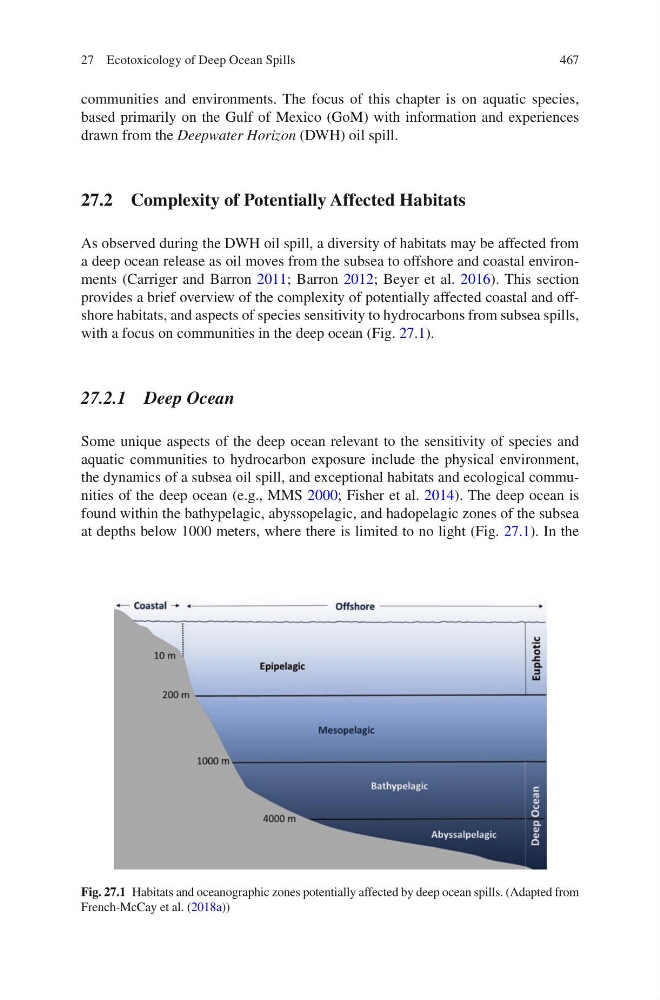
with a focus on communities in the deep ocean (Fig. 27.1).
27.2.1 Deep Ocean
Some unique aspects of the deep ocean relevant to the sensitivity of species and
aquatic communities to hydrocarbon exposure include the physical environment,
the dynamics of a subsea oil spill, and exceptional habitats and ecological communities of the deep ocean (e.g., MMS 2000; Fisher et al. 2014). The deep ocean is
found within the bathypelagic, abyssopelagic, and hadopelagic zones of the subsea
at depths below 1000 meters, where there is limited to no light (Fig. 27.1). In the
Fig. 27.1 Habitats and oceanographic zones potentially affected by deep ocean spills. (Adapted from
French-McCay et al. (2018a))
27 Ecotoxicology of Deep Ocean Spills
communities and environments. The focus of this chapter is on aquatic species,
based primarily on the Gulf of Mexico (GoM) with information and experiences
drawn from the Deepwater Horizon (DWH) oil spill.
27.2 Complexity of Potentially Affected Habitats
As observed during the DWH oil spill, a diversity of habitats may be affected from
a deep ocean release as oil moves from the subsea to offshore and coastal environments (Carriger and Barron 2011; Barron 2012; Beyer et al. 2016). This section
provides a brief overview of the complexity of potentially affected coastal and offshore habitats, and aspects of species sensitivity to hydrocarbons from subsea spills,
with a focus on communities in the deep ocean (Fig. 27.1).
27.2.1 Deep Ocean
Some unique aspects of the deep ocean relevant to the sensitivity of species and
aquatic communities to hydrocarbon exposure include the physical environment,
the dynamics of a subsea oil spill, and exceptional habitats and ecological communities of the deep ocean (e.g., MMS 2000; Fisher et al. 2014). The deep ocean is
found within the bathypelagic, abyssopelagic, and hadopelagic zones of the subsea
at depths below 1000 meters, where there is limited to no light (Fig. 27.1). In the
Fig. 27.1 Habitats and oceanographic zones potentially affected by deep ocean spills. (Adapted from
French-McCay et al. (2018a))
27 Ecotoxicology of Deep Ocean Spills