

34
3.2.6 Interfacial Tension
The pendant drop method has proved to be the most feasible way to measure the
interfacial tension at elevated pressures. The respective experiments are carried out
in so-called high-pressure view cells (Jaeger et al. 2010). The axisymmetric shapes
of pendant drops of a liquid within the surrounding compressed phase are recorded
and evaluated based on the Laplace pressure difference across curved phase boundaries (Bashford and Adams 1883). Under deep-sea conditions, it is especially of
interest to determine the interfacial tension between a gas-saturated (live) oil and
seawater. In view of the complexity of this type of system, well-defined procedures
need to be followed in order to minimize artifacts caused by chemical reactions and
excessive formation of surfactants. Figure 3.5 shows the interfacial tension of live
crude oil drops in seawater as a function of the drop age for different pressures.
In all cases the interfacial tension drops to a quasi-equilibrium value. Due to
interface-active compounds in the crude oil, the interfacial tension decreases within
the first 20 minutes. The methane content in this liquid-liquid system has a substantial effect on density and composition (Sect. 3.4) and is therefore assumed to play a
decisive role in this particular behavior of increasing the interfacial tension as a
function of pressure.
3.3 Modeling Phase Equilibria (Gas-Oil-Water) in Oil
Reservoirs and in the Deep Sea and Oil Constituent
Partitioning
Phase equilibria play a major role in understanding the state and behavior of petroleum fluids. Petroleum fluids within oil reservoirs have had millions of years to
reach equilibrium. During a deep-sea release of petroleum fluids, new pressure and
Ϭ
Ϯ
ϰ
ϲ
ϴ
ϭϬ
ϭϮ
ϭϰ
ϭϲ
ϭϴ
Ϭ
Ϯ
ϰ
ϲ
ϴ
ϭϬ
ϭϮ
ϭϰ
ϭϲ
ɻŵWĂƐ
WDWĂ
>^͕ϮϬΣ
>^н,ϰ͕ϮϬΣ
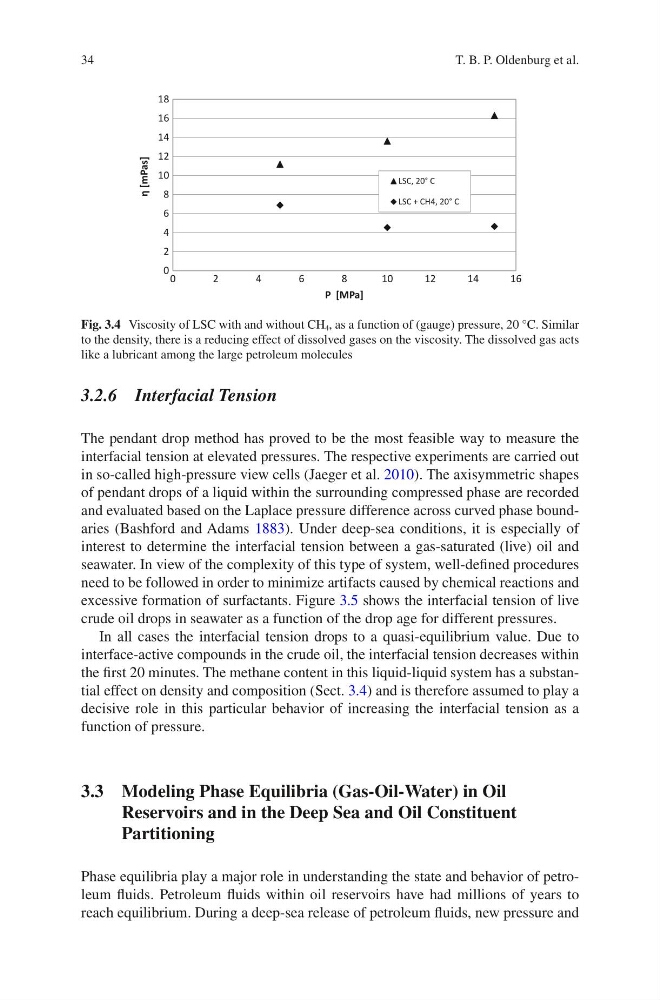
Fig. 3.4 Viscosity of LSC with and without CH 4 , as a function of (gauge) pressure, 20 °C. Similar
to the density, there is a reducing effect of dissolved gases on the viscosity. The dissolved gas acts
like a lubricant among the large petroleum molecules
T. B. P. Oldenburg et al.
3.2.6 Interfacial Tension
The pendant drop method has proved to be the most feasible way to measure the
interfacial tension at elevated pressures. The respective experiments are carried out
in so-called high-pressure view cells (Jaeger et al. 2010). The axisymmetric shapes
of pendant drops of a liquid within the surrounding compressed phase are recorded
and evaluated based on the Laplace pressure difference across curved phase boundaries (Bashford and Adams 1883). Under deep-sea conditions, it is especially of
interest to determine the interfacial tension between a gas-saturated (live) oil and
seawater. In view of the complexity of this type of system, well-defined procedures
need to be followed in order to minimize artifacts caused by chemical reactions and
excessive formation of surfactants. Figure 3.5 shows the interfacial tension of live
crude oil drops in seawater as a function of the drop age for different pressures.
In all cases the interfacial tension drops to a quasi-equilibrium value. Due to
interface-active compounds in the crude oil, the interfacial tension decreases within
the first 20 minutes. The methane content in this liquid-liquid system has a substantial effect on density and composition (Sect. 3.4) and is therefore assumed to play a
decisive role in this particular behavior of increasing the interfacial tension as a
function of pressure.
3.3 Modeling Phase Equilibria (Gas-Oil-Water) in Oil
Reservoirs and in the Deep Sea and Oil Constituent
Partitioning
Phase equilibria play a major role in understanding the state and behavior of petroleum fluids. Petroleum fluids within oil reservoirs have had millions of years to
reach equilibrium. During a deep-sea release of petroleum fluids, new pressure and
Ϭ
Ϯ
ϰ
ϲ
ϴ
ϭϬ
ϭϮ
ϭϰ
ϭϲ
ϭϴ
Ϭ
Ϯ
ϰ
ϲ
ϴ
ϭϬ
ϭϮ
ϭϰ
ϭϲ
ɻŵWĂƐ
WDWĂ
>^͕ϮϬΣ
>^н,ϰ͕ϮϬΣ
Fig. 3.4 Viscosity of LSC with and without CH 4 , as a function of (gauge) pressure, 20 °C. Similar
to the density, there is a reducing effect of dissolved gases on the viscosity. The dissolved gas acts
like a lubricant among the large petroleum molecules
T. B. P. Oldenburg et al.