

418
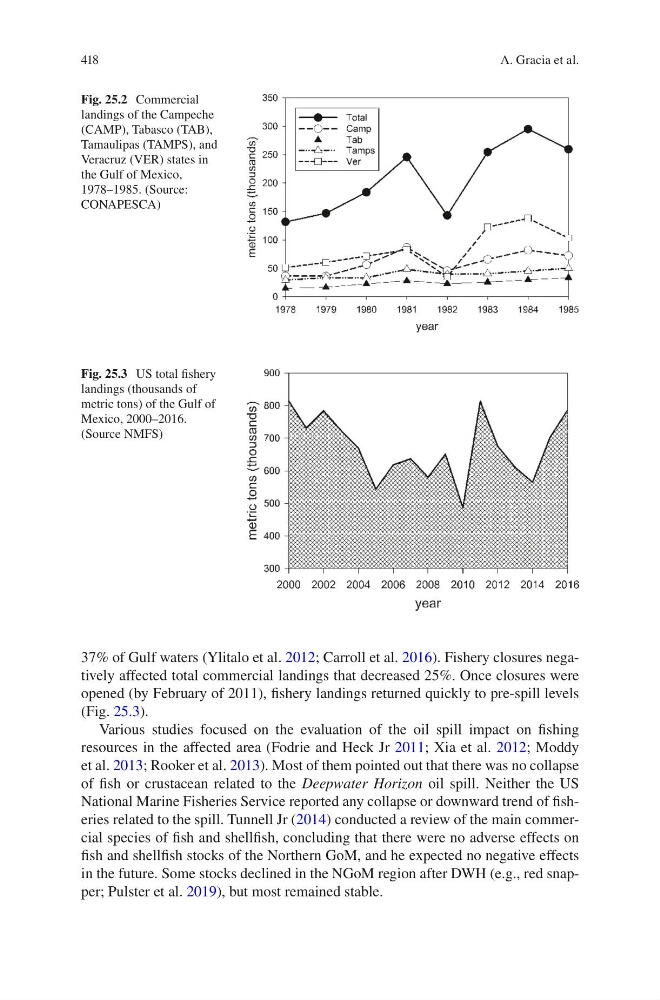
37% of Gulf waters (Ylitalo et al. 2012; Carroll et al. 2016). Fishery closures negatively affected total commercial landings that decreased 25%. Once closures were
opened (by February of 2011), fishery landings returned quickly to pre-spill levels
(Fig. 25.3).
Various studies focused on the evaluation of the oil spill impact on fishing
resources in the affected area (Fodrie and Heck Jr 2011; Xia et al. 2012; Moddy
et al. 2013; Rooker et al. 2013). Most of them pointed out that there was no collapse
of fish or crustacean related to the Deepwater Horizon oil spill. Neither the US
National Marine Fisheries Service reported any collapse or downward trend of fisheries related to the spill. Tunnell Jr (2014) conducted a review of the main commercial species of fish and shellfish, concluding that there were no adverse effects on
fish and shellfish stocks of the Northern GoM, and he expected no negative effects
in the future. Some stocks declined in the NGoM region after DWH (e.g., red snapper; Pulster et al. 2019), but most remained stable.
Fig. 25.2 Commercial
landings of the Campeche
(CAMP), Tabasco (TAB),
Tamaulipas (TAMPS), and
Veracruz (VER) states in
the Gulf of Mexico,
1978–1985. (Source:
CONAPESCA)
Fig. 25.3 US total fishery
landings (thousands of
metric tons) of the Gulf of
Mexico, 2000–2016.
(Source NMFS)
A. Gracia et al.
37% of Gulf waters (Ylitalo et al. 2012; Carroll et al. 2016). Fishery closures negatively affected total commercial landings that decreased 25%. Once closures were
opened (by February of 2011), fishery landings returned quickly to pre-spill levels
(Fig. 25.3).
Various studies focused on the evaluation of the oil spill impact on fishing
resources in the affected area (Fodrie and Heck Jr 2011; Xia et al. 2012; Moddy
et al. 2013; Rooker et al. 2013). Most of them pointed out that there was no collapse
of fish or crustacean related to the Deepwater Horizon oil spill. Neither the US
National Marine Fisheries Service reported any collapse or downward trend of fisheries related to the spill. Tunnell Jr (2014) conducted a review of the main commercial species of fish and shellfish, concluding that there were no adverse effects on
fish and shellfish stocks of the Northern GoM, and he expected no negative effects
in the future. Some stocks declined in the NGoM region after DWH (e.g., red snapper; Pulster et al. 2019), but most remained stable.
Fig. 25.2 Commercial
landings of the Campeche
(CAMP), Tabasco (TAB),
Tamaulipas (TAMPS), and
Veracruz (VER) states in
the Gulf of Mexico,
1978–1985. (Source:
CONAPESCA)
Fig. 25.3 US total fishery
landings (thousands of
metric tons) of the Gulf of
Mexico, 2000–2016.
(Source NMFS)
A. Gracia et al.