

417
25.3 GoM Fishery Landings
The extension and timing of both mega oil spills caused great concern regarding
potential impact on fish and shellfish stocks and their population dynamic processes
including spawning, larval survival, recruitment, and eventually fishery
production.
During the Ixtoc 1 spill, there was no general closure in the SGoM; only in
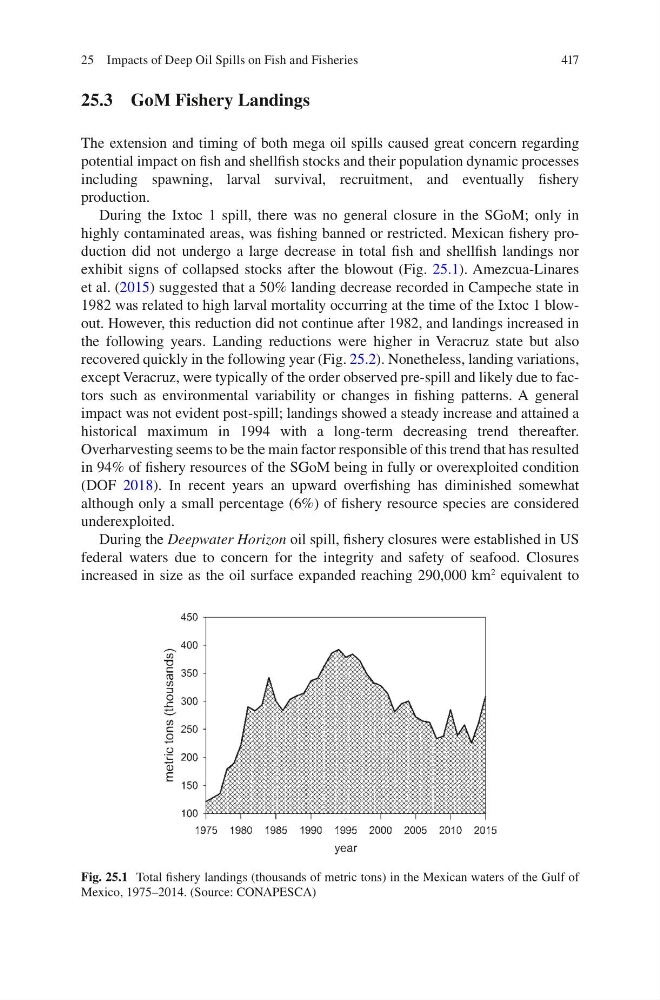
highly contaminated areas, was fishing banned or restricted. Mexican fishery production did not undergo a large decrease in total fish and shellfish landings nor
exhibit signs of collapsed stocks after the blowout (Fig. 25.1). Amezcua-Linares
et al. (2015) suggested that a 50% landing decrease recorded in Campeche state in
1982 was related to high larval mortality occurring at the time of the Ixtoc 1 blowout. However, this reduction did not continue after 1982, and landings increased in
the following years. Landing reductions were higher in Veracruz state but also
recovered quickly in the following year (Fig. 25.2). Nonetheless, landing variations,
except Veracruz, were typically of the order observed pre-spill and likely due to factors such as environmental variability or changes in fishing patterns. A general
impact was not evident post-spill; landings showed a steady increase and attained a
historical maximum in 1994 with a long-term decreasing trend thereafter.
Overharvesting seems to be the main factor responsible of this trend that has resulted
in 94% of fishery resources of the SGoM being in fully or overexploited condition
(DOF 2018). In recent years an upward overfishing has diminished somewhat
although only a small percentage (6%) of fishery resource species are considered
underexploited.
During the Deepwater Horizon oil spill, fishery closures were established in US
federal waters due to concern for the integrity and safety of seafood. Closures
increased in size as the oil surface expanded reaching 290,000 km
2
equivalent to
Fig. 25.1 Total fishery landings (thousands of metric tons) in the Mexican waters of the Gulf of
Mexico, 1975–2014. (Source: CONAPESCA)
25 Impacts of Deep Oil Spills on Fish and Fisheries
25.3 GoM Fishery Landings
The extension and timing of both mega oil spills caused great concern regarding
potential impact on fish and shellfish stocks and their population dynamic processes
including spawning, larval survival, recruitment, and eventually fishery
production.
During the Ixtoc 1 spill, there was no general closure in the SGoM; only in
highly contaminated areas, was fishing banned or restricted. Mexican fishery production did not undergo a large decrease in total fish and shellfish landings nor
exhibit signs of collapsed stocks after the blowout (Fig. 25.1). Amezcua-Linares
et al. (2015) suggested that a 50% landing decrease recorded in Campeche state in
1982 was related to high larval mortality occurring at the time of the Ixtoc 1 blowout. However, this reduction did not continue after 1982, and landings increased in
the following years. Landing reductions were higher in Veracruz state but also
recovered quickly in the following year (Fig. 25.2). Nonetheless, landing variations,
except Veracruz, were typically of the order observed pre-spill and likely due to factors such as environmental variability or changes in fishing patterns. A general
impact was not evident post-spill; landings showed a steady increase and attained a
historical maximum in 1994 with a long-term decreasing trend thereafter.
Overharvesting seems to be the main factor responsible of this trend that has resulted
in 94% of fishery resources of the SGoM being in fully or overexploited condition
(DOF 2018). In recent years an upward overfishing has diminished somewhat
although only a small percentage (6%) of fishery resource species are considered
underexploited.
During the Deepwater Horizon oil spill, fishery closures were established in US
federal waters due to concern for the integrity and safety of seafood. Closures
increased in size as the oil surface expanded reaching 290,000 km
2
equivalent to
Fig. 25.1 Total fishery landings (thousands of metric tons) in the Mexican waters of the Gulf of
Mexico, 1975–2014. (Source: CONAPESCA)
25 Impacts of Deep Oil Spills on Fish and Fisheries