

403
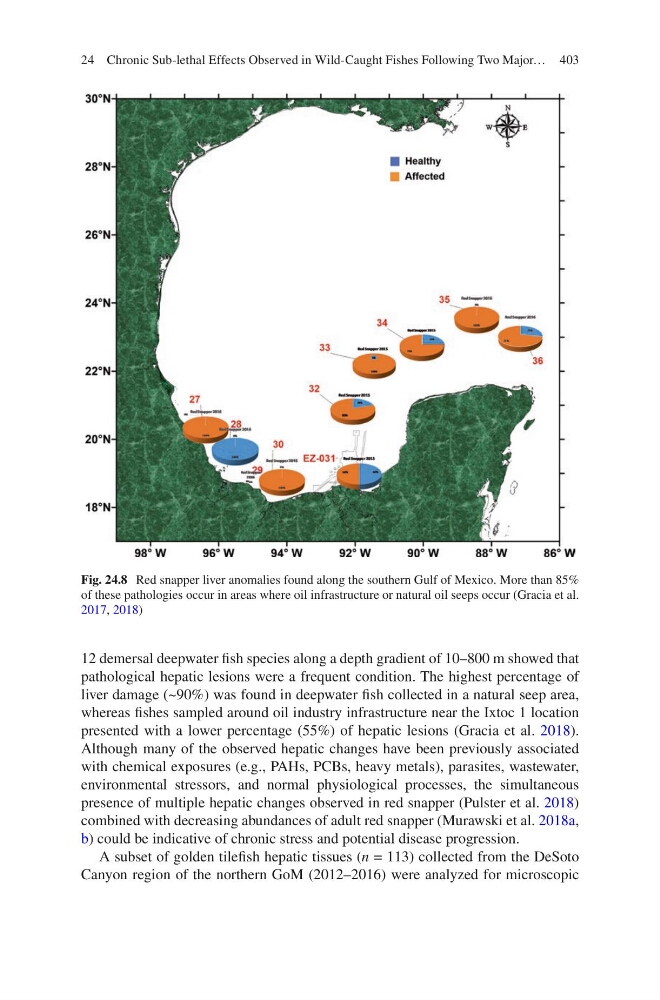
12 demersal deepwater fish species along a depth gradient of 10–800 m showed that
pathological hepatic lesions were a frequent condition. The highest percentage of
liver damage (~90%) was found in deepwater fish collected in a natural seep area,
whereas fishes sampled around oil industry infrastructure near the Ixtoc 1 location
presented with a lower percentage (55%) of hepatic lesions (Gracia et al. 2018).
Although many of the observed hepatic changes have been previously associated
with chemical exposures (e.g., PAHs, PCBs, heavy metals), parasites, wastewater,
environmental stressors, and normal physiological processes, the simultaneous
presence of multiple hepatic changes observed in red snapper (Pulster et al. 2018)
combined with decreasing abundances of adult red snapper (Murawski et al. 2018a,
b) could be indicative of chronic stress and potential disease progression.
A subset of golden tilefish hepatic tissues (n = 113) collected from the DeSoto
Canyon region of the northern GoM (2012–2016) were analyzed for microscopic
Fig. 24.8 Red snapper liver anomalies found along the southern Gulf of Mexico. More than 85%
of these pathologies occur in areas where oil infrastructure or natural oil seeps occur (Gracia et al.
2017, 2018)
24 Chronic Sub-lethal Effects Observed in Wild-Caught Fishes Following Two Major…
12 demersal deepwater fish species along a depth gradient of 10–800 m showed that
pathological hepatic lesions were a frequent condition. The highest percentage of
liver damage (~90%) was found in deepwater fish collected in a natural seep area,
whereas fishes sampled around oil industry infrastructure near the Ixtoc 1 location
presented with a lower percentage (55%) of hepatic lesions (Gracia et al. 2018).
Although many of the observed hepatic changes have been previously associated
with chemical exposures (e.g., PAHs, PCBs, heavy metals), parasites, wastewater,
environmental stressors, and normal physiological processes, the simultaneous
presence of multiple hepatic changes observed in red snapper (Pulster et al. 2018)
combined with decreasing abundances of adult red snapper (Murawski et al. 2018a,
b) could be indicative of chronic stress and potential disease progression.
A subset of golden tilefish hepatic tissues (n = 113) collected from the DeSoto
Canyon region of the northern GoM (2012–2016) were analyzed for microscopic
Fig. 24.8 Red snapper liver anomalies found along the southern Gulf of Mexico. More than 85%
of these pathologies occur in areas where oil infrastructure or natural oil seeps occur (Gracia et al.
2017, 2018)
24 Chronic Sub-lethal Effects Observed in Wild-Caught Fishes Following Two Major…