

399
From 2015 to 2017, golden tilefish (n = 255) and red snapper (n = 125) were collected throughout the GoM via demersal longline to (1) generate the first reference
intervals for a variety of biomarkers for these species, (2) examine differences (and
outliers) in responses around the Gulf, and (3) select suitable candidate specimens
for a subsequent de novo golden tilefish transcriptome analysis (Deak et al. 2017).
Preliminary reference intervals were successfully established in both species for
biomarkers of immune status (hematocrit, leukocrit, differential white blood cell
counts, and lysozyme), oxidative stress (sorbitol dehydrogenase, superoxide dismutase, and malondialdehyde), and genotoxicity (erythrocyte nuclear abnormalities, Deak (in prep), according to ASVCP guidelines (Friedrichs et al. 2012). While
statistically significant differences were found in some variables by geographic
location, sex, and size, partitioning into subgroups was unnecessary since the sample means did not meet the customary ¼ of the 95% confidence interval level for the
entire reference population (Walton 2001).
Statistically significant differences in biomarker reference values were observed
between species. The most pronounced of these differences occurred in elevated
erythrocyte nuclear abnormality counts (genotoxicity) and sorbitol dehydrogenase
(antioxidant) response in golden tilefish (Figs. 24.5 and 24.6). This is not surprising,
given the disparate life histories between red snapper and golden tilefish, with the
latter forming burrows in silt-clay sediments, thereby having a documented elevation of heavy metals and pollutant accumulation (Hall et al. 1978; Harris and Boyd
1990; Snyder et al. 2015). Differential biomarker responses were observed at
stations Gulf-wide, particularly in expression of lysozyme, superoxide dismutase,
sorbitol dehydrogenase, and nuclear abnormalities, further supporting their inclusion in health assessments (Deak et al. 2017).
A transcriptome analysis was performed by Deak et al. (2018) on 15 reproductively mature female goleden tilefishes, all caught during the same time period of
the spawning cycle. Five fishes each were selected from three stations: one on
the northern edge of the DeSoto Canyon (likely impacted by the DWH), one from
the oil fields of Campeche Bay, and one station with no local oil platforms, off the
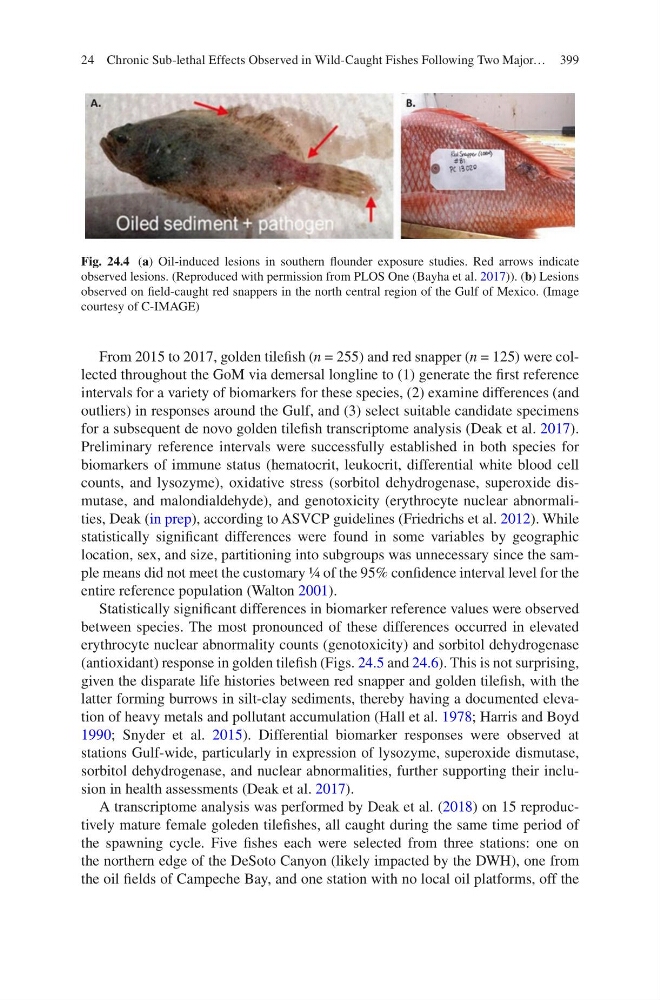
Fig. 24.4 (a) Oil-induced lesions in southern flounder exposure studies. Red arrows indicate
observed lesions. (Reproduced with permission from PLOS One (Bayha et al. 2017)). (b) Lesions
observed on field-caught red snappers in the north central region of the Gulf of Mexico. (Image
courtesy of C-IMAGE)
24 Chronic Sub-lethal Effects Observed in Wild-Caught Fishes Following Two Major…
From 2015 to 2017, golden tilefish (n = 255) and red snapper (n = 125) were collected throughout the GoM via demersal longline to (1) generate the first reference
intervals for a variety of biomarkers for these species, (2) examine differences (and
outliers) in responses around the Gulf, and (3) select suitable candidate specimens
for a subsequent de novo golden tilefish transcriptome analysis (Deak et al. 2017).
Preliminary reference intervals were successfully established in both species for
biomarkers of immune status (hematocrit, leukocrit, differential white blood cell
counts, and lysozyme), oxidative stress (sorbitol dehydrogenase, superoxide dismutase, and malondialdehyde), and genotoxicity (erythrocyte nuclear abnormalities, Deak (in prep), according to ASVCP guidelines (Friedrichs et al. 2012). While
statistically significant differences were found in some variables by geographic
location, sex, and size, partitioning into subgroups was unnecessary since the sample means did not meet the customary ¼ of the 95% confidence interval level for the
entire reference population (Walton 2001).
Statistically significant differences in biomarker reference values were observed
between species. The most pronounced of these differences occurred in elevated
erythrocyte nuclear abnormality counts (genotoxicity) and sorbitol dehydrogenase
(antioxidant) response in golden tilefish (Figs. 24.5 and 24.6). This is not surprising,
given the disparate life histories between red snapper and golden tilefish, with the
latter forming burrows in silt-clay sediments, thereby having a documented elevation of heavy metals and pollutant accumulation (Hall et al. 1978; Harris and Boyd
1990; Snyder et al. 2015). Differential biomarker responses were observed at
stations Gulf-wide, particularly in expression of lysozyme, superoxide dismutase,
sorbitol dehydrogenase, and nuclear abnormalities, further supporting their inclusion in health assessments (Deak et al. 2017).
A transcriptome analysis was performed by Deak et al. (2018) on 15 reproductively mature female goleden tilefishes, all caught during the same time period of
the spawning cycle. Five fishes each were selected from three stations: one on
the northern edge of the DeSoto Canyon (likely impacted by the DWH), one from
the oil fields of Campeche Bay, and one station with no local oil platforms, off the
Fig. 24.4 (a) Oil-induced lesions in southern flounder exposure studies. Red arrows indicate
observed lesions. (Reproduced with permission from PLOS One (Bayha et al. 2017)). (b) Lesions
observed on field-caught red snappers in the north central region of the Gulf of Mexico. (Image
courtesy of C-IMAGE)
24 Chronic Sub-lethal Effects Observed in Wild-Caught Fishes Following Two Major…