

350
by Dr. Ken Sulak of the United States Geological Survey, Dr. Peter Etnoyer of
NOAA, and Dr. Ian MacDonald of Florida State University; deep-sea hardground
corals led by Dr. Chuck Fisher from Pennsylvania State University and Dr. Erik
Cordes from Temple University; red crabs led by Ms. Harriet Perry formerly from
the University of Southern Mississippi and Tuck Hines from the Smithsonian; and
benthic infauna within deep-sea sediments led by Dr. Paul Montagna from Texas
A&M University Corpus Christi and Dr. Jeff Baguley from the University of
Nevada, Reno. Over time, these disparate lines of evidence of injury were combined with other information from independent academics and other NRDA
researchers working on the fate and transport of oil in the deep sea, including extensive work related to the fingerprinting of polycyclic aromatic hydrocarbons (PAHs)
conducted by Dr. Scott Stout, into a broader ecosystem-level understanding of
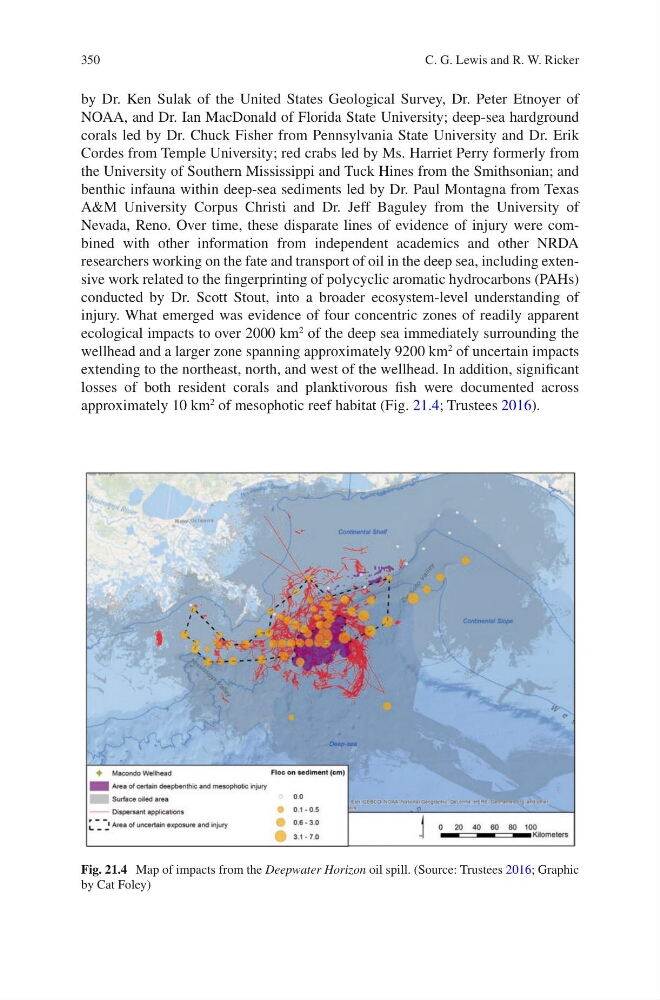
injury. What emerged was evidence of four concentric zones of readily apparent
ecological impacts to over 2000 km
2
of the deep sea immediately surrounding the
wellhead and a larger zone spanning approximately 9200 km
2
of uncertain impacts
extending to the northeast, north, and west of the wellhead. In addition, significant
losses of both resident corals and planktivorous fish were documented across
approximately 10 km
2
of mesophotic reef habitat (Fig. 21.4; Trustees 2016).
Fig. 21.4 Map of impacts from the Deepwater Horizon oil spill. (Source: Trustees 2016; Graphic
by Cat Foley)
C. G. Lewis and R. W. Ricker
by Dr. Ken Sulak of the United States Geological Survey, Dr. Peter Etnoyer of
NOAA, and Dr. Ian MacDonald of Florida State University; deep-sea hardground
corals led by Dr. Chuck Fisher from Pennsylvania State University and Dr. Erik
Cordes from Temple University; red crabs led by Ms. Harriet Perry formerly from
the University of Southern Mississippi and Tuck Hines from the Smithsonian; and
benthic infauna within deep-sea sediments led by Dr. Paul Montagna from Texas
A&M University Corpus Christi and Dr. Jeff Baguley from the University of
Nevada, Reno. Over time, these disparate lines of evidence of injury were combined with other information from independent academics and other NRDA
researchers working on the fate and transport of oil in the deep sea, including extensive work related to the fingerprinting of polycyclic aromatic hydrocarbons (PAHs)
conducted by Dr. Scott Stout, into a broader ecosystem-level understanding of
injury. What emerged was evidence of four concentric zones of readily apparent
ecological impacts to over 2000 km
2
of the deep sea immediately surrounding the
wellhead and a larger zone spanning approximately 9200 km
2
of uncertain impacts
extending to the northeast, north, and west of the wellhead. In addition, significant
losses of both resident corals and planktivorous fish were documented across
approximately 10 km
2
of mesophotic reef habitat (Fig. 21.4; Trustees 2016).
Fig. 21.4 Map of impacts from the Deepwater Horizon oil spill. (Source: Trustees 2016; Graphic
by Cat Foley)
C. G. Lewis and R. W. Ricker