

347
followed by approaches for identifying and quantifying the magnitude of injuries,
and identifying and scaling appropriate restoration actions.
In light of this multistep process, it is important for Trustees to develop conceptual models at the outset of an oil spill to identify likely fate and transport mechanisms and potential resources at risk. This was particularly important in the case of
the Deepwater Horizon oil spill, where it was quickly realized that oil and gas (and
dispersant, applied to break up and disperse the oil, as well as other materials used
to stem the flow from the broken wellhead) were being released at an extreme depth.
A conceptual model can also be useful for identifying where assessment efforts
should be expended, where data gaps might exist, and ultimately opportunities for
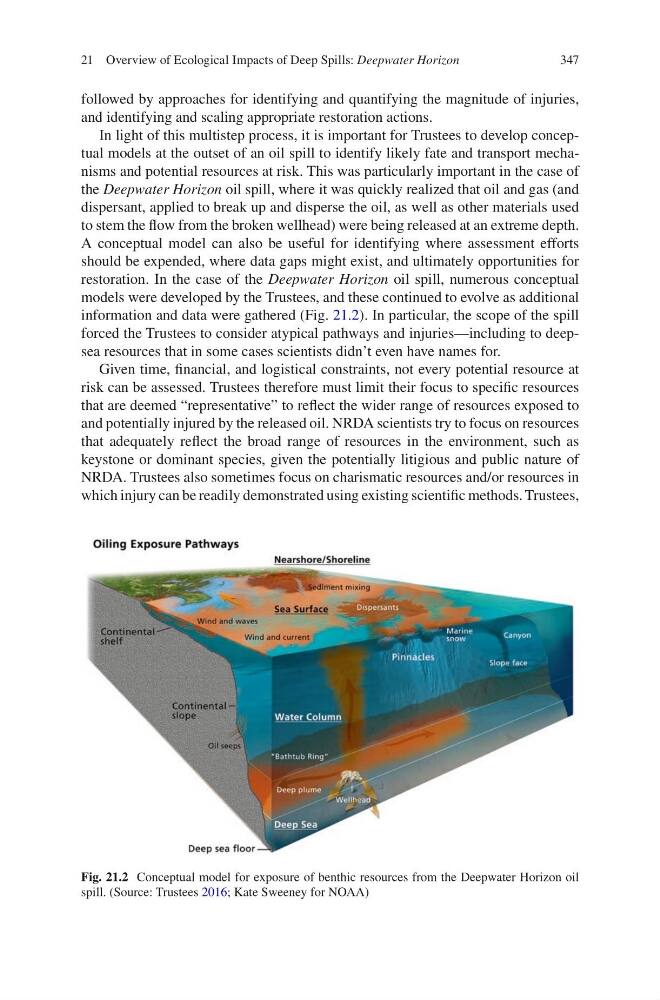
restoration. In the case of the Deepwater Horizon oil spill, numerous conceptual
models were developed by the Trustees, and these continued to evolve as additional
information and data were gathered (Fig. 21.2). In particular, the scope of the spill
forced the Trustees to consider atypical pathways and injuries—including to deepsea resources that in some cases scientists didn’t even have names for.
Given time, financial, and logistical constraints, not every potential resource at
risk can be assessed. Trustees therefore must limit their focus to specific resources
that are deemed “representative” to reflect the wider range of resources exposed to
and potentially injured by the released oil. NRDA scientists try to focus on resources
that adequately reflect the broad range of resources in the environment, such as
keystone or dominant species, given the potentially litigious and public nature of
NRDA. Trustees also sometimes focus on charismatic resources and/or resources in
which injury can be readily demonstrated using existing scientific methods. Trustees,
Fig. 21.2 Conceptual model for exposure of benthic resources from the Deepwater Horizon oil
spill. (Source: Trustees 2016; Kate Sweeney for NOAA)
21 Overview of Ecological Impacts of Deep Spills: Deepwater Horizon
followed by approaches for identifying and quantifying the magnitude of injuries,
and identifying and scaling appropriate restoration actions.
In light of this multistep process, it is important for Trustees to develop conceptual models at the outset of an oil spill to identify likely fate and transport mechanisms and potential resources at risk. This was particularly important in the case of
the Deepwater Horizon oil spill, where it was quickly realized that oil and gas (and
dispersant, applied to break up and disperse the oil, as well as other materials used
to stem the flow from the broken wellhead) were being released at an extreme depth.
A conceptual model can also be useful for identifying where assessment efforts
should be expended, where data gaps might exist, and ultimately opportunities for
restoration. In the case of the Deepwater Horizon oil spill, numerous conceptual
models were developed by the Trustees, and these continued to evolve as additional
information and data were gathered (Fig. 21.2). In particular, the scope of the spill
forced the Trustees to consider atypical pathways and injuries—including to deepsea resources that in some cases scientists didn’t even have names for.
Given time, financial, and logistical constraints, not every potential resource at
risk can be assessed. Trustees therefore must limit their focus to specific resources
that are deemed “representative” to reflect the wider range of resources exposed to
and potentially injured by the released oil. NRDA scientists try to focus on resources
that adequately reflect the broad range of resources in the environment, such as
keystone or dominant species, given the potentially litigious and public nature of
NRDA. Trustees also sometimes focus on charismatic resources and/or resources in
which injury can be readily demonstrated using existing scientific methods. Trustees,
Fig. 21.2 Conceptual model for exposure of benthic resources from the Deepwater Horizon oil
spill. (Source: Trustees 2016; Kate Sweeney for NOAA)
21 Overview of Ecological Impacts of Deep Spills: Deepwater Horizon