

308
snow, thus reducing their concentrations in the water phase. Furthermore, it was
hypothesized that an inner aggregate environment is created, where mass transfer of
the oil to the bacteria is enhanced. This will lead to the release of degradable oil
compounds and shortens the diffusion distances between the oil phase and the oildegrading bacteria (Rahsepar et al. 2017).
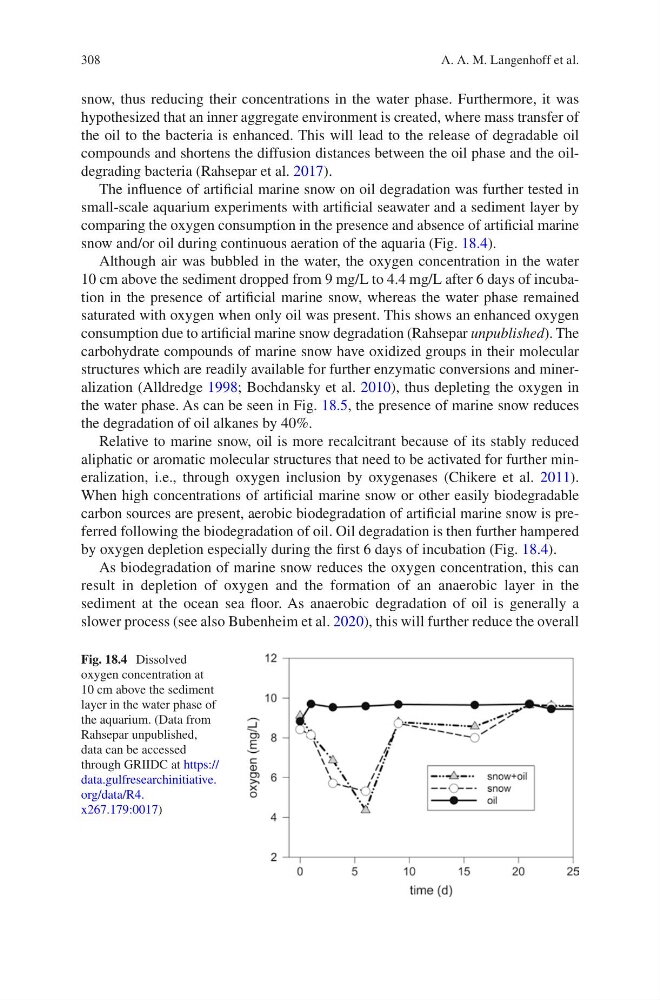
The influence of artificial marine snow on oil degradation was further tested in
small-scale aquarium experiments with artificial seawater and a sediment layer by
comparing the oxygen consumption in the presence and absence of artificial marine
snow and/or oil during continuous aeration of the aquaria (Fig. 18.4).
Although air was bubbled in the water, the oxygen concentration in the water
10 cm above the sediment dropped from 9 mg/L to 4.4 mg/L after 6 days of incubation in the presence of artificial marine snow, whereas the water phase remained
saturated with oxygen when only oil was present. This shows an enhanced oxygen
consumption due to artificial marine snow degradation (Rahsepar unpublished). The
carbohydrate compounds of marine snow have oxidized groups in their molecular
structures which are readily available for further enzymatic conversions and mineralization (Alldredge 1998; Bochdansky et al. 2010), thus depleting the oxygen in
the water phase. As can be seen in Fig. 18.5, the presence of marine snow reduces
the degradation of oil alkanes by 40%.
Relative to marine snow, oil is more recalcitrant because of its stably reduced
aliphatic or aromatic molecular structures that need to be activated for further mineralization, i.e., through oxygen inclusion by oxygenases (Chikere et al. 2011).
When high concentrations of artificial marine snow or other easily biodegradable
carbon sources are present, aerobic biodegradation of artificial marine snow is preferred following the biodegradation of oil. Oil degradation is then further hampered
by oxygen depletion especially during the first 6 days of incubation (Fig. 18.4).
As biodegradation of marine snow reduces the oxygen concentration, this can
result in depletion of oxygen and the formation of an anaerobic layer in the
sediment at the ocean sea floor. As anaerobic degradation of oil is generally a
slower process (see also Bubenheim et al. 2020), this will further reduce the overall
Fig. 18.4 Dissolved
oxygen concentration at
10 cm above the sediment
layer in the water phase of
the aquarium. (Data from
Rahsepar unpublished,
data can be accessed
through GRIIDC at https://
data.gulfresearchinitiative.
org/data/R4.
x267.179:0017)
A. A. M. Langenhoff et al.
snow, thus reducing their concentrations in the water phase. Furthermore, it was
hypothesized that an inner aggregate environment is created, where mass transfer of
the oil to the bacteria is enhanced. This will lead to the release of degradable oil
compounds and shortens the diffusion distances between the oil phase and the oildegrading bacteria (Rahsepar et al. 2017).
The influence of artificial marine snow on oil degradation was further tested in
small-scale aquarium experiments with artificial seawater and a sediment layer by
comparing the oxygen consumption in the presence and absence of artificial marine
snow and/or oil during continuous aeration of the aquaria (Fig. 18.4).
Although air was bubbled in the water, the oxygen concentration in the water
10 cm above the sediment dropped from 9 mg/L to 4.4 mg/L after 6 days of incubation in the presence of artificial marine snow, whereas the water phase remained
saturated with oxygen when only oil was present. This shows an enhanced oxygen
consumption due to artificial marine snow degradation (Rahsepar unpublished). The
carbohydrate compounds of marine snow have oxidized groups in their molecular
structures which are readily available for further enzymatic conversions and mineralization (Alldredge 1998; Bochdansky et al. 2010), thus depleting the oxygen in
the water phase. As can be seen in Fig. 18.5, the presence of marine snow reduces
the degradation of oil alkanes by 40%.
Relative to marine snow, oil is more recalcitrant because of its stably reduced
aliphatic or aromatic molecular structures that need to be activated for further mineralization, i.e., through oxygen inclusion by oxygenases (Chikere et al. 2011).
When high concentrations of artificial marine snow or other easily biodegradable
carbon sources are present, aerobic biodegradation of artificial marine snow is preferred following the biodegradation of oil. Oil degradation is then further hampered
by oxygen depletion especially during the first 6 days of incubation (Fig. 18.4).
As biodegradation of marine snow reduces the oxygen concentration, this can
result in depletion of oxygen and the formation of an anaerobic layer in the
sediment at the ocean sea floor. As anaerobic degradation of oil is generally a
slower process (see also Bubenheim et al. 2020), this will further reduce the overall
Fig. 18.4 Dissolved
oxygen concentration at
10 cm above the sediment
layer in the water phase of
the aquarium. (Data from
Rahsepar unpublished,
data can be accessed
through GRIIDC at https://
data.gulfresearchinitiative.
org/data/R4.
x267.179:0017)
A. A. M. Langenhoff et al.