

264
microbes associated with sinking particles (Doyle et al. 2018), where rapid colonization of the MOS occurred as it provided an ideal substrate, rich in readily degradable organic matter (exopolymeric exudates and oil).
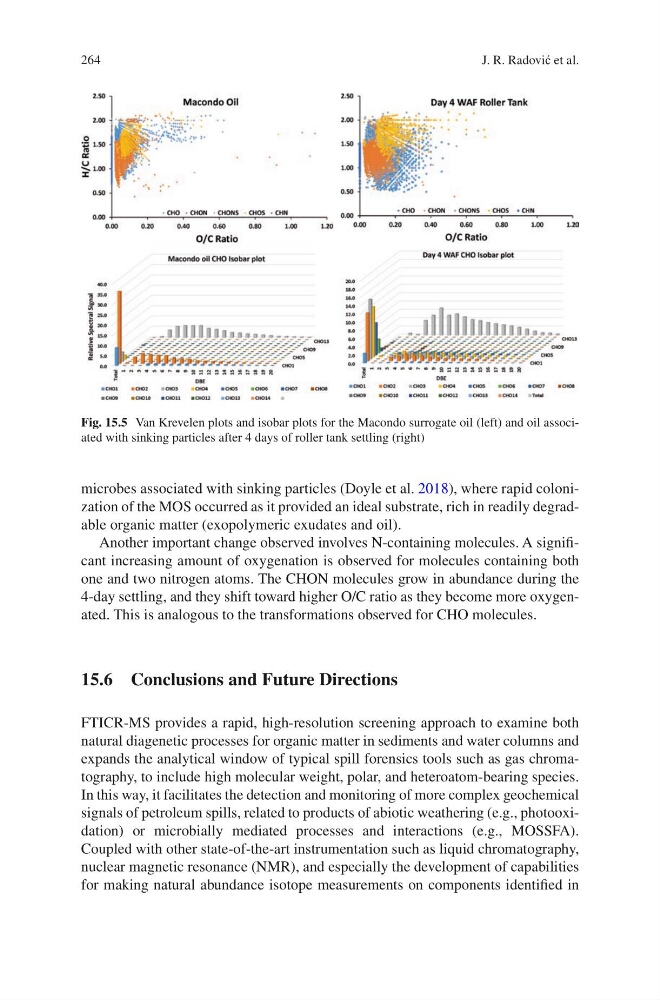
Another important change observed involves N-containing molecules. A significant increasing amount of oxygenation is observed for molecules containing both
one and two nitrogen atoms. The CHON molecules grow in abundance during the
4-day settling, and they shift toward higher O/C ratio as they become more oxygenated. This is analogous to the transformations observed for CHO molecules.
15.6 Conclusions and Future Directions
FTICR-MS provides a rapid, high-resolution screening approach to examine both
natural diagenetic processes for organic matter in sediments and water columns and
expands the analytical window of typical spill forensics tools such as gas chromatography, to include high molecular weight, polar, and heteroatom-bearing species.
In this way, it facilitates the detection and monitoring of more complex geochemical
signals of petroleum spills, related to products of abiotic weathering (e.g., photooxidation) or microbially mediated processes and interactions (e.g., MOSSFA).
Coupled with other state-of-the-art instrumentation such as liquid chromatography,
nuclear magnetic resonance (NMR), and especially the development of capabilities
for making natural abundance isotope measurements on components identified in
Fig. 15.5 Van Krevelen plots and isobar plots for the Macondo surrogate oil (left) and oil associated with sinking particles after 4 days of roller tank settling (right)
J. R. Radović et al.
microbes associated with sinking particles (Doyle et al. 2018), where rapid colonization of the MOS occurred as it provided an ideal substrate, rich in readily degradable organic matter (exopolymeric exudates and oil).
Another important change observed involves N-containing molecules. A significant increasing amount of oxygenation is observed for molecules containing both
one and two nitrogen atoms. The CHON molecules grow in abundance during the
4-day settling, and they shift toward higher O/C ratio as they become more oxygenated. This is analogous to the transformations observed for CHO molecules.
15.6 Conclusions and Future Directions
FTICR-MS provides a rapid, high-resolution screening approach to examine both
natural diagenetic processes for organic matter in sediments and water columns and
expands the analytical window of typical spill forensics tools such as gas chromatography, to include high molecular weight, polar, and heteroatom-bearing species.
In this way, it facilitates the detection and monitoring of more complex geochemical
signals of petroleum spills, related to products of abiotic weathering (e.g., photooxidation) or microbially mediated processes and interactions (e.g., MOSSFA).
Coupled with other state-of-the-art instrumentation such as liquid chromatography,
nuclear magnetic resonance (NMR), and especially the development of capabilities
for making natural abundance isotope measurements on components identified in
Fig. 15.5 Van Krevelen plots and isobar plots for the Macondo surrogate oil (left) and oil associated with sinking particles after 4 days of roller tank settling (right)
J. R. Radović et al.