

225
polycyclic aromatic hydrocarbons (PAHs), which are indicative of surface burning
response tactics (Romero et al. 2015). Surface sediments were radiocarbon depleted
relative to deeper sediments, consistent with deposition of petrocarbon (Chanton
et al. 2015). The characteristics and magnitude of deposition measured in the seafloor sedimentary records are consistent with those measured in sediment traps in
the northern GoM (Yan et al. 2016; Stout and German 2017; Giering et al. 2018).
13.3 What Was the Extent of MOSSFA on the Seafloor?
Multiple approaches were employed to determine the spatial extent of MOSSFA on
the deep-sea areas of the seafloor in the northern GoM following DWH. Overall,
estimates from these various approaches indicate MOSSFA deposition over spatial
extents in the deep sea that ranged from 1030 to 35,425 km
2
(Valentine et al. 2014;
Chanton et al. 2015; Romero et al. 2015; Passow and Ziervogel 2016; Romero et al.
2017; Schwing et al. 2017a; Stout and German 2017) comprising between 3.7% and
14.4% of the total petroleum volume released that was not recovered or burned
(3.19 million barrels, US District Court 2015). Using hopane and total PAH concentrations in surface sediments (relative to downcore sediments), Stout and German
(2017) estimated that the deep-sea surface sediment spatial extent ranged from 1030
to 1910 km
2
and the sunken surface oil’s spatial extent was 7600 km
2
, which comprised 6.8–7.2% of the total petroleum released. Valentine et al. (2014) also utilized
hopane concentrations in surface sediments to constrain an area of 3200 km
2
. Both
studies found that oil residues were primarily deposited proximal to the DWH
0
5
10
15
20
25
30
35
40
45
0
2
4
Depth (mm)
Depth (mm)
Biogenic Silica Percentage
DWH-2010
0.04
0.08
0.12
0.16
Cyanobacteria and Phytoplankton
Chloroplast 16S RNA Percentage
DWH-2010
0
50
100
0
1 0
2 0
3 0
1
3
5
7
9
11
13
15
17
19
21
23
25
29
31
Planktic Foraminifera Accumulation
Rate (indiv. cm
-2 yr
-1 )
Depth (mm)
DWH-2010
A
B
C
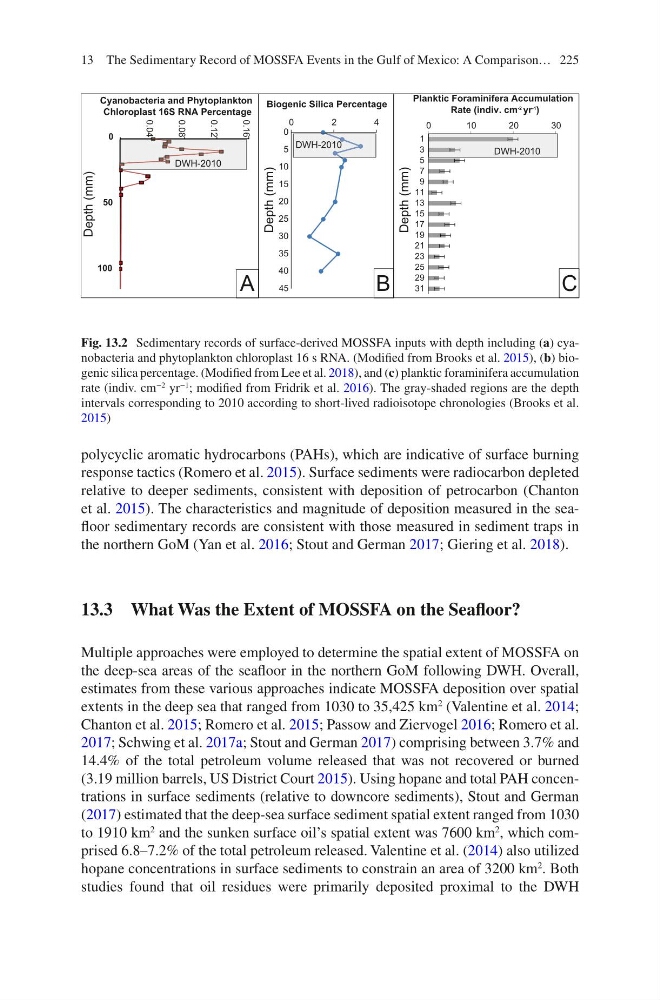
Fig. 13.2 Sedimentary records of surface-derived MOSSFA inputs with depth including (a) cyanobacteria and phytoplankton chloroplast 16 s RNA. (Modified from Brooks et al. 2015), (b) biogenic silica percentage. (Modified from Lee et al. 2018), and (c) planktic foraminifera accumulation
rate (indiv. cm
−2 yr
−1 ; modified from Fridrik et al. 2016). The gray-shaded regions are the depth
intervals corresponding to 2010 according to short-lived radioisotope chronologies (Brooks et al.
2015)
13 The Sedimentary Record of MOSSFA Events in the Gulf of Mexico: A Comparison…
polycyclic aromatic hydrocarbons (PAHs), which are indicative of surface burning
response tactics (Romero et al. 2015). Surface sediments were radiocarbon depleted
relative to deeper sediments, consistent with deposition of petrocarbon (Chanton
et al. 2015). The characteristics and magnitude of deposition measured in the seafloor sedimentary records are consistent with those measured in sediment traps in
the northern GoM (Yan et al. 2016; Stout and German 2017; Giering et al. 2018).
13.3 What Was the Extent of MOSSFA on the Seafloor?
Multiple approaches were employed to determine the spatial extent of MOSSFA on
the deep-sea areas of the seafloor in the northern GoM following DWH. Overall,
estimates from these various approaches indicate MOSSFA deposition over spatial
extents in the deep sea that ranged from 1030 to 35,425 km
2
(Valentine et al. 2014;
Chanton et al. 2015; Romero et al. 2015; Passow and Ziervogel 2016; Romero et al.
2017; Schwing et al. 2017a; Stout and German 2017) comprising between 3.7% and
14.4% of the total petroleum volume released that was not recovered or burned
(3.19 million barrels, US District Court 2015). Using hopane and total PAH concentrations in surface sediments (relative to downcore sediments), Stout and German
(2017) estimated that the deep-sea surface sediment spatial extent ranged from 1030
to 1910 km
2
and the sunken surface oil’s spatial extent was 7600 km
2
, which comprised 6.8–7.2% of the total petroleum released. Valentine et al. (2014) also utilized
hopane concentrations in surface sediments to constrain an area of 3200 km
2
. Both
studies found that oil residues were primarily deposited proximal to the DWH
0
5
10
15
20
25
30
35
40
45
0
2
4
Depth (mm)
Depth (mm)
Biogenic Silica Percentage
DWH-2010
0.04
0.08
0.12
0.16
Cyanobacteria and Phytoplankton
Chloroplast 16S RNA Percentage
DWH-2010
0
50
100
0
1 0
2 0
3 0
1
3
5
7
9
11
13
15
17
19
21
23
25
29
31
Planktic Foraminifera Accumulation
Rate (indiv. cm
-2 yr
-1 )
Depth (mm)
DWH-2010
A
B
C
Fig. 13.2 Sedimentary records of surface-derived MOSSFA inputs with depth including (a) cyanobacteria and phytoplankton chloroplast 16 s RNA. (Modified from Brooks et al. 2015), (b) biogenic silica percentage. (Modified from Lee et al. 2018), and (c) planktic foraminifera accumulation
rate (indiv. cm
−2 yr
−1 ; modified from Fridrik et al. 2016). The gray-shaded regions are the depth
intervals corresponding to 2010 according to short-lived radioisotope chronologies (Brooks et al.
2015)
13 The Sedimentary Record of MOSSFA Events in the Gulf of Mexico: A Comparison…