

181
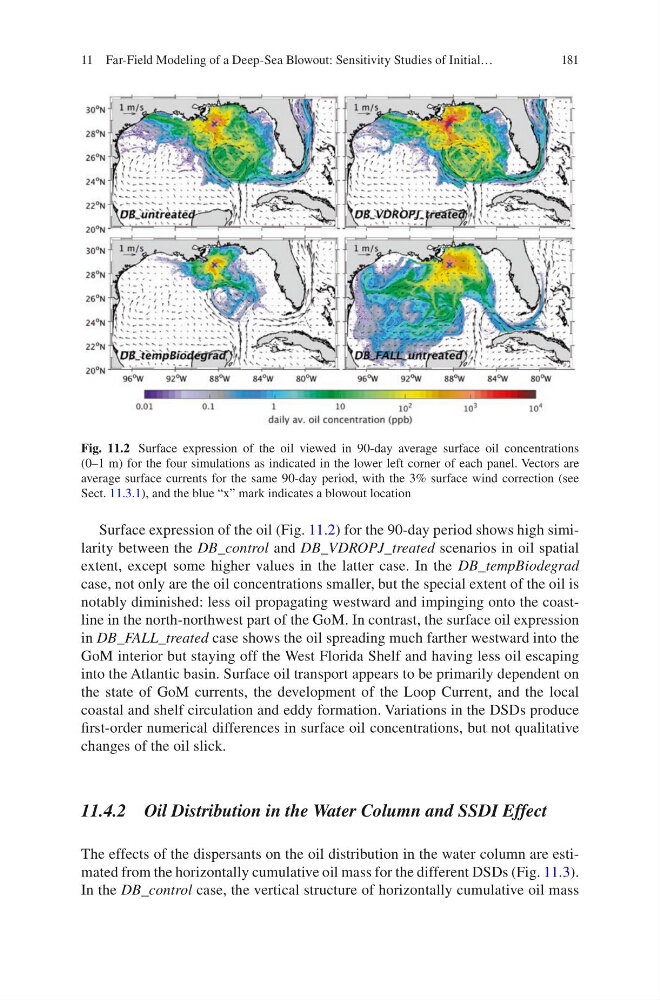
Surface expression of the oil (Fig. 11.2) for the 90-day period shows high similarity between the DB_control and DB_VDROPJ_treated scenarios in oil spatial
extent, except some higher values in the latter case. In the DB_tempBiodegrad
case, not only are the oil concentrations smaller, but the special extent of the oil is
notably diminished: less oil propagating westward and impinging onto the coastline in the north-northwest part of the GoM. In contrast, the surface oil expression
in DB_FALL_treated case shows the oil spreading much farther westward into the
GoM interior but staying off the West Florida Shelf and having less oil escaping
into the Atlantic basin. Surface oil transport appears to be primarily dependent on
the state of GoM currents, the development of the Loop Current, and the local
coastal and shelf circulation and eddy formation. Variations in the DSDs produce
first-order numerical differences in surface oil concentrations, but not qualitative
changes of the oil slick.
11.4.2 Oil Distribution in the Water Column and SSDI Effect
The effects of the dispersants on the oil distribution in the water column are estimated from the horizontally cumulative oil mass for the different DSDs (Fig. 11.3).
In the DB_control case, the vertical structure of horizontally cumulative oil mass
Fig. 11.2 Surface expression of the oil viewed in 90-day average surface oil concentrations
(0–1 m) for the four simulations as indicated in the lower left corner of each panel. Vectors are
average surface currents for the same 90-day period, with the 3% surface wind correction (see
Sect. 11.3.1), and the blue “x” mark indicates a blowout location
11 Far-Field Modeling of a Deep-Sea Blowout: Sensitivity Studies of Initial…
Surface expression of the oil (Fig. 11.2) for the 90-day period shows high similarity between the DB_control and DB_VDROPJ_treated scenarios in oil spatial
extent, except some higher values in the latter case. In the DB_tempBiodegrad
case, not only are the oil concentrations smaller, but the special extent of the oil is
notably diminished: less oil propagating westward and impinging onto the coastline in the north-northwest part of the GoM. In contrast, the surface oil expression
in DB_FALL_treated case shows the oil spreading much farther westward into the
GoM interior but staying off the West Florida Shelf and having less oil escaping
into the Atlantic basin. Surface oil transport appears to be primarily dependent on
the state of GoM currents, the development of the Loop Current, and the local
coastal and shelf circulation and eddy formation. Variations in the DSDs produce
first-order numerical differences in surface oil concentrations, but not qualitative
changes of the oil slick.
11.4.2 Oil Distribution in the Water Column and SSDI Effect
The effects of the dispersants on the oil distribution in the water column are estimated from the horizontally cumulative oil mass for the different DSDs (Fig. 11.3).
In the DB_control case, the vertical structure of horizontally cumulative oil mass
Fig. 11.2 Surface expression of the oil viewed in 90-day average surface oil concentrations
(0–1 m) for the four simulations as indicated in the lower left corner of each panel. Vectors are
average surface currents for the same 90-day period, with the 3% surface wind correction (see
Sect. 11.3.1), and the blue “x” mark indicates a blowout location
11 Far-Field Modeling of a Deep-Sea Blowout: Sensitivity Studies of Initial…