

163
In addition, at a higher wind speed, the slick moves faster causing more of the
suspended droplets to resurface in the tail instead of in the main slick area, thus
increasing the relatively thin slick area with more effective natural dispersion.
10.3.5 Dispersants
It is self-evident that addition of dispersants enhances the dispersion process. The
main mode of dispersant action is to reduce the oil-water interfacial tension, thereby
allowing smaller droplets to be formed.
In the slick elongation model, dispersant application is simulated by a decrease
of the input value for oil-water interfacial tension. This parameter affects the droplet
breakup process by decreasing the resulting droplet sizes but has no impact on the
other steps in the dispersion and elongation process.
The droplet sizes of the entrained oil are calculated with a Weber and Reynolds
number relation fitted to the experimental results (Zeinstra-Helfrich et al. 2017).
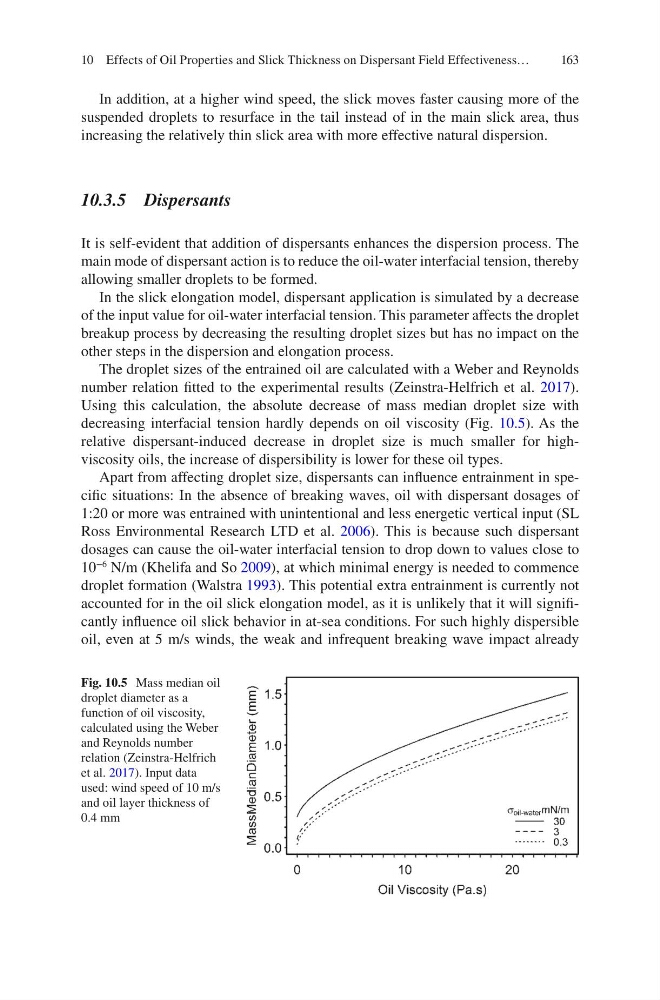
Using this calculation, the absolute decrease of mass median droplet size with
decreasing interfacial tension hardly depends on oil viscosity (Fig. 10.5). As the
relative dispersant-induced decrease in droplet size is much smaller for highviscosity oils, the increase of dispersibility is lower for these oil types.
Apart from affecting droplet size, dispersants can influence entrainment in specific situations: In the absence of breaking waves, oil with dispersant dosages of
1:20 or more was entrained with unintentional and less energetic vertical input (SL
Ross Environmental Research LTD et al. 2006). This is because such dispersant
dosages can cause the oil-water interfacial tension to drop down to values close to
10
−6
N/m (Khelifa and So 2009), at which minimal energy is needed to commence
droplet formation (Walstra 1993). This potential extra entrainment is currently not
accounted for in the oil slick elongation model, as it is unlikely that it will significantly influence oil slick behavior in at-sea conditions. For such highly dispersible
oil, even at 5 m/s winds, the weak and infrequent breaking wave impact already
Fig. 10.5 Mass median oil
droplet diameter as a
function of oil viscosity,
calculated using the Weber
and Reynolds number
relation (Zeinstra-Helfrich
et al. 2017). Input data
used: wind speed of 10 m/s
and oil layer thickness of
0.4 mm
10 Effects of Oil Properties and Slick Thickness on Dispersant Field Effectiveness…
In addition, at a higher wind speed, the slick moves faster causing more of the
suspended droplets to resurface in the tail instead of in the main slick area, thus
increasing the relatively thin slick area with more effective natural dispersion.
10.3.5 Dispersants
It is self-evident that addition of dispersants enhances the dispersion process. The
main mode of dispersant action is to reduce the oil-water interfacial tension, thereby
allowing smaller droplets to be formed.
In the slick elongation model, dispersant application is simulated by a decrease
of the input value for oil-water interfacial tension. This parameter affects the droplet
breakup process by decreasing the resulting droplet sizes but has no impact on the
other steps in the dispersion and elongation process.
The droplet sizes of the entrained oil are calculated with a Weber and Reynolds
number relation fitted to the experimental results (Zeinstra-Helfrich et al. 2017).
Using this calculation, the absolute decrease of mass median droplet size with
decreasing interfacial tension hardly depends on oil viscosity (Fig. 10.5). As the
relative dispersant-induced decrease in droplet size is much smaller for highviscosity oils, the increase of dispersibility is lower for these oil types.
Apart from affecting droplet size, dispersants can influence entrainment in specific situations: In the absence of breaking waves, oil with dispersant dosages of
1:20 or more was entrained with unintentional and less energetic vertical input (SL
Ross Environmental Research LTD et al. 2006). This is because such dispersant
dosages can cause the oil-water interfacial tension to drop down to values close to
10
−6
N/m (Khelifa and So 2009), at which minimal energy is needed to commence
droplet formation (Walstra 1993). This potential extra entrainment is currently not
accounted for in the oil slick elongation model, as it is unlikely that it will significantly influence oil slick behavior in at-sea conditions. For such highly dispersible
oil, even at 5 m/s winds, the weak and infrequent breaking wave impact already
Fig. 10.5 Mass median oil
droplet diameter as a
function of oil viscosity,
calculated using the Weber
and Reynolds number
relation (Zeinstra-Helfrich
et al. 2017). Input data
used: wind speed of 10 m/s
and oil layer thickness of
0.4 mm
10 Effects of Oil Properties and Slick Thickness on Dispersant Field Effectiveness…