

162
longer initial slick means that resurfacing oil from the downwind edge “feeds” the
main slick instead of the tail. The oil resurfacing back into the main slick slows
down the decrease in thickness that is necessary to transition into the more efficient
vertical dispersion regime. In this case, dispersant application could assist by
enhancing dispersibility and transitioning into the vertical regime more quickly.
10.3.4 Wind Speed
Wind speed is considered an important variable in the dispersion process, as it indirectly provides the energy for the dispersion to occur.
In the dispersion model studies (Zeinstra-Helfrich et al. 2017), indeed, wind
speed is a very dominant factor in the outcome. This input parameter plays a role in
several process parameters. Firstly, the amount of entrainment and energy levels
indeed depend on wind speed:
• The area fraction agitated increases A mix ~U wind
2.26
, resulting in a proportional
increase of volume of oil entrained.
• The plunge height increases H plunge ~U wind
2
, causing smaller oil droplets to be
formed.
As the mixing depth increases, z i ~U wind
2
, and the time between breaking waves
decreases, T bw ~ U wind
−2.26
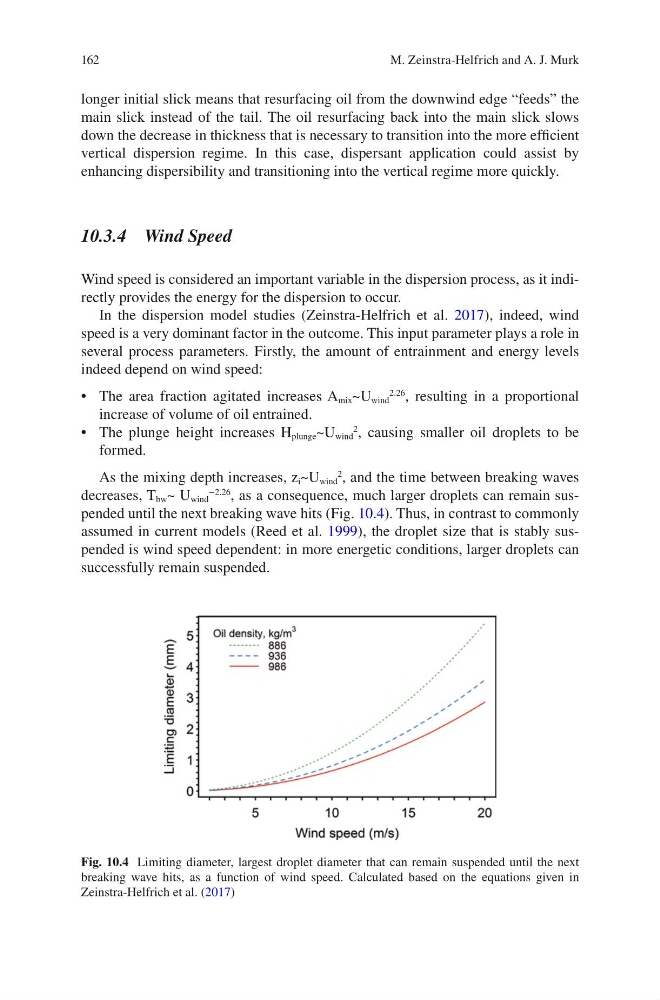
, as a consequence, much larger droplets can remain suspended until the next breaking wave hits (Fig. 10.4). Thus, in contrast to commonly
assumed in current models (Reed et al. 1999), the droplet size that is stably suspended is wind speed dependent: in more energetic conditions, larger droplets can
successfully remain suspended.
Fig. 10.4 Limiting diameter, largest droplet diameter that can remain suspended until the next
breaking wave hits, as a function of wind speed. Calculated based on the equations given in
Zeinstra-Helfrich et al. (2017)
M. Zeinstra-Helfrich and A. J. Murk
longer initial slick means that resurfacing oil from the downwind edge “feeds” the
main slick instead of the tail. The oil resurfacing back into the main slick slows
down the decrease in thickness that is necessary to transition into the more efficient
vertical dispersion regime. In this case, dispersant application could assist by
enhancing dispersibility and transitioning into the vertical regime more quickly.
10.3.4 Wind Speed
Wind speed is considered an important variable in the dispersion process, as it indirectly provides the energy for the dispersion to occur.
In the dispersion model studies (Zeinstra-Helfrich et al. 2017), indeed, wind
speed is a very dominant factor in the outcome. This input parameter plays a role in
several process parameters. Firstly, the amount of entrainment and energy levels
indeed depend on wind speed:
• The area fraction agitated increases A mix ~U wind
2.26
, resulting in a proportional
increase of volume of oil entrained.
• The plunge height increases H plunge ~U wind
2
, causing smaller oil droplets to be
formed.
As the mixing depth increases, z i ~U wind
2
, and the time between breaking waves
decreases, T bw ~ U wind
−2.26
, as a consequence, much larger droplets can remain suspended until the next breaking wave hits (Fig. 10.4). Thus, in contrast to commonly
assumed in current models (Reed et al. 1999), the droplet size that is stably suspended is wind speed dependent: in more energetic conditions, larger droplets can
successfully remain suspended.
Fig. 10.4 Limiting diameter, largest droplet diameter that can remain suspended until the next
breaking wave hits, as a function of wind speed. Calculated based on the equations given in
Zeinstra-Helfrich et al. (2017)
M. Zeinstra-Helfrich and A. J. Murk