

149
dissipation rate (Malone et al. 2020; Pesch et al. 2020), degassing, and variable
partitioning with SSDI.
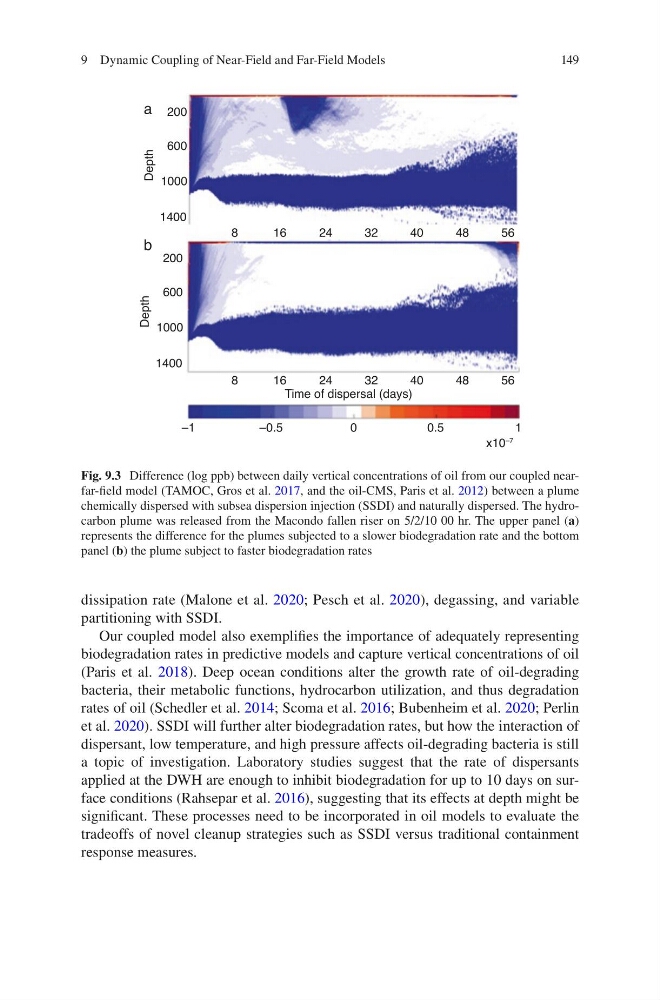
Our coupled model also exemplifies the importance of adequately representing
biodegradation rates in predictive models and capture vertical concentrations of oil
(Paris et al. 2018). Deep ocean conditions alter the growth rate of oil-degrading
bacteria, their metabolic functions, hydrocarbon utilization, and thus degradation
rates of oil (Schedler et al. 2014; Scoma et al. 2016; Bubenheim et al. 2020; Perlin
et al. 2020). SSDI will further alter biodegradation rates, but how the interaction of
dispersant, low temperature, and high pressure affects oil-degrading bacteria is still
a topic of investigation. Laboratory studies suggest that the rate of dispersants
applied at the DWH are enough to inhibit biodegradation for up to 10 days on surface conditions (Rahsepar et al. 2016), suggesting that its effects at depth might be
significant. These processes need to be incorporated in oil models to evaluate the
tradeoffs of novel cleanup strategies such as SSDI versus traditional containment
response measures.
'HSWK
'HSWK
7LPHRIGLVSHUVDOGD\V
ڏ
ڏ
[
ڏ
D
E
Fig. 9.3 Difference (log ppb) between daily vertical concentrations of oil from our coupled nearfar- field model (TAMOC, Gros et al. 2017, and the oil-CMS, Paris et al. 2012) between a plume
chemically dispersed with subsea dispersion injection (SSDI) and naturally dispersed. The hydrocarbon plume was released from the Macondo fallen riser on 5/2/10 00 hr. The upper panel (a)
represents the difference for the plumes subjected to a slower biodegradation rate and the bottom
panel (b) the plume subject to faster biodegradation rates
9 Dynamic Coupling of Near-Field and Far-Field Models
dissipation rate (Malone et al. 2020; Pesch et al. 2020), degassing, and variable
partitioning with SSDI.
Our coupled model also exemplifies the importance of adequately representing
biodegradation rates in predictive models and capture vertical concentrations of oil
(Paris et al. 2018). Deep ocean conditions alter the growth rate of oil-degrading
bacteria, their metabolic functions, hydrocarbon utilization, and thus degradation
rates of oil (Schedler et al. 2014; Scoma et al. 2016; Bubenheim et al. 2020; Perlin
et al. 2020). SSDI will further alter biodegradation rates, but how the interaction of
dispersant, low temperature, and high pressure affects oil-degrading bacteria is still
a topic of investigation. Laboratory studies suggest that the rate of dispersants
applied at the DWH are enough to inhibit biodegradation for up to 10 days on surface conditions (Rahsepar et al. 2016), suggesting that its effects at depth might be
significant. These processes need to be incorporated in oil models to evaluate the
tradeoffs of novel cleanup strategies such as SSDI versus traditional containment
response measures.
'HSWK
'HSWK
7LPHRIGLVSHUVDOGD\V
ڏ
ڏ
[
ڏ
D
E
Fig. 9.3 Difference (log ppb) between daily vertical concentrations of oil from our coupled nearfar- field model (TAMOC, Gros et al. 2017, and the oil-CMS, Paris et al. 2012) between a plume
chemically dispersed with subsea dispersion injection (SSDI) and naturally dispersed. The hydrocarbon plume was released from the Macondo fallen riser on 5/2/10 00 hr. The upper panel (a)
represents the difference for the plumes subjected to a slower biodegradation rate and the bottom
panel (b) the plume subject to faster biodegradation rates
9 Dynamic Coupling of Near-Field and Far-Field Models