

128
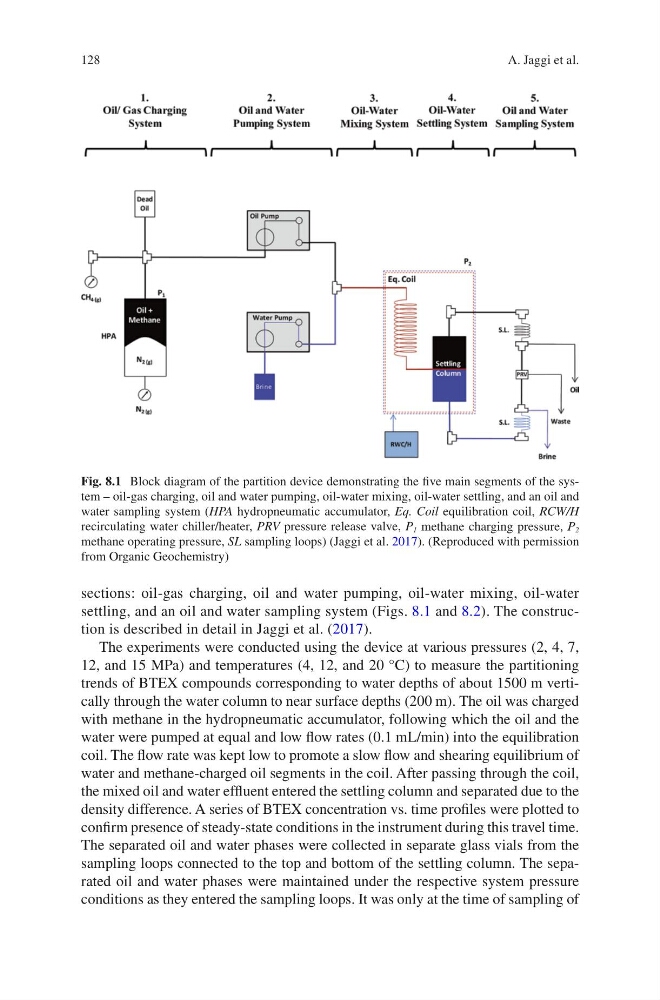
sections: oil-gas charging, oil and water pumping, oil-water mixing, oil-water
settling, and an oil and water sampling system (Figs. 8.1 and 8.2). The construction is described in detail in Jaggi et al. (2017).
The experiments were conducted using the device at various pressures (2, 4, 7,
12, and 15 MPa) and temperatures (4, 12, and 20 °C) to measure the partitioning
trends of BTEX compounds corresponding to water depths of about 1500 m vertically through the water column to near surface depths (200 m). The oil was charged
with methane in the hydropneumatic accumulator, following which the oil and the
water were pumped at equal and low flow rates (0.1 mL/min) into the equilibration
coil. The flow rate was kept low to promote a slow flow and shearing equilibrium of
water and methane-charged oil segments in the coil. After passing through the coil,
the mixed oil and water effluent entered the settling column and separated due to the
density difference. A series of BTEX concentration vs. time profiles were plotted to
confirm presence of steady-state conditions in the instrument during this travel time.
The separated oil and water phases were collected in separate glass vials from the
sampling loops connected to the top and bottom of the settling column. The separated oil and water phases were maintained under the respective system pressure
conditions as they entered the sampling loops. It was only at the time of sampling of
Fig. 8.1 Block diagram of the partition device demonstrating the five main segments of the system – oil-gas charging, oil and water pumping, oil-water mixing, oil-water settling, and an oil and
water sampling system (HPA hydropneumatic accumulator, Eq. Coil equilibration coil, RCW/H
recirculating water chiller/heater, PRV pressure release valve, P 1 methane charging pressure, P 2
methane operating pressure, SL sampling loops) (Jaggi et al. 2017). (Reproduced with permission
from Organic Geochemistry)
A. Jaggi et al.
sections: oil-gas charging, oil and water pumping, oil-water mixing, oil-water
settling, and an oil and water sampling system (Figs. 8.1 and 8.2). The construction is described in detail in Jaggi et al. (2017).
The experiments were conducted using the device at various pressures (2, 4, 7,
12, and 15 MPa) and temperatures (4, 12, and 20 °C) to measure the partitioning
trends of BTEX compounds corresponding to water depths of about 1500 m vertically through the water column to near surface depths (200 m). The oil was charged
with methane in the hydropneumatic accumulator, following which the oil and the
water were pumped at equal and low flow rates (0.1 mL/min) into the equilibration
coil. The flow rate was kept low to promote a slow flow and shearing equilibrium of
water and methane-charged oil segments in the coil. After passing through the coil,
the mixed oil and water effluent entered the settling column and separated due to the
density difference. A series of BTEX concentration vs. time profiles were plotted to
confirm presence of steady-state conditions in the instrument during this travel time.
The separated oil and water phases were collected in separate glass vials from the
sampling loops connected to the top and bottom of the settling column. The separated oil and water phases were maintained under the respective system pressure
conditions as they entered the sampling loops. It was only at the time of sampling of
Fig. 8.1 Block diagram of the partition device demonstrating the five main segments of the system – oil-gas charging, oil and water pumping, oil-water mixing, oil-water settling, and an oil and
water sampling system (HPA hydropneumatic accumulator, Eq. Coil equilibration coil, RCW/H
recirculating water chiller/heater, PRV pressure release valve, P 1 methane charging pressure, P 2
methane operating pressure, SL sampling loops) (Jaggi et al. 2017). (Reproduced with permission
from Organic Geochemistry)
A. Jaggi et al.