

100
working assumption might be that primary metabolism converts 50% of the oil to
biomass and that this conversion ratio is repeated as the carbon proceeds up the food
web. Isotopic evidence indicates some of this petrocarbon was still circulating in the
microbial food web for several years and also suggested that some methane metabolism stimulated nitrogen fixation at depth (Fernández-Carrera et al. 2016). In the
long run, it is quite possible that the DWH spill will lead to more fish (Levy and
Lee 1988).
6.6 Tracing the Fate of Oil in the Deep Sea: The Mass
Balance
Ultimately, oil released in an offshore oil spill can form a slick, be transported to
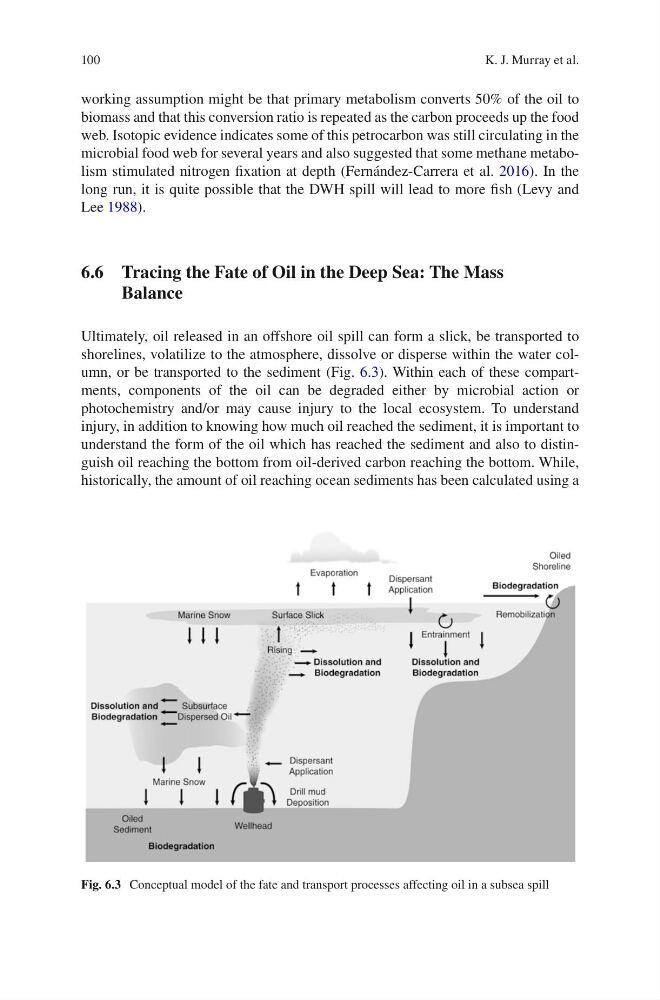
shorelines, volatilize to the atmosphere, dissolve or disperse within the water column, or be transported to the sediment (Fig. 6.3). Within each of these compartments, components of the oil can be degraded either by microbial action or
photochemistry and/or may cause injury to the local ecosystem. To understand
injury, in addition to knowing how much oil reached the sediment, it is important to
understand the form of the oil which has reached the sediment and also to distinguish oil reaching the bottom from oil-derived carbon reaching the bottom. While,
historically, the amount of oil reaching ocean sediments has been calculated using a
Fig. 6.3 Conceptual model of the fate and transport processes affecting oil in a subsea spill
K. J. Murray et al.
working assumption might be that primary metabolism converts 50% of the oil to
biomass and that this conversion ratio is repeated as the carbon proceeds up the food
web. Isotopic evidence indicates some of this petrocarbon was still circulating in the
microbial food web for several years and also suggested that some methane metabolism stimulated nitrogen fixation at depth (Fernández-Carrera et al. 2016). In the
long run, it is quite possible that the DWH spill will lead to more fish (Levy and
Lee 1988).
6.6 Tracing the Fate of Oil in the Deep Sea: The Mass
Balance
Ultimately, oil released in an offshore oil spill can form a slick, be transported to
shorelines, volatilize to the atmosphere, dissolve or disperse within the water column, or be transported to the sediment (Fig. 6.3). Within each of these compartments, components of the oil can be degraded either by microbial action or
photochemistry and/or may cause injury to the local ecosystem. To understand
injury, in addition to knowing how much oil reached the sediment, it is important to
understand the form of the oil which has reached the sediment and also to distinguish oil reaching the bottom from oil-derived carbon reaching the bottom. While,
historically, the amount of oil reaching ocean sediments has been calculated using a
Fig. 6.3 Conceptual model of the fate and transport processes affecting oil in a subsea spill
K. J. Murray et al.