

70
3 Bio-augmented Composting of Organic Wastes in Villages and Towns
Table 3.2 The characteristics of colonial morphology of pure culture isolates from microbial
consortium degrading organic acids
Serial
number
of
bacterial
strains
Shape of
bacterial
colony
Color
Transparent State of
moisture
content
Having
folds or
not
Having
bulges
or not
Edge
morphology
S-1
Round
Light
yellow
Y
Moist
N
N
Ringwise
extending
S-2
Round
Yellow N
Moist
N
N
Regular
S-3
Round
Light
yellow
N
Moist
N
Y
Ringwise
extending
S-4
Round
Milk
white
N
Moist
N
N
Incised
shape
S-5
Round
Milk
white
N
Moist
N
N
Regular
S-6
Round
Milk
white
N
Moist
N
N
Regular
S-7
Round
Light
yellow
Y
Moist
N
Y
Incised
shape
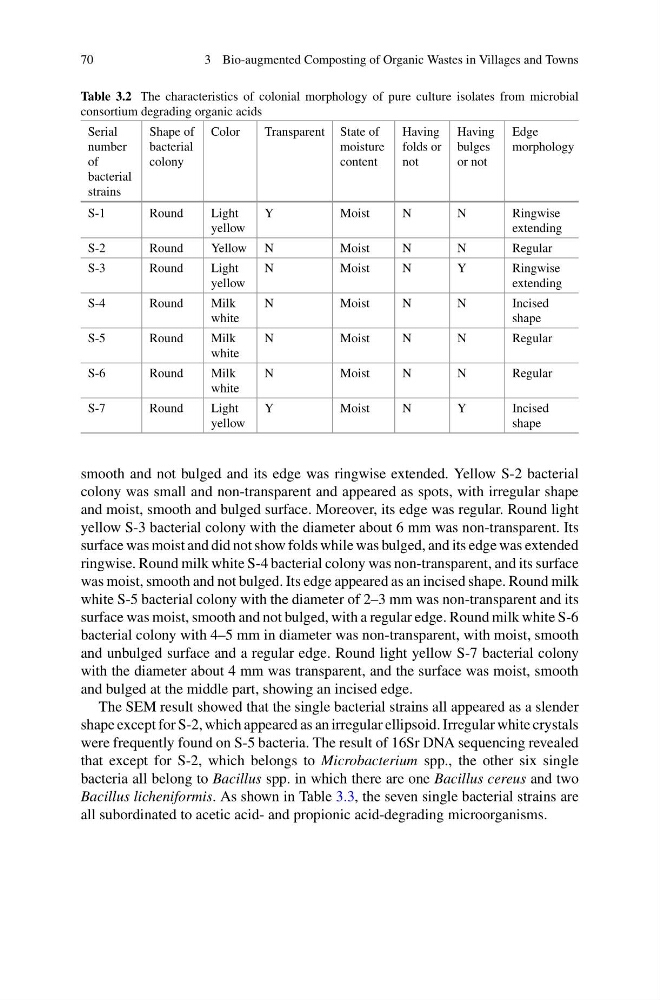
smooth and not bulged and its edge was ringwise extended. Yellow S-2 bacterial
colony was small and non-transparent and appeared as spots, with irregular shape
and moist, smooth and bulged surface. Moreover, its edge was regular. Round light
yellow S-3 bacterial colony with the diameter about 6 mm was non-transparent. Its
surface was moist and did not show folds while was bulged, and its edge was extended
ringwise. Round milk white S-4 bacterial colony was non-transparent, and its surface
was moist, smooth and not bulged. Its edge appeared as an incised shape. Round milk
white S-5 bacterial colony with the diameter of 2–3 mm was non-transparent and its
surface was moist, smooth and not bulged, with a regular edge. Round milk white S-6
bacterial colony with 4–5 mm in diameter was non-transparent, with moist, smooth
and unbulged surface and a regular edge. Round light yellow S-7 bacterial colony
with the diameter about 4 mm was transparent, and the surface was moist, smooth
and bulged at the middle part, showing an incised edge.
The SEM result showed that the single bacterial strains all appeared as a slender
shape except for S-2, which appeared as an irregular ellipsoid. Irregular white crystals
were frequently found on S-5 bacteria. The result of 16Sr DNA sequencing revealed
that except for S-2, which belongs to Microbacterium spp., the other six single
bacteria all belong to Bacillus spp. in which there are one Bacillus cereus and two
Bacillus licheniformis. As shown in Table 3.3, the seven single bacterial strains are
all subordinated to acetic acid- and propionic acid-degrading microorganisms.
3 Bio-augmented Composting of Organic Wastes in Villages and Towns
Table 3.2 The characteristics of colonial morphology of pure culture isolates from microbial
consortium degrading organic acids
Serial
number
of
bacterial
strains
Shape of
bacterial
colony
Color
Transparent State of
moisture
content
Having
folds or
not
Having
bulges
or not
Edge
morphology
S-1
Round
Light
yellow
Y
Moist
N
N
Ringwise
extending
S-2
Round
Yellow N
Moist
N
N
Regular
S-3
Round
Light
yellow
N
Moist
N
Y
Ringwise
extending
S-4
Round
Milk
white
N
Moist
N
N
Incised
shape
S-5
Round
Milk
white
N
Moist
N
N
Regular
S-6
Round
Milk
white
N
Moist
N
N
Regular
S-7
Round
Light
yellow
Y
Moist
N
Y
Incised
shape
smooth and not bulged and its edge was ringwise extended. Yellow S-2 bacterial
colony was small and non-transparent and appeared as spots, with irregular shape
and moist, smooth and bulged surface. Moreover, its edge was regular. Round light
yellow S-3 bacterial colony with the diameter about 6 mm was non-transparent. Its
surface was moist and did not show folds while was bulged, and its edge was extended
ringwise. Round milk white S-4 bacterial colony was non-transparent, and its surface
was moist, smooth and not bulged. Its edge appeared as an incised shape. Round milk
white S-5 bacterial colony with the diameter of 2–3 mm was non-transparent and its
surface was moist, smooth and not bulged, with a regular edge. Round milk white S-6
bacterial colony with 4–5 mm in diameter was non-transparent, with moist, smooth
and unbulged surface and a regular edge. Round light yellow S-7 bacterial colony
with the diameter about 4 mm was transparent, and the surface was moist, smooth
and bulged at the middle part, showing an incised edge.
The SEM result showed that the single bacterial strains all appeared as a slender
shape except for S-2, which appeared as an irregular ellipsoid. Irregular white crystals
were frequently found on S-5 bacteria. The result of 16Sr DNA sequencing revealed
that except for S-2, which belongs to Microbacterium spp., the other six single
bacteria all belong to Bacillus spp. in which there are one Bacillus cereus and two
Bacillus licheniformis. As shown in Table 3.3, the seven single bacterial strains are
all subordinated to acetic acid- and propionic acid-degrading microorganisms.