

58
2 High-Efficient Anaerobic Fermentation Technology of Organic …
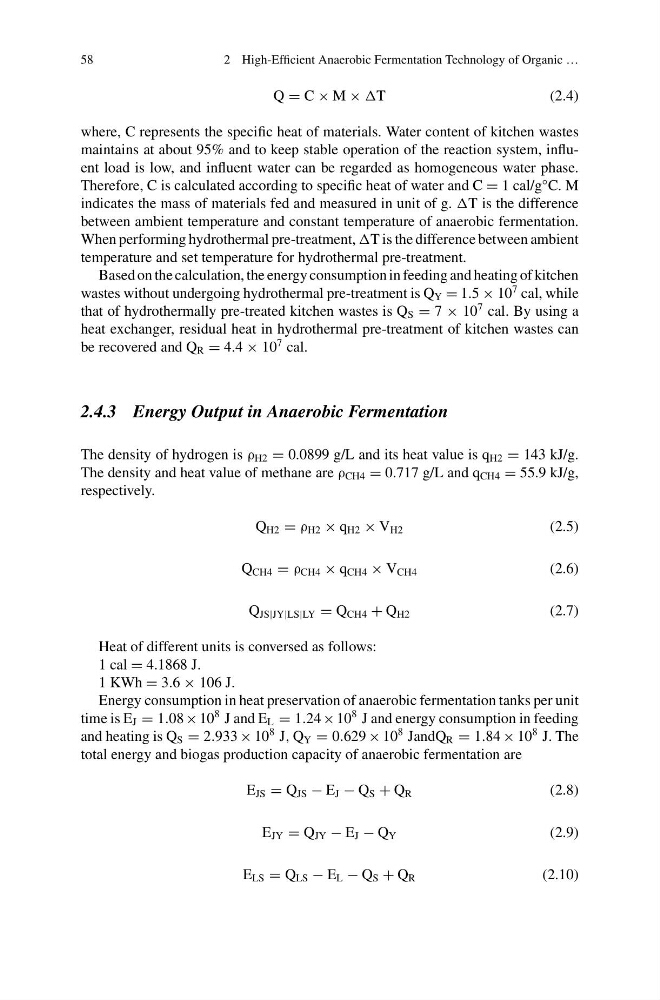
Q = C × M × T
( 2 . 4 )
where, C represents the specific heat of materials. Water content of kitchen wastes
maintains at about 95% and to keep stable operation of the reaction system, influent load is low, and influent water can be regarded as homogeneous water phase.
Therefore, C is calculated according to specific heat of water and C = 1 cal/g°C. M
indicates the mass of materials fed and measured in unit of g. T is the difference
between ambient temperature and constant temperature of anaerobic fermentation.
When performing hydrothermal pre-treatment, T is the difference between ambient
temperature and set temperature for hydrothermal pre-treatment.
Based on the calculation, the energy consumption in feeding and heating of kitchen
wastes without undergoing hydrothermal pre-treatment is Q Y = 1.5 × 10
7 cal, while
that of hydrothermally pre-treated kitchen wastes is Q S = 7 × 10
7 cal. By using a
heat exchanger, residual heat in hydrothermal pre-treatment of kitchen wastes can
be recovered and Q R = 4.4 × 10
7 cal.
2.4.3 Energy Output in Anaerobic Fermentation
The density of hydrogen is ρ H2 = 0.0899 g/L and its heat value is q H2 = 143 kJ/g.
The density and heat value of methane are ρ CH4 = 0.717 g/L and q CH4 = 55.9 kJ/g,
respectively.
Q H2 = ρ H2 × q H2 × V H2
(2.5)
Q CH4 = ρ CH4 × q CH4 × V CH4
(2.6)
Q JS|JY|LS|LY = Q CH4 + Q H2
(2.7)
Heat of different units is conversed as follows:
1 cal = 4.1868 J.
1 KWh = 3.6 × 10⁶ J.
Energy consumption in heat preservation of anaerobic fermentation tanks per unit
time is E J = 1.08 × 10
8 J and E L = 1.24 × 10
8 J and energy consumption in feeding
and heating is Q S = 2.933 × 10
8 J, Q Y = 0.629 × 10
8 JandQ R = 1.84 × 10
8 J. The
total energy and biogas production capacity of anaerobic fermentation are
E JS = Q JS − E J − Q S + Q R
(2.8)
E JY = Q JY − E J − Q Y
(2.9)
E LS = Q LS − E L − Q S + Q R
(2.10)
2 High-Efficient Anaerobic Fermentation Technology of Organic …
Q = C × M × T
( 2 . 4 )
where, C represents the specific heat of materials. Water content of kitchen wastes
maintains at about 95% and to keep stable operation of the reaction system, influent load is low, and influent water can be regarded as homogeneous water phase.
Therefore, C is calculated according to specific heat of water and C = 1 cal/g°C. M
indicates the mass of materials fed and measured in unit of g. T is the difference
between ambient temperature and constant temperature of anaerobic fermentation.
When performing hydrothermal pre-treatment, T is the difference between ambient
temperature and set temperature for hydrothermal pre-treatment.
Based on the calculation, the energy consumption in feeding and heating of kitchen
wastes without undergoing hydrothermal pre-treatment is Q Y = 1.5 × 10
7 cal, while
that of hydrothermally pre-treated kitchen wastes is Q S = 7 × 10
7 cal. By using a
heat exchanger, residual heat in hydrothermal pre-treatment of kitchen wastes can
be recovered and Q R = 4.4 × 10
7 cal.
2.4.3 Energy Output in Anaerobic Fermentation
The density of hydrogen is ρ H2 = 0.0899 g/L and its heat value is q H2 = 143 kJ/g.
The density and heat value of methane are ρ CH4 = 0.717 g/L and q CH4 = 55.9 kJ/g,
respectively.
Q H2 = ρ H2 × q H2 × V H2
(2.5)
Q CH4 = ρ CH4 × q CH4 × V CH4
(2.6)
Q JS|JY|LS|LY = Q CH4 + Q H2
(2.7)
Heat of different units is conversed as follows:
1 cal = 4.1868 J.
1 KWh = 3.6 × 10⁶ J.
Energy consumption in heat preservation of anaerobic fermentation tanks per unit
time is E J = 1.08 × 10
8 J and E L = 1.24 × 10
8 J and energy consumption in feeding
and heating is Q S = 2.933 × 10
8 J, Q Y = 0.629 × 10
8 JandQ R = 1.84 × 10
8 J. The
total energy and biogas production capacity of anaerobic fermentation are
E JS = Q JS − E J − Q S + Q R
(2.8)
E JY = Q JY − E J − Q Y
(2.9)
E LS = Q LS − E L − Q S + Q R
(2.10)