

2.3 Research on High-Efficient Anaerobic Fermentation Technology …
55
this research developed small and automatic dry anaerobic fermentation equipment
suiting for villages and towns.
Based on the research of biogas production performance of dry anaerobic fermentation of excrements of livestock and poultry, the influences of feed amount and
reflux ratio on biogas production of dry anaerobic fermentation of excrements of
livestock and poultry were studied. Furthermore, this study performed the research
on quick start and control over stable operation of the dry anaerobic fermentation
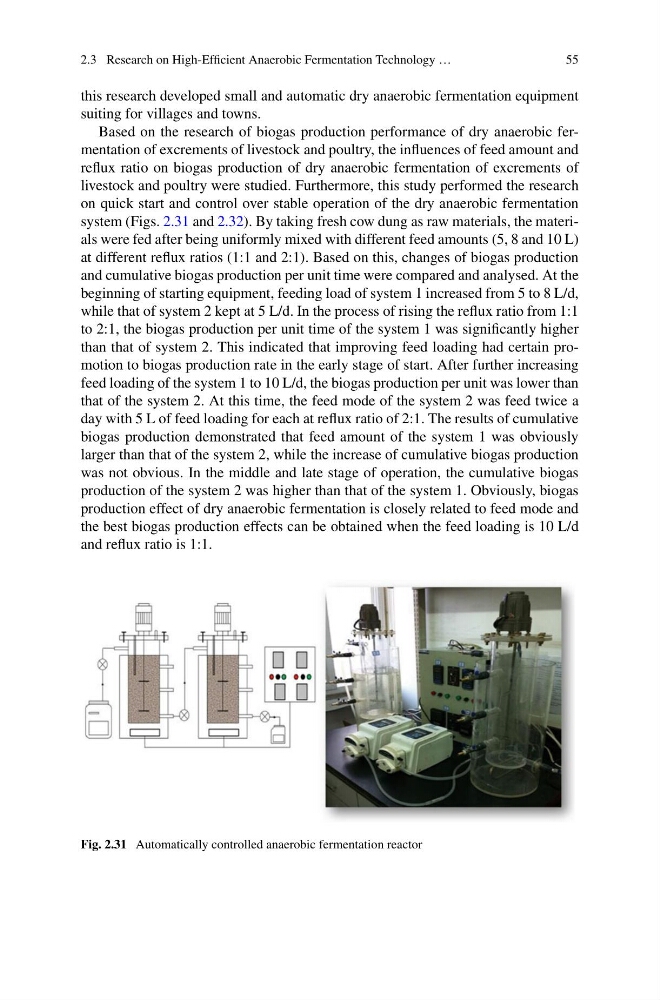
system (Figs. 2.31 and 2.32). By taking fresh cow dung as raw materials, the materials were fed after being uniformly mixed with different feed amounts (5, 8 and 10 L)
at different reflux ratios (1:1 and 2:1). Based on this, changes of biogas production
and cumulative biogas production per unit time were compared and analysed. At the
beginning of starting equipment, feeding load of system 1 increased from 5 to 8 L/d,
while that of system 2 kept at 5 L/d. In the process of rising the reflux ratio from 1:1
to 2:1, the biogas production per unit time of the system 1 was significantly higher
than that of system 2. This indicated that improving feed loading had certain promotion to biogas production rate in the early stage of start. After further increasing
feed loading of the system 1 to 10 L/d, the biogas production per unit was lower than
that of the system 2. At this time, the feed mode of the system 2 was feed twice a
day with 5 L of feed loading for each at reflux ratio of 2:1. The results of cumulative
biogas production demonstrated that feed amount of the system 1 was obviously
larger than that of the system 2, while the increase of cumulative biogas production
was not obvious. In the middle and late stage of operation, the cumulative biogas
production of the system 2 was higher than that of the system 1. Obviously, biogas
production effect of dry anaerobic fermentation is closely related to feed mode and
the best biogas production effects can be obtained when the feed loading is 10 L/d
and reflux ratio is 1:1.
Fig. 2.31 Automatically controlled anaerobic fermentation reactor
55
this research developed small and automatic dry anaerobic fermentation equipment
suiting for villages and towns.
Based on the research of biogas production performance of dry anaerobic fermentation of excrements of livestock and poultry, the influences of feed amount and
reflux ratio on biogas production of dry anaerobic fermentation of excrements of
livestock and poultry were studied. Furthermore, this study performed the research
on quick start and control over stable operation of the dry anaerobic fermentation
system (Figs. 2.31 and 2.32). By taking fresh cow dung as raw materials, the materials were fed after being uniformly mixed with different feed amounts (5, 8 and 10 L)
at different reflux ratios (1:1 and 2:1). Based on this, changes of biogas production
and cumulative biogas production per unit time were compared and analysed. At the
beginning of starting equipment, feeding load of system 1 increased from 5 to 8 L/d,
while that of system 2 kept at 5 L/d. In the process of rising the reflux ratio from 1:1
to 2:1, the biogas production per unit time of the system 1 was significantly higher
than that of system 2. This indicated that improving feed loading had certain promotion to biogas production rate in the early stage of start. After further increasing
feed loading of the system 1 to 10 L/d, the biogas production per unit was lower than
that of the system 2. At this time, the feed mode of the system 2 was feed twice a
day with 5 L of feed loading for each at reflux ratio of 2:1. The results of cumulative
biogas production demonstrated that feed amount of the system 1 was obviously
larger than that of the system 2, while the increase of cumulative biogas production
was not obvious. In the middle and late stage of operation, the cumulative biogas
production of the system 2 was higher than that of the system 1. Obviously, biogas
production effect of dry anaerobic fermentation is closely related to feed mode and
the best biogas production effects can be obtained when the feed loading is 10 L/d
and reflux ratio is 1:1.
Fig. 2.31 Automatically controlled anaerobic fermentation reactor