

Laboratory Analyses
88
Aliquots for BC analysis are generally stored in polyethylene or polypropylene
bottles, which are economical and considered sufficiently inert with respect
to BC, whereas aliquots for DOC analysis are usually stored in glass bottles
to avoid organic contamination from plastic. An example of a typical sampleprocessing schedule for low-nutrient, low-ionic-strength samples is shown in
Table 3.2. It is important to set up this type of schedule with laboratory personnel to ensure that all samples from a particular project will receive the correct
processing. In this example, reminders are included to tape bottle caps and not
fill bottles completely for aliquots that are preserved by freezing.
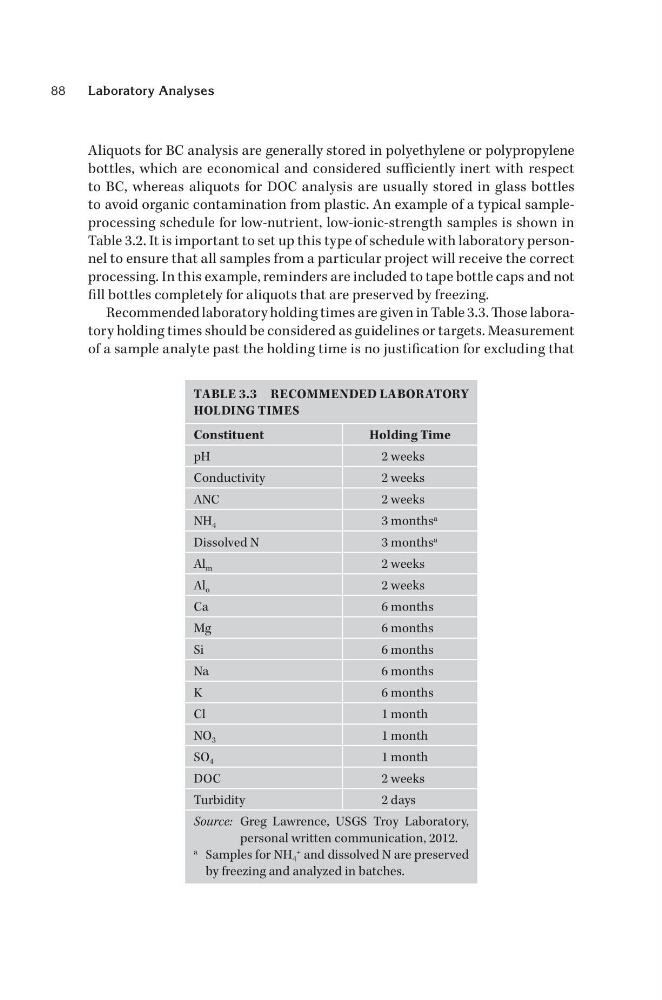
Recommended laboratory holding times are given in Table 3.3. Those laboratory holding times should be considered as guidelines or targets. Measurement
of a sample analyte past the holding time is no justification for excluding that
TABLE 3.3 RECOMMENDED LABORATORY
HOLDING TIMES
Constituent
Holding Time
pH
2 weeks
Conductivity
2 weeks
ANC
2 weeks
NH 4
3 months a
Dissolved N
3 months a
Al m
2 weeks
Al o
2 weeks
Ca
6 months
Mg
6 months
Si
6 months
Na
6 months
K
6 months
Cl
1 month
NO 3
1 month
SO 4
1 month
DOC
2 weeks
Turbidity
2 days
Source: Greg Lawrence, USGS Troy Laboratory,
personal written communication, 2012.
a Samples for NH 4
+ and dissolved N are preserved
by freezing and analyzed in batches.
88
Aliquots for BC analysis are generally stored in polyethylene or polypropylene
bottles, which are economical and considered sufficiently inert with respect
to BC, whereas aliquots for DOC analysis are usually stored in glass bottles
to avoid organic contamination from plastic. An example of a typical sampleprocessing schedule for low-nutrient, low-ionic-strength samples is shown in
Table 3.2. It is important to set up this type of schedule with laboratory personnel to ensure that all samples from a particular project will receive the correct
processing. In this example, reminders are included to tape bottle caps and not
fill bottles completely for aliquots that are preserved by freezing.
Recommended laboratory holding times are given in Table 3.3. Those laboratory holding times should be considered as guidelines or targets. Measurement
of a sample analyte past the holding time is no justification for excluding that
TABLE 3.3 RECOMMENDED LABORATORY
HOLDING TIMES
Constituent
Holding Time
pH
2 weeks
Conductivity
2 weeks
ANC
2 weeks
NH 4
3 months a
Dissolved N
3 months a
Al m
2 weeks
Al o
2 weeks
Ca
6 months
Mg
6 months
Si
6 months
Na
6 months
K
6 months
Cl
1 month
NO 3
1 month
SO 4
1 month
DOC
2 weeks
Turbidity
2 days
Source: Greg Lawrence, USGS Troy Laboratory,
personal written communication, 2012.
a Samples for NH 4
+ and dissolved N are preserved
by freezing and analyzed in batches.