

3.2 Laboratory Preparation Prior to Sample Analysis
87
of base cations (BCs) (Ca, Mg, Na, and K) may require filtration through
a 0.45-μm polycarbonate filter, whereas analysis of DOC may require filtration
through a glass fiber filter to avoid possible organic contamination from the
polycarbonate filter. Preservation of samples for analysis of BC and other metals
that could form precipitates at nonacidic pH values usually involves the addition of nitric acid. However, addition of chemicals to samples should be avoided
unless necessary to reduce the potential for sample contamination or alteration.
All samples that require filtering to remove particulate matter are normally
filtered as soon as possible after arrival at the laboratory. Prompt filtration
after sample collection is normally done for the purpose of removing bacteria,
which can alter sample chemistry through their metabolic processes. Samples
should be chilled as soon as possible after collection, up to the time of processing and preservation, because refrigeration retards microbial activity. Some
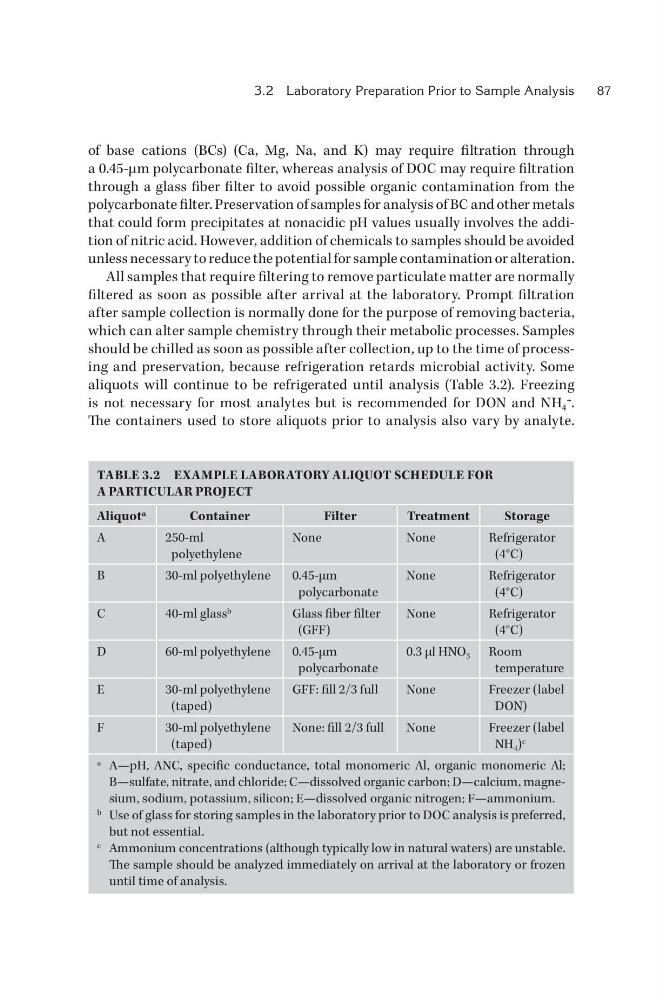
aliquots will continue to be refrigerated until analysis (Table 3.2). Freezing
is not necessary for most analytes but is recommended for DON and NH 4
+ .
The containers used to store aliquots prior to analysis also vary by analyte.
TABLE 3.2 EXAMPLE LABORATORY ALIQUOT SCHEDULE FOR
A PARTICULAR PROJECT
Aliquot a
Container
Filter
Treatment
Storage
A
250-ml
polyethylene
None
None
Refrigerator
(4°C)
B
30-ml polyethylene
0.45-μm
polycarbonate
None
Refrigerator
(4°C)
C
40-ml glass b
Glass fiber filter
(GFF)
None
Refrigerator
(4°C)
D
60-ml polyethylene
0.45-μm
polycarbonate
0.3 μl HNO 3 Room
temperature
E
30-ml polyethylene
(taped)
GFF: fill 2/3 full
None
Freezer (label
DON)
F
30-ml polyethylene
(taped)
None: fill 2/3 full
None
Freezer (label
NH 4 ) c
a A—pH, ANC, specific conductance, total monomeric Al, organic monomeric Al;
B—sulfate, nitrate, and chloride; C—dissolved organic carbon; D—calcium, magnesium, sodium, potassium, silicon; E—dissolved organic nitrogen; F—ammonium.
b Use of glass for storing samples in the laboratory prior to DOC analysis is preferred,
but not essential.
c Ammonium concentrations (although typically low in natural waters) are unstable.
The sample should be analyzed immediately on arrival at the laboratory or frozen
until time of analysis.
87
of base cations (BCs) (Ca, Mg, Na, and K) may require filtration through
a 0.45-μm polycarbonate filter, whereas analysis of DOC may require filtration
through a glass fiber filter to avoid possible organic contamination from the
polycarbonate filter. Preservation of samples for analysis of BC and other metals
that could form precipitates at nonacidic pH values usually involves the addition of nitric acid. However, addition of chemicals to samples should be avoided
unless necessary to reduce the potential for sample contamination or alteration.
All samples that require filtering to remove particulate matter are normally
filtered as soon as possible after arrival at the laboratory. Prompt filtration
after sample collection is normally done for the purpose of removing bacteria,
which can alter sample chemistry through their metabolic processes. Samples
should be chilled as soon as possible after collection, up to the time of processing and preservation, because refrigeration retards microbial activity. Some
aliquots will continue to be refrigerated until analysis (Table 3.2). Freezing
is not necessary for most analytes but is recommended for DON and NH 4
+ .
The containers used to store aliquots prior to analysis also vary by analyte.
TABLE 3.2 EXAMPLE LABORATORY ALIQUOT SCHEDULE FOR
A PARTICULAR PROJECT
Aliquot a
Container
Filter
Treatment
Storage
A
250-ml
polyethylene
None
None
Refrigerator
(4°C)
B
30-ml polyethylene
0.45-μm
polycarbonate
None
Refrigerator
(4°C)
C
40-ml glass b
Glass fiber filter
(GFF)
None
Refrigerator
(4°C)
D
60-ml polyethylene
0.45-μm
polycarbonate
0.3 μl HNO 3 Room
temperature
E
30-ml polyethylene
(taped)
GFF: fill 2/3 full
None
Freezer (label
DON)
F
30-ml polyethylene
(taped)
None: fill 2/3 full
None
Freezer (label
NH 4 ) c
a A—pH, ANC, specific conductance, total monomeric Al, organic monomeric Al;
B—sulfate, nitrate, and chloride; C—dissolved organic carbon; D—calcium, magnesium, sodium, potassium, silicon; E—dissolved organic nitrogen; F—ammonium.
b Use of glass for storing samples in the laboratory prior to DOC analysis is preferred,
but not essential.
c Ammonium concentrations (although typically low in natural waters) are unstable.
The sample should be analyzed immediately on arrival at the laboratory or frozen
until time of analysis.