

Result and discussion
76
XI. Paper treatment with chitosan hydrochloride
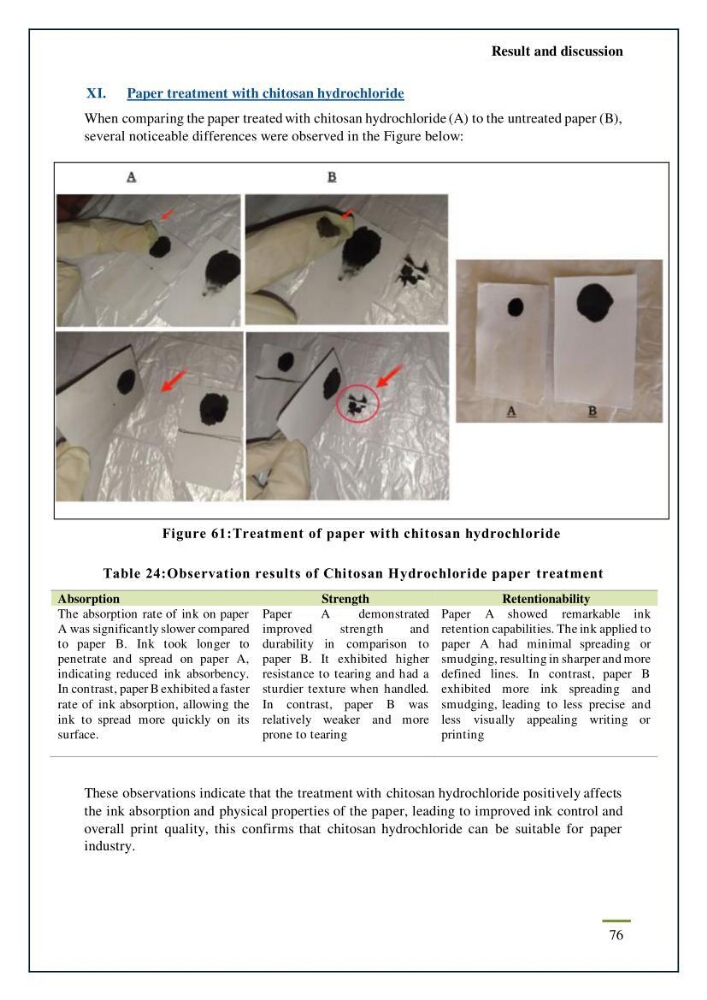
When comparing the paper treated with chitosan hydrochloride (A) to the untreated paper (B),
several noticeable differences were observed in the Figure below:
Table 24:Observation results of Chitosan Hydrochloride paper treatment
Absorption
Strength
Retentionability
The absorption rate of ink on paper
A was significantly slower compared
to paper B. Ink took longer to
penetrate and spread on paper A,
indicating reduced ink absorbency.
In contrast, paper B exhibited a faster
rate of ink absorption, allowing the
ink to spread more quickly on its
surface.
Paper
A
demonstrated
improved
strength
and
durability in comparison to
paper B. It exhibited higher
resistance to tearing and had a
sturdier texture when handled.
In contrast, paper B was
relatively weaker and more
prone to tearing
Paper A showed remarkable ink
retention capabilities. The ink applied to
paper A had minimal spreading or
smudging, resulting in sharper and more
defined lines. In contrast, paper B
exhibited more ink spreading and
smudging, leading to less precise and
less visually appealing writing or
printing
These observations indicate that the treatment with chitosan hydrochloride positively affects
the ink absorption and physical properties of the paper, leading to improved ink control and
overall print quality, this confirms that chitosan hydrochloride can be suitable for paper
industry.
Figure 61:Treatment of paper with chitosan hydrochloride
76
XI. Paper treatment with chitosan hydrochloride
When comparing the paper treated with chitosan hydrochloride (A) to the untreated paper (B),
several noticeable differences were observed in the Figure below:
Table 24:Observation results of Chitosan Hydrochloride paper treatment
Absorption
Strength
Retentionability
The absorption rate of ink on paper
A was significantly slower compared
to paper B. Ink took longer to
penetrate and spread on paper A,
indicating reduced ink absorbency.
In contrast, paper B exhibited a faster
rate of ink absorption, allowing the
ink to spread more quickly on its
surface.
Paper
A
demonstrated
improved
strength
and
durability in comparison to
paper B. It exhibited higher
resistance to tearing and had a
sturdier texture when handled.
In contrast, paper B was
relatively weaker and more
prone to tearing
Paper A showed remarkable ink
retention capabilities. The ink applied to
paper A had minimal spreading or
smudging, resulting in sharper and more
defined lines. In contrast, paper B
exhibited more ink spreading and
smudging, leading to less precise and
less visually appealing writing or
printing
These observations indicate that the treatment with chitosan hydrochloride positively affects
the ink absorption and physical properties of the paper, leading to improved ink control and
overall print quality, this confirms that chitosan hydrochloride can be suitable for paper
industry.
Figure 61:Treatment of paper with chitosan hydrochloride